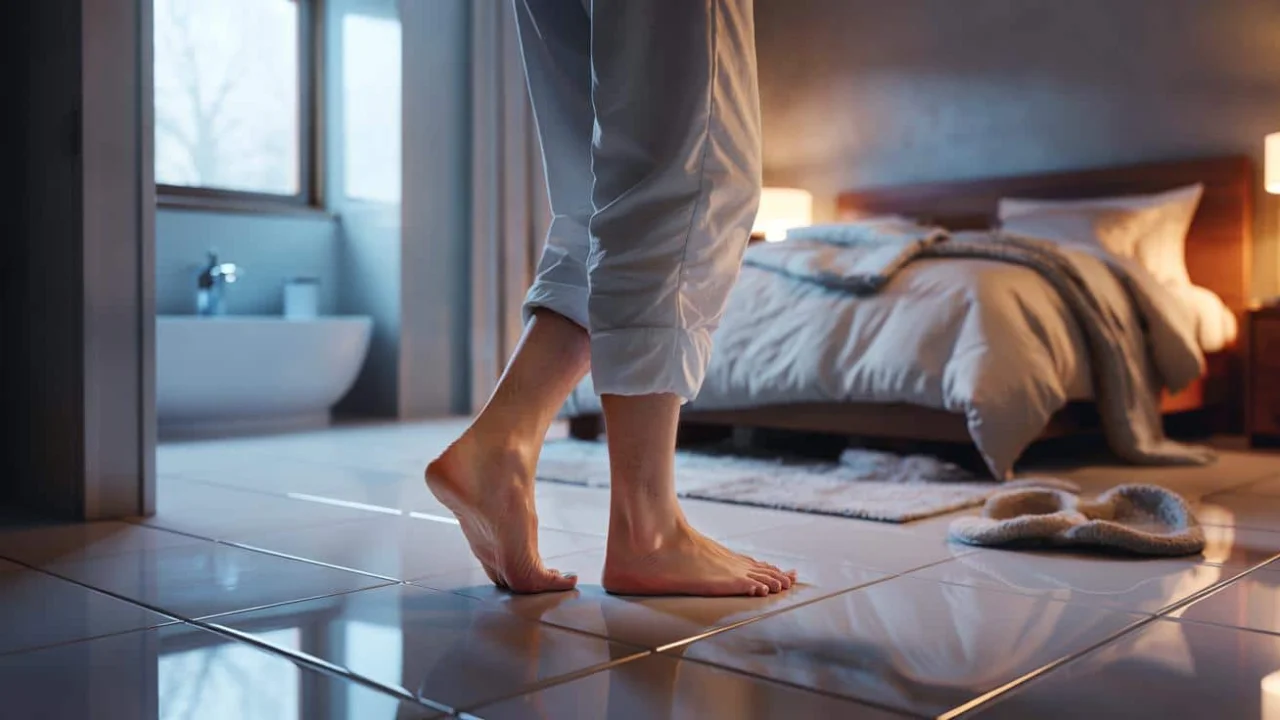
Sarah rolled out of bed at 6:30 AM, still wrapped in the drowsy comfort of sleep. The bedroom felt perfectly warm—her thermostat read a cozy 22°C. But the moment her bare feet touched the hardwood floor, everything changed. A sharp chill shot up through her legs like an electric current, making her shoulders instantly tense and her jaw clench.

“Why does this always happen?” she muttered, tiptoeing toward the bathroom like she was walking on hot coals. Within seconds, her hands felt cold too, and she found herself reaching for a robe despite the warm air around her.
The room temperature hadn’t dropped a single degree. Yet Sarah’s entire body was now convinced it was freezing. This daily ritual of walking barefoot on cold floors had triggered a full-body response that seemed completely out of proportion to simply stepping on a chilly surface.

Your Feet Are Your Body’s Early Warning System
When you step barefoot on a cold floor, you’re not just experiencing localized coldness in your feet. You’re triggering a complex biological response that affects your entire body. The soles of your feet contain thousands of temperature-sensitive nerve endings called thermoreceptors, which act like tiny alarm systems.
“The moment these receptors detect rapid heat loss, they send urgent signals to your brain,” explains Dr. Michael Chen, a thermoregulation specialist. “Your brain interprets this as a potential threat to your core body temperature and immediately activates protective mechanisms.”

This response happens within milliseconds. Your brain doesn’t wait to see if the cold sensation continues—it assumes the worst and prepares your body for a freezing environment. Blood vessels in your hands, arms, and other extremities begin to constrict, redirecting warm blood toward your vital organs.
The result? Your hands get cold, your muscles tense up, and you experience that full-body shiver response, even though the air temperature around you remains perfectly comfortable.

The Science Behind the Whole-Body Chill
Walking barefoot on cold floors triggers a cascade of physiological responses that extend far beyond your feet. Here’s what happens inside your body during those first few seconds of contact:
- Vasoconstriction: Blood vessels in your extremities narrow to reduce heat loss
- Muscle tension: Your muscles contract slightly to generate heat through small tremors
- Hormonal response: Your body releases stress hormones like adrenaline
- Nervous system activation: Your sympathetic nervous system kicks into high gear
- Breathing changes: You may notice your breathing becoming slightly more shallow

Different flooring materials affect this response in varying degrees:
| Floor Material | Heat Conduction | Cold Sensation Level |
|---|---|---|
| Ceramic/Porcelain Tile | High | Very High |
| Natural Stone | High | Very High |
| Hardwood | Medium | Moderate |
| Laminate | Medium | Moderate |
| Carpet | Low | Minimal |
“Materials like ceramic and stone are excellent heat conductors,” notes Dr. Lisa Rodriguez, a materials scientist. “They literally pull heat from your feet much faster than materials like wood or carpet, which have better insulating properties.”
The temperature difference doesn’t have to be extreme to trigger this response. Even floors that are just 5-10 degrees cooler than your body temperature can cause the full-body chill effect when walking barefoot.
Who Feels the Chill Most Intensely
Not everyone experiences the same degree of whole-body coldness when walking barefoot on cold floors. Several factors influence how intensely you feel this response:
People with poor circulation often experience the most dramatic reactions. Their bodies are already working harder to maintain proper blood flow to extremities, so the additional challenge of cold floors can trigger more severe responses.
Age plays a significant role too. Older adults typically have less efficient thermoregulation systems, making them more sensitive to cold surfaces. Children, on the other hand, often seem less bothered by cold floors, partly because their metabolic rates run higher.
“Women tend to experience this phenomenon more intensely than men,” explains Dr. Rachel Thompson, a physiologist specializing in gender differences in thermoregulation. “Women typically have better circulation to vital organs but reduced blood flow to extremities, making them more sensitive to cold surfaces.”
Your overall health status matters significantly. People with conditions like diabetes, thyroid disorders, or autoimmune diseases may experience exaggerated responses to walking barefoot on cold floors. Even factors like stress levels, sleep quality, and recent illness can influence how your body reacts.
The time of day affects the intensity too. Your body temperature naturally fluctuates throughout the day, typically reaching its lowest point in the early morning hours. This is why that first step onto a cold bathroom floor feels particularly brutal at 6 AM.
Interestingly, people who regularly walk barefoot tend to develop some tolerance over time. Their feet become more accustomed to temperature variations, though the initial shock response never completely disappears.
The psychological component shouldn’t be underestimated either. If you’re anticipating the cold sensation, your body may actually begin preparing for it before your feet even touch the floor. This anticipatory response can make the actual experience feel even more intense.
Simple solutions can dramatically reduce this whole-body chill effect. Wearing slippers or thick socks creates a barrier that prevents rapid heat loss. Some people find that gradually transitioning from warm to cold surfaces helps minimize the shock. Even something as simple as keeping a small rug beside your bed can eliminate those jarring morning encounters with cold floors.
Understanding why walking barefoot on cold floors affects your whole body helps explain why such a small contact point can create such a dramatic physical response. Your feet might be small, but they’re connected to a sophisticated system designed to keep you alive—even if it sometimes overreacts to a chilly bathroom tile.
FAQs
Why do cold floors make me feel colder than cold air?
Cold floors conduct heat away from your feet much faster than cold air. This rapid heat loss triggers your body’s emergency warming response, making you feel colder overall.
Is it bad for my health to walk barefoot on cold floors?
For healthy individuals, it’s generally not harmful, just uncomfortable. However, people with circulation problems or diabetes should be more cautious about exposing their feet to cold surfaces.
Why do my hands get cold when my feet touch a cold floor?
Your body redirects warm blood away from your extremities toward your vital organs when it detects heat loss. This causes your hands to feel cold even though they haven’t touched anything cold.
Do some people feel this effect more than others?
Yes, factors like age, gender, circulation, overall health, and even stress levels can influence how intensely someone experiences the whole-body chill from cold floors.
What’s the best way to prevent feeling cold all over from cold floors?
Wearing slippers, thick socks, or placing rugs on cold surfaces creates insulation that prevents rapid heat loss from your feet, eliminating the whole-body response.
Why does this happen more in the morning?
Your body temperature naturally drops during the night and reaches its lowest point in early morning hours, making you more sensitive to cold surfaces when you first wake up.
About the Author