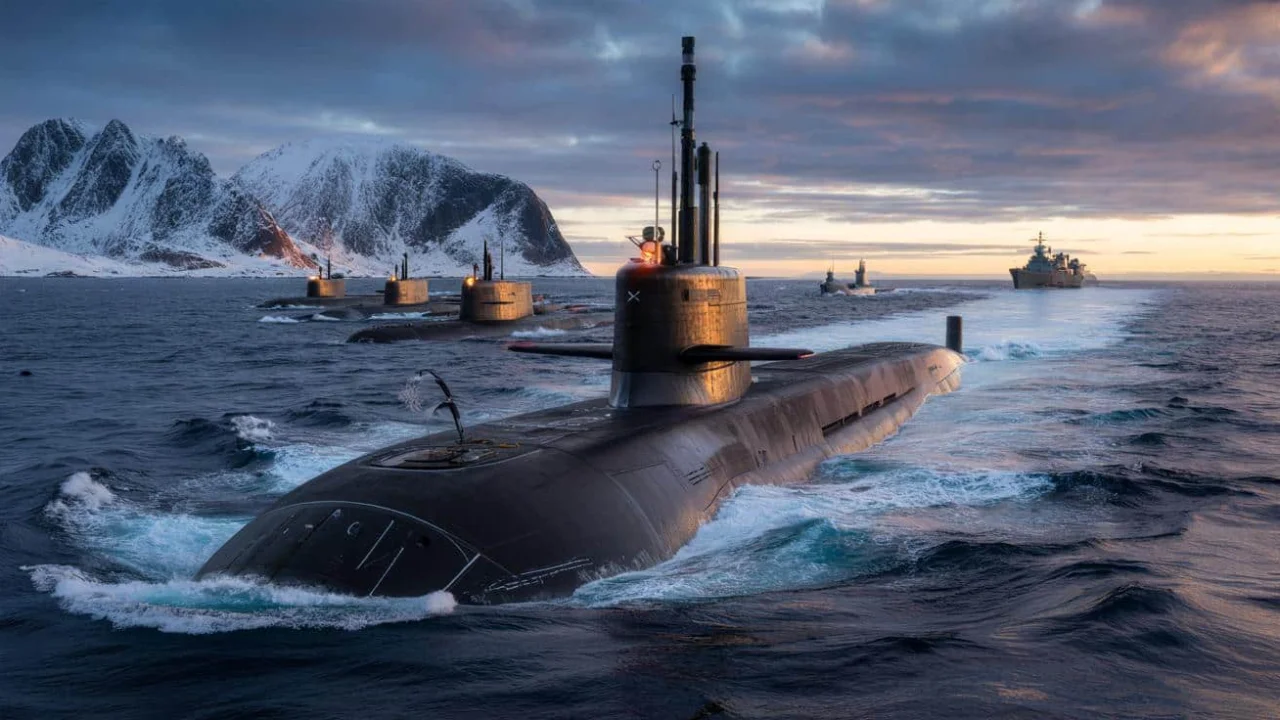
Captain Erik Haugen remembers the exact moment he realized Norway’s submarine fleet wasn’t just old—it was dangerously outdated. Standing in the cramped control room of a decades-old Ula-class submarine during a 2023 Arctic patrol, he watched ice formations on sonar that should have been crystal clear appear as fuzzy blobs on aging screens. “We were essentially sailing blind in waters that belong to us,” he later told colleagues. That conversation, shared in naval circles from Oslo to NATO headquarters, helped spark what’s now become Norway’s most ambitious submarine expansion in generations.
Today, Norway isn’t just replacing those aging boats—they’re doubling down on underwater power in a way that’s catching international attention. The Norwegian government just approved two additional Type 212CD submarines, bringing their total order to six boats and signaling a dramatic shift in how this Nordic nation views underwater warfare.
Why Norway Just Made Submarine History
Norway’s decision to expand from four to six Type 212CD submarines represents more than just fleet renewal—it’s a strategic pivot that could reshape naval dynamics across the North Atlantic and Arctic regions. The move extends Norway’s partnership with German shipbuilder Thyssenkrupp Marine Systems (TKMS) in what’s become one of the largest submarine deals in recent European history.
The timing isn’t coincidental. With Russia’s increased naval activity in Arctic waters and growing tensions across Northern Europe, Norway’s submarine expansion sends a clear message about regional security priorities. “This isn’t just about replacing old boats,” explains Admiral Lars Saunes, former chief of the Royal Norwegian Navy. “It’s about maintaining credible deterrence in waters that are becoming increasingly contested.”
The Type 212CD submarines—where “CD” stands for Common Design—represent a joint German-Norwegian engineering project that’s been years in development. These aren’t your grandfather’s submarines. They feature air-independent propulsion systems that allow them to operate underwater for weeks without surfacing, advanced sonar systems designed for Arctic conditions, and stealth technologies that make them nearly impossible to detect.
Breaking Down the Details: What Makes These Submarines Special
The Type 212CD submarines incorporate cutting-edge technology that puts them among the world’s most advanced conventional submarines. Here’s what makes them stand out:
- Air-Independent Propulsion (AIP) system allowing 2-3 weeks underwater operation
- Advanced fuel cell technology for ultra-quiet running
- Arctic-optimized sonar and navigation systems
- Modular weapon systems compatible with NATO standards
- Advanced stealth coating reducing acoustic and magnetic signatures
- Crew of approximately 27-33 personnel
| Specification | Type 212CD | Current Ula-class |
|---|---|---|
| Length | 73 meters | 59 meters |
| Crew Size | 27-33 | 21 |
| Submerged Range | 2-3 weeks | 5-7 days |
| Torpedo Tubes | 6 | 8 |
| First Delivery | 2029 (planned) | 1989-1992 |
“The technology gap between what we have now and what we’re getting is like jumping from a flip phone to a smartphone,” notes Dr. Kristin Haugevik, a defense analyst at the Norwegian Institute for Defence Studies. “These submarines will give Norway capabilities it’s never had before.”
The German connection runs deeper than just manufacturing. Norway and Germany are co-developing the Type 212CD platform, sharing development costs and operational knowledge. Germany plans to order six submarines of its own, making this a true binational project that strengthens European naval cooperation.
The Real-World Impact: Who This Affects and Why
Norway’s submarine expansion ripples far beyond Scandinavian waters. For NATO allies, it represents a significant strengthening of the alliance’s northern flank—critical territory as climate change opens new Arctic shipping routes and resource extraction opportunities.
Fishing communities along Norway’s extensive coastline will benefit from enhanced maritime security. The country’s exclusive economic zone covers 2.2 million square kilometers—an area larger than Mexico—and protecting those waters requires serious underwater capability.
The defense industry impact is substantial too. TKMS expects the expanded Norwegian order to support thousands of jobs across Germany’s shipbuilding sector, while Norwegian companies will participate in manufacturing and maintenance contracts worth billions over the submarines’ operational lifetime.
“This order secures work for our shipyards well into the 2030s,” says Heinrich Weber, a TKMS spokesperson. “It also demonstrates that European nations can work together on major defense projects without relying on external partners.”
Arctic researchers and environmental scientists are watching closely too. These submarines will provide unprecedented data collection capabilities in polar waters, potentially advancing climate science and marine biology research in regions that are difficult and dangerous to study using surface vessels.
The geopolitical implications extend to Russia, whose Northern Fleet operates from bases just across the border in the Kola Peninsula. Norway’s enhanced submarine capability changes the strategic calculus in Arctic waters, where submarine detection and tracking have become increasingly important as ice coverage diminishes.
For taxpayers, the expanded order represents a significant investment. While exact costs haven’t been disclosed, submarine programs typically run into billions of dollars over their lifetime when accounting for construction, maintenance, crew training, and operational costs.
The first of Norway’s new Type 212CD submarines is scheduled for delivery in 2029, with the complete fleet expected to be operational by the mid-2030s. This timeline allows for proper crew training and infrastructure development at Norway’s Haakonsvern naval base, which is undergoing extensive modifications to accommodate the larger, more sophisticated boats.
“We’re not just buying submarines,” explains Captain Haugen, now involved in the transition planning. “We’re building a completely new underwater warfare capability that will serve Norway for the next 40 years.”
FAQs
What makes the Type 212CD submarines different from Norway’s current fleet?
The Type 212CD submarines feature air-independent propulsion allowing weeks of underwater operation, compared to days for current boats, plus advanced Arctic-optimized systems and much better stealth capabilities.
Why did Norway increase its order from four to six submarines?
The expansion reflects growing security concerns in Arctic waters and the need for enhanced deterrence capabilities as geopolitical tensions rise in Northern Europe.
When will Norway receive these new submarines?
The first Type 212CD submarine is scheduled for delivery in 2029, with all six expected to be operational by the mid-2030s.
Are other countries buying the same submarines?
Yes, Germany is also ordering six Type 212CD submarines as part of the joint development program, making this a binational project.
How much will this submarine program cost Norway?
While exact figures haven’t been disclosed, submarine programs typically cost several billion dollars over their complete lifecycle including construction, maintenance, and operations.
What will happen to Norway’s current Ula-class submarines?
The aging Ula-class submarines will be gradually retired as the new Type 212CD boats enter service, with some potentially sold or transferred to allied nations.
About the Author