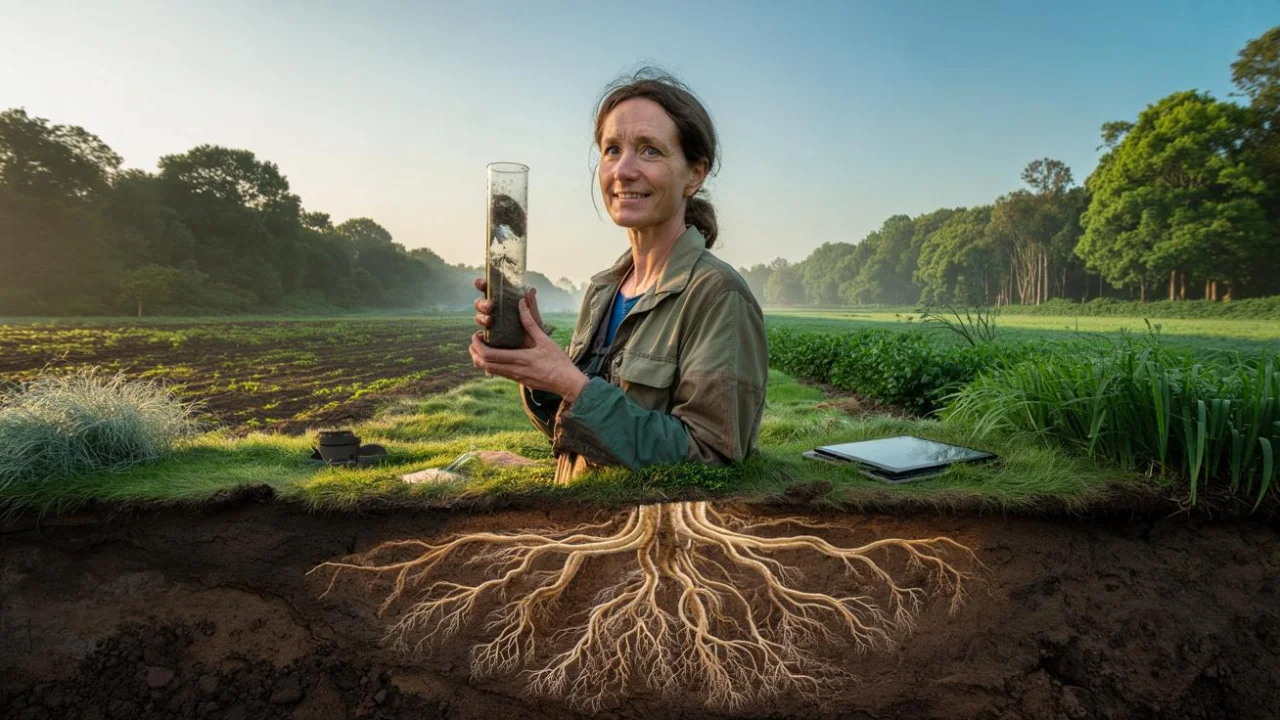
Picture yourself standing in an old-growth forest, breathing in the earthy smell of damp soil and decomposing leaves. You might think the real action is happening above ground – birds singing, branches swaying, sunlight filtering through the canopy. But beneath your feet, an entire world thrives in darkness, trading resources and information through networks more complex than any internet system we’ve built.

This hidden universe is exactly what captured the imagination of American biologist Toby Kiers nearly three decades ago. While other scientists focused on what we could see, she became obsessed with the invisible partnerships happening in the soil. Now, her groundbreaking work has earned her the 2026 Tyler Prize for Environmental Achievement, often called the “Nobel of the environment.”
What makes this recognition so remarkable isn’t just the prestige – it’s the fact that Kiers has fundamentally changed how we think about climate change by looking down instead of up.

Why This Underground Detective Work Matters for Our Planet
The Tyler Prize for Environmental Achievement represents the highest honor in environmental science. Created in 1973 and hosted by the University of Southern California, this prestigious award has recognized game-changers like Jane Goodall and climate scientist Michael Mann. These aren’t just researchers publishing papers – they’re people who shift entire paradigms.
Kiers fits perfectly into this legacy. For years, conversations about global warming centered on smokestacks, car emissions, and melting ice caps. Meanwhile, she was crawling through forests with specialized equipment, mapping the intricate fungal networks that connect plant roots underground.
“Kiers’ research shows that fungal networks are not just background biology; they are active players in regulating carbon on a planetary scale,” explains Dr. Sarah Chen, an ecological systems researcher at Stanford University.
What Kiers discovered challenges everything we thought we knew about how plants survive and how carbon moves through ecosystems. These underground partnerships aren’t just nice-to-have biological curiosities – they’re critical infrastructure for life on Earth.

Under nearly every forest, grassland, and farm field, plant roots intertwine with thread-like fungal filaments called mycorrhizae. These fungi form partnerships with roughly 90% of all land plants, creating a vast underground economy where nutrients and water get traded for plant-produced sugars.
The Hidden Economy That Runs Our World
Think of these fungal networks as nature’s version of the internet, but instead of data packets, they’re moving life-sustaining resources. Here’s what makes Kiers’ discoveries so revolutionary:

- Massive scale: A single handful of forest soil can contain miles of fungal threads
- Cross-species connections: These networks link different plant species, sharing resources across the forest
- Smart distribution: Fungi don’t randomly share nutrients – they behave like savvy traders, sending resources where they’ll get the best return
- Carbon storage: These systems lock away enormous amounts of atmospheric carbon underground
- Climate regulation: Healthy fungal networks help ecosystems adapt to changing weather patterns
Scientists have nicknamed this underground mesh the “wood wide web” – a living infrastructure that quietly supports entire ecosystems. But Kiers took this understanding further by applying economic principles to fungal behavior.
| What Fungi Provide | What Plants Give Back | Environmental Impact |
|---|---|---|
| Nitrogen and phosphorus | Carbon-rich sugars | Reduced need for chemical fertilizers |
| Water during droughts | Organic compounds | Increased forest resilience |
| Disease protection | Amino acids | Healthier ecosystems |
| Stress signals between plants | Lipids and proteins | Better survival rates during climate stress |
“We discovered that fungi don’t just randomly distribute resources,” Kiers noted in a recent interview. “They’re like sophisticated market players, making strategic decisions about where to invest their energy based on what they’ll get back.”
This economic approach to understanding nature has opened up entirely new research directions and practical applications for fighting climate change.
How This Changes Everything We Know About Fighting Climate Change
Kiers’ work doesn’t just satisfy scientific curiosity – it has massive implications for how we approach environmental protection and climate policy. Her research reveals that healthy soils and fungal networks are some of our most powerful tools for capturing and storing atmospheric carbon.
Farmers and land managers are already applying her discoveries. Instead of relying solely on chemical fertilizers that can disrupt fungal partnerships, some are now focusing on nurturing these underground networks. The results? More resilient crops, healthier soil, and significantly more carbon storage.
“Any serious climate plan must take soils and fungi into account,” Kiers argues, and her Tyler Prize recognition validates this perspective at the highest levels of environmental science.
The practical applications extend far beyond agriculture. Urban planners are incorporating fungal network principles into green infrastructure projects. Forest restoration efforts now prioritize soil health and fungal diversity alongside tree planting. Even carbon credit programs are beginning to account for underground carbon storage.
“What Toby has shown us is that we’ve been missing half the story when it comes to ecosystem health,” says Dr. Michael Rodriguez, a soil ecologist at the University of California Berkeley. “The underground world isn’t just supporting what we see above ground – it’s actively managing it.”
Climate scientists are also reconsidering their models. Traditional climate projections often underestimated the role of soil systems in carbon cycling. Kiers’ work provides the detailed understanding needed to create more accurate predictions and better policy recommendations.
The timing of this Tyler Prize recognition couldn’t be more critical. As governments worldwide struggle to meet carbon reduction goals, Kiers’ research offers a path forward that works with natural systems instead of against them. Her advocacy for “the invisible biodiversity beneath our feet” is reshaping how we think about environmental solutions.
For nearly three decades, Toby Kiers has been telling us to look down, not up, for climate answers. Now, with the Tyler Prize for Environmental Achievement in hand, the world is finally listening to this underground revolution.
FAQs
What exactly is the Tyler Prize for Environmental Achievement?
It’s often called the “Nobel Prize of the environment” and recognizes scientists who make groundbreaking contributions to environmental understanding and protection.
How do fungal networks actually fight climate change?
They store massive amounts of carbon underground and help plants survive climate stress, making ecosystems more resilient to environmental changes.
Can regular people do anything to support these underground networks?
Yes! Avoid using chemical pesticides in gardens, compost organic matter, and support regenerative farming practices that nurture soil health.
Why wasn’t this underground research taken seriously before?
Soil science was often overlooked because the networks are invisible and extremely difficult to study without specialized technology that only became available recently.
What makes Toby Kiers’ approach different from other environmental scientists?
She combines traditional biology with economic principles to understand how fungi make “business decisions” about resource distribution.
How long do these fungal networks take to develop?
Simple connections can form in weeks, but complex, mature networks that provide maximum climate benefits can take years or even decades to fully establish.
About the Author