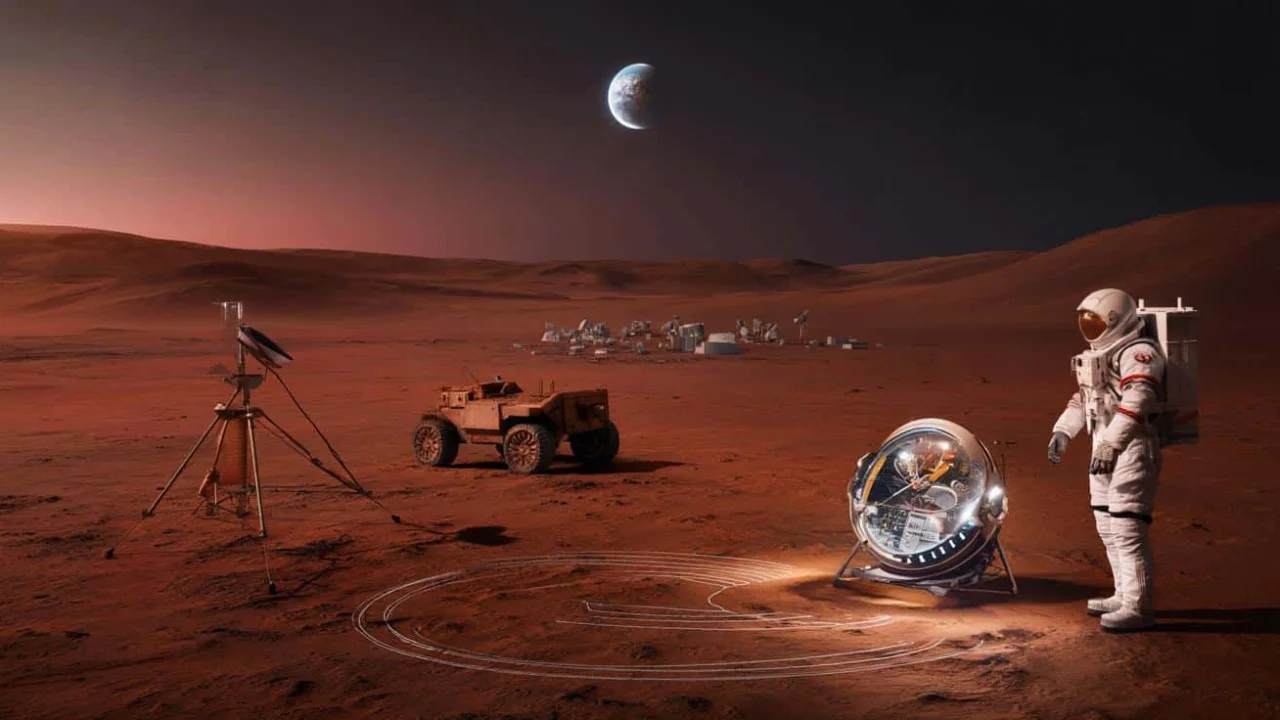
Imagine you’re an astronaut on Mars, trying to coordinate a critical mission with Earth. You check your watch, call mission control, and discover something unsettling: your carefully synchronized timepiece is already off by nearly half a millisecond from Earth time. It’s been just one day.

This isn’t science fiction anymore. It’s the reality that future Mars explorers will face, thanks to a groundbreaking study that finally measured exactly how time flows differently on the Red Planet. What Einstein predicted over a century ago, Mars has now confirmed in ways that will fundamentally change how we approach interplanetary exploration.
The discovery isn’t just academic curiosity. Every communication delay, every navigation calculation, every coordinated mission between Earth and Mars will need to account for this time difference. And here’s the kicker: time on Mars doesn’t just run differently – it speeds up and slows down as the planet swings through its orbit.

Why Einstein Was Right All Along (And Why Mars Proves It)
Albert Einstein’s theory of relativity told us something radical: time isn’t the same everywhere. Gravity stretches and squeezes time like putty. Weaker gravity means clocks tick faster. Stronger gravity slows them down.
You’ve actually experienced this without knowing it. Every time your phone’s GPS pinpoints your location, it’s correcting for time differences between satellites orbiting above Earth and receivers on the ground. Those satellites experience slightly less gravity, so their clocks run faster than ours by about 38 microseconds per day.

“GPS wouldn’t work without Einstein’s corrections,” explains Dr. Sarah Chen, a physicist at the Institute for Advanced Study. “We’d be off by miles within hours.”
Mars takes this concept to another level. The Red Planet has about 38% of Earth’s gravity, which means time on Mars flows faster than Earth time. But there’s more: Mars follows a more elliptical orbit around the Sun, sometimes closer, sometimes farther away. This creates a variable gravitational field that makes Martian time speed up and slow down in a cosmic dance.

The result? Time on Mars isn’t just different from Earth time – it’s constantly changing relative to Earth time throughout the Martian year.
The Numbers That Will Reshape Space Exploration
The National Institute of Standards and Technology (NIST) recently crunched the numbers with unprecedented precision. Their findings reveal exactly how much time diverges between our two worlds:

| Time Difference | Amount | What It Means |
|---|---|---|
| Average daily offset | 477 microseconds | Mars clocks run ahead of Earth |
| Orbital variation | ±226 microseconds | Time difference changes with Mars’ position |
| Annual accumulation | ~174 milliseconds | Nearly 1/5th of a second per Earth year |
These microseconds might seem insignificant, but they’re not. In space exploration, precision matters more than almost anywhere else. Consider these implications:
- Communication systems must account for varying time delays beyond just distance
- Navigation computers need constant recalibration for orbital mechanics
- Synchronized operations between planets become exponentially more complex
- Data timestamps from Mars missions require time-zone-like conversions
- Emergency response protocols must factor in time drift for critical decisions
“When you’re landing a rover or coordinating a human mission, every microsecond counts,” notes Dr. Michael Rodriguez, a mission planning specialist at JPL. “These calculations aren’t just theoretical – they’re operational necessities.”
The study modeled gravitational effects from the Sun, Earth, and Moon, plus Mars’ own rotation and orbital mechanics. This comprehensive approach gives us the most accurate picture yet of how time actually behaves on Mars across multiple Martian years.
What This Means for Future Mars Missions
Here’s where things get really interesting for the future of Mars exploration. Every major space agency planning human missions to Mars will need to completely rethink their approach to timekeeping and coordination.
Think about daily life on Mars. Astronauts will need two different time systems: Mars time for local operations and Earth time for communications home. Mission schedules, shift rotations, and equipment maintenance will all operate on Martian time, while video calls with family and mission updates will require constant time conversions.
“It’s like living in the ultimate time zone challenge,” explains Dr. Lisa Park, who studies human factors in space exploration. “Astronauts will essentially be living in two different time streams simultaneously.”
The technical challenges are equally daunting. Spacecraft computers will need sophisticated algorithms to maintain synchronization across interplanetary distances. Navigation systems must account for the fact that time itself is a moving target between worlds.
Communication protocols will become more complex. Instead of simple time stamps, every message between Earth and Mars will need time-differential metadata. Mission control centers will require new displays showing both planetary time systems and their constantly shifting relationship.
Even more fascinating: as Mars missions extend beyond simple exploration to permanent settlements, this time difference could influence everything from business operations to legal systems. Contracts, patents, and legal proceedings involving both planets will need to specify which planetary time system applies.
The discovery also opens new possibilities for scientific research. Mars essentially becomes a natural laboratory for studying relativistic effects over long time periods. Future missions could carry ultra-precise atomic clocks to validate these calculations and potentially discover new aspects of how gravity and motion affect time.
“We’re not just planning missions anymore,” concludes Dr. Chen. “We’re planning for two different temporal realities that need to work together across 140 million miles of space.”
FAQs
How much faster does time move on Mars compared to Earth?
Mars clocks run ahead by about 477 microseconds per day on average, though this varies by ±226 microseconds depending on Mars’ orbital position.
Will astronauts on Mars actually feel time moving differently?
No, astronauts won’t perceive any difference in time flow. The effect only becomes apparent when comparing synchronized clocks between planets.
How does this affect communication between Earth and Mars?
Beyond the usual radio signal delay, mission controllers must now account for time drift when coordinating operations and interpreting data timestamps from Mars.
Do other planets have similar time differences?
Yes, every planet experiences time slightly differently based on its gravity and orbital characteristics, but Mars is the first where we’ve calculated the precise effects for human missions.
How will future Mars colonists handle two different time systems?
They’ll likely use Mars time for daily life and local operations while maintaining Earth time awareness for interplanetary communications and coordination.
Could this discovery affect GPS systems on Mars?
Absolutely. Any future Martian GPS constellation will need to account for these relativistic effects, plus the additional complexity of Mars’ more elliptical orbit.
About the Author
