Captain Maria Santos checks her phone before heading to the bridge of her cargo ship. The route from Singapore to Tokyo used to be routine—just another three-day haul through some of the world’s busiest shipping lanes. Now she scrolls through maritime alerts like a weather report, counting warships instead of storm clouds.

“My crew asks me every morning if we’re taking the long route again,” she says, watching her fuel costs climb with each detour. “When a Filipino fishing boat gets rammed and a US destroyer shows up the next day, you start wondering if your cargo is worth the risk.”
Her concern isn’t misplaced. The South China Sea tensions have transformed from diplomatic disputes into a high-stakes game where every ship movement gets scrutinized, every radar contact could spark an international incident, and every captain sailing through these waters holds their breath a little longer.
What’s really happening beneath the diplomatic headlines
The current crisis isn’t just about territorial claims anymore. Chinese naval forces have pushed deeper into contested waters around the Spratly and Paracel Islands, establishing what military analysts call “facts on the water”—permanent presence that makes their territorial claims harder to challenge.
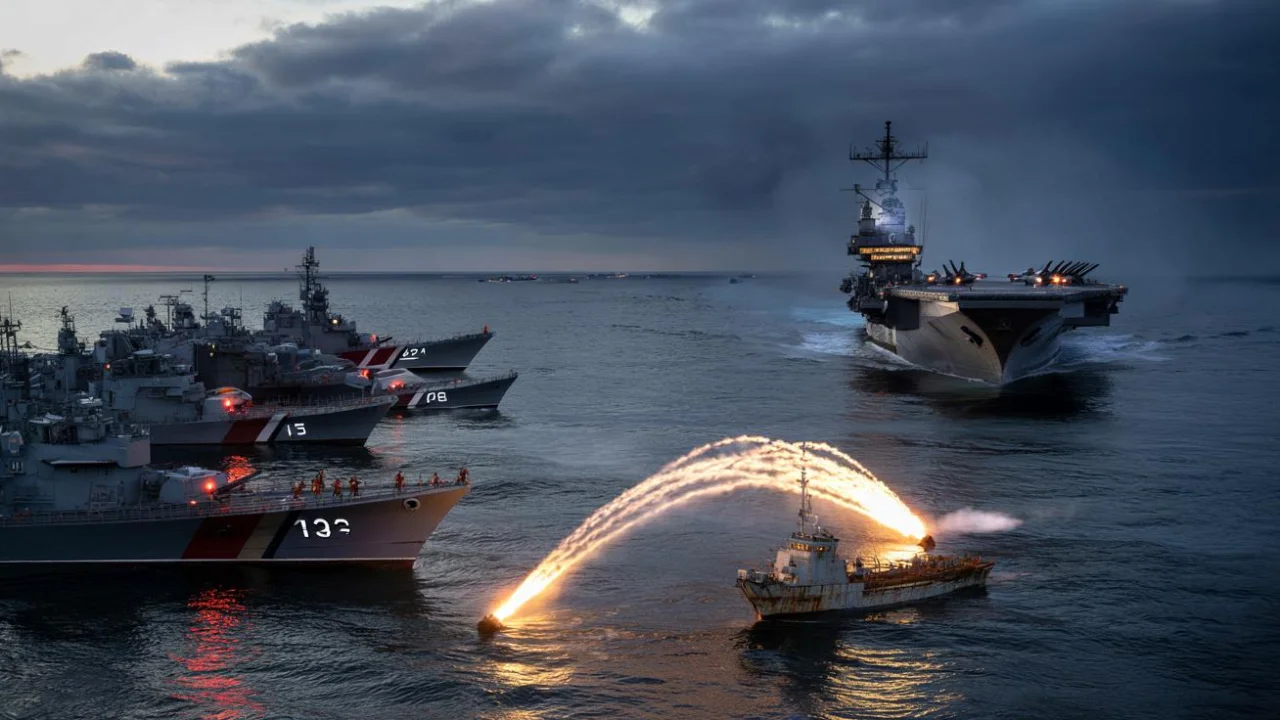
Meanwhile, a US carrier strike group has positioned itself closer to these flashpoints than it has in months, with fighter jets conducting what the Pentagon calls “freedom of navigation operations.” The message is clear: America won’t back down from its security commitments to regional allies.

“We’re seeing the most dangerous escalation in the South China Sea since 2016,” explains Dr. James Chen, a maritime security expert at the Pacific Institute. “Both sides are playing chicken with billion-dollar warships.”
What makes this standoff particularly volatile is the involvement of multiple players. Philippine coast guard vessels continue their resupply missions to disputed outposts, often facing water cannon attacks and aggressive maneuvering from Chinese ships. Vietnamese fishing fleets report being harassed or turned away from traditional fishing grounds. Japanese maritime patrols have increased their frequency in nearby waters.

The players, stakes, and flashpoints you need to understand
The current tensions involve more than just military posturing. Here’s what’s actually at stake:
| Key Players | What They Want | Current Position |
|---|---|---|
| China | Control over 90% of South China Sea via Nine-Dash Line claim | Deployed coast guard and naval vessels to contested areas |
| United States | Maintain freedom of navigation and support regional allies | Carrier strike group conducting patrols and joint exercises |
| Philippines | Access to traditional fishing grounds and resource areas | Continuing resupply missions despite Chinese interference |
| Vietnam | Protect fishing fleet and oil exploration rights | Increased coast guard presence, diplomatic protests |
The most dangerous flashpoints right now include:

- Second Thomas Shoal – Where Philippine marines maintain an outpost on a grounded warship, facing regular Chinese attempts to block resupply missions
- Scarborough Shoal – A traditional Filipino fishing ground now under effective Chinese control
- Paracel Islands – Where Chinese and Vietnamese forces have clashed before, with new infrastructure developments raising tensions
- Reed Bank – Rich in natural gas reserves, claimed by both China and the Philippines
“The problem is that every encounter now gets filmed, shared, and analyzed by millions of people in real-time,” notes Admiral retired Sarah Mitchell, former commander of Pacific naval operations. “There’s no quiet diplomacy anymore—everything plays out in public, making it harder for anyone to back down without losing face.”
What this means for your world beyond the headlines
These South China Sea tensions aren’t just abstract geopolitical chess moves. They’re already affecting real people in measurable ways:
Global shipping costs have increased by 15% on routes through the disputed waters as insurance companies factor in higher risks. Major cargo companies like Captain Santos’s employer are adding extra days to voyages by taking longer, safer routes around the conflict zones.
Energy markets are watching nervously. The South China Sea contains an estimated 11 billion barrels of oil and 190 trillion cubic feet of natural gas. Vietnam has suspended several offshore drilling projects after Chinese vessels interfered with exploration ships.
“My family has been fishing these waters for four generations,” says Nguyen Van Duc, a Vietnamese fisherman whose boat was recently intercepted by Chinese coast guard. “Now we stay closer to shore, catch fewer fish, make less money. But what choice do we have?”
Technology companies are also feeling the pressure. About 60% of maritime trade passes through the South China Sea, including crucial semiconductor shipments and rare earth materials. Any major disruption could trigger supply chain problems similar to those seen during the pandemic.
Regional stock markets have shown increased volatility whenever tensions spike. The Hong Kong Hang Seng Index drops measurably after each widely-reported incident between naval forces.
Defense spending is climbing across Southeast Asia as countries hedge their bets. The Philippines recently announced plans to boost its coast guard budget by 40%. Vietnam is fast-tracking naval modernization programs. Even traditionally neutral Singapore has increased maritime patrol activities.
“We’re seeing the militarization of what should be international waters,” observes Professor Liu Wei from the Institute for Strategic Studies. “Every country is preparing for scenarios they hope will never happen, but that preparation itself makes those scenarios more likely.”
The human cost extends beyond economics. Fishing communities across the region report their traditional grounds becoming inaccessible or dangerous. Young fishermen are leaving the profession, unable to make a living in increasingly restricted waters.
For travelers, several airlines have quietly adjusted flight paths to avoid areas where military exercises are conducted. While passenger safety isn’t directly threatened, the changes add time and fuel costs to regional flights.
The diplomatic fallout is reshaping regional alliances too. Countries are being forced to choose sides or risk being caught in the middle of a superpower confrontation they never wanted to join.
FAQs
How close are Chinese and US forces actually getting?
Military analysts report they’re operating within 50-100 nautical miles of each other, close enough that radio communications sometimes overlap and radar systems track each other continuously.
Could this actually lead to military conflict?
While both sides want to avoid direct confrontation, the risk of accidental collision or miscommunication grows higher as more ships crowd into smaller areas with heightened tensions.
Why don’t other countries just avoid these waters entirely?
The South China Sea handles about $3.4 trillion in annual trade—there’s no practical alternative route for most Asian commerce, and avoiding it would add thousands of miles to shipping routes.
What happens if a Chinese and US ship actually collide?
Both militaries have protocols for managing accidents, but in the current environment, even a minor incident could escalate quickly through social media and public pressure before diplomats can control the narrative.
How are ordinary people in the region reacting?
Fishing communities are changing their traditional routes, shipping companies are buying additional insurance, and many people are simply avoiding travel through the most contested areas when possible.
Is there any way to reduce these tensions peacefully?
Diplomatic solutions exist, but they require all parties to make compromises on territorial claims that have become matters of national pride, making peaceful resolution increasingly difficult.
About the Author