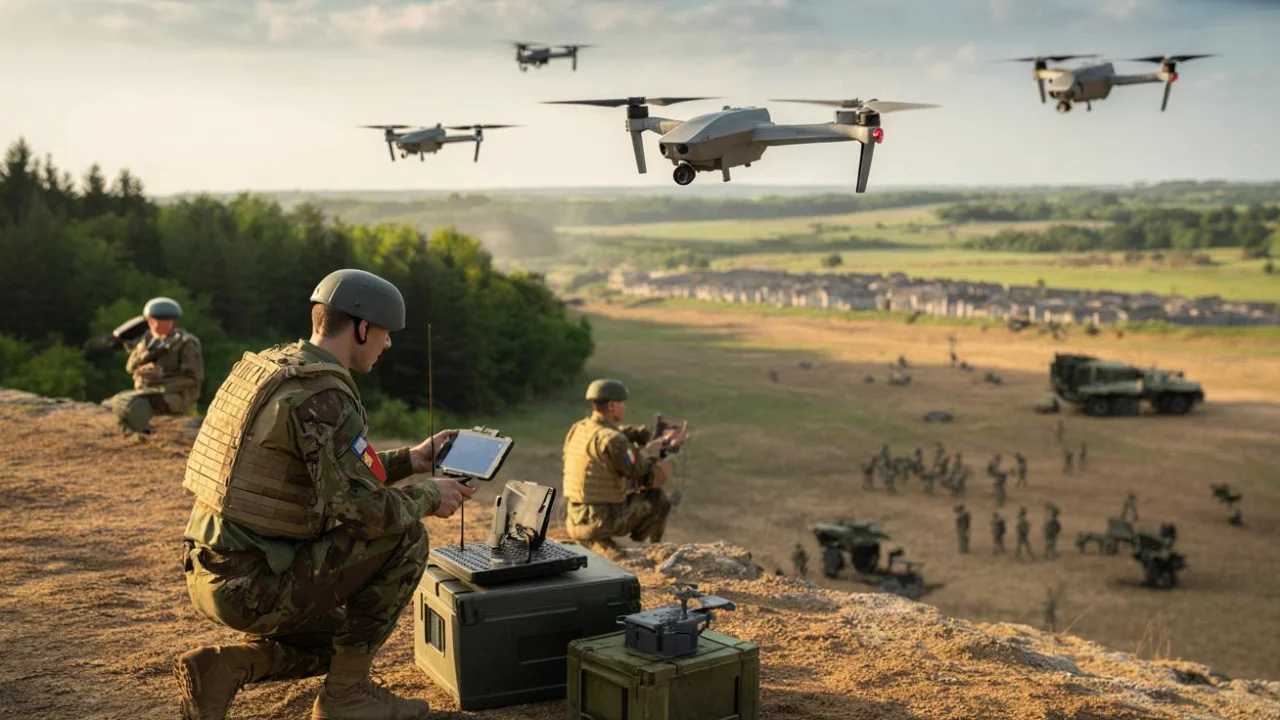
Captain Marie Dubois watched her squad unpack the small grey boxes that arrived at their training facility outside Lyon. Inside each container sat a compact quadcopter, no bigger than a dinner plate, that would soon change how her soldiers prepared for combat. “Six months ago, this was just an idea on paper,” she told her troops. “Now we’re holding the future of reconnaissance training.”
Her story reflects a remarkable achievement in military procurement. While defense contracts typically take years to fulfill, the French Army has just received all 1,000 of its ordered Sonora drones in record time.
What makes this delivery extraordinary isn’t just the speed—it’s what it represents for modern military readiness. These aren’t just toys for training exercises. They’re a complete shift in how armies think about equipping soldiers quickly and efficiently.

France’s Military Gets a Technology Boost
The French Army has completed its groundbreaking order of 1,000 Sonora drones from Harmattan AI, a defense startup that didn’t even exist two years ago. The contract, signed in June, demonstrates how quickly military needs can be met when bureaucracy steps aside.
These micro-drones arrived just in time for Orion 2026, one of Europe’s largest military exercises scheduled for later this year. French units will use the Sonora drones for reconnaissance and surveillance during complex combat scenarios designed to test high-intensity warfare capabilities.
“The Sonora programme shows how fast a Western army can move when it accepts simpler specifications and short development cycles,” explains defense analyst Jean-Pierre Martineau.
Unlike traditional military procurement that can drag on for decades, this project moved from concept to delivery in months. The French Defense Procurement Agency (DGA) prioritized speed over perfection, focusing on getting functional equipment into soldiers’ hands quickly.
The urgency behind this procurement stems from lessons learned in Ukraine, where small, inexpensive drones proved more valuable than expensive, sophisticated systems. French military planners recognized that quantity and rapid deployment often matter more than technical perfection in modern warfare.
Harmattan AI’s approach broke the traditional mold of defense contracting. Instead of promising cutting-edge features that would take years to develop, the company focused on delivering proven drone technology adapted specifically for military training requirements. This pragmatic approach allowed them to meet aggressive timelines while maintaining quality standards.
Key Features and Specifications
The Sonora drones represent a new category of military equipment designed for practicality over complexity. Here’s what makes these micro-drones special:
| Specification | Details |
|---|---|
| Size | Compact quadcopter, dinner plate-sized |
| Weight | 450 grams including battery |
| Flight Time | 25 minutes per battery charge |
| Range | 2 kilometers line-of-sight communication |
| Camera | HD video with 3x digital zoom |
| Primary Use | Training, reconnaissance, surveillance |
| Development Time | Less than 12 months |
| Total Units | 1,000 drones delivered |
| Deployment | Orion 2026 military exercise |
| Operating Temperature | -10°C to +45°C |
| Weather Resistance | Light rain and wind up to 35 km/h |
The drones offer several advantages for military training:
- Low-cost operation compared to traditional reconnaissance equipment
- Easy deployment by individual soldiers without specialized training
- Real-time surveillance capabilities for tactical scenarios
- Rapid replacement if damaged during exercises
- Minimal maintenance requirements in field conditions
- Encrypted communication to prevent signal interception
- Modular design allowing quick battery and propeller changes
- Silent operation mode for covert reconnaissance missions
Major General François Leclerc, who oversees training operations, notes: “These drones let our soldiers practice with technology they’ll actually use in combat, not just expensive equipment that sits in storage.”
The Sonora project also highlights France’s push for domestic defense production. Rather than relying on foreign suppliers, the military worked with Harmattan AI to develop indigenous capabilities that could be scaled up quickly.
Each drone comes with a ruggedized tablet controller and training materials available in French, English, and German to support NATO interoperability. The system’s simplicity means soldiers can become proficient operators within hours rather than weeks.
Impact on Modern Military Training
The arrival of these Sonora drones signals a broader transformation in how militaries approach equipment procurement and soldier preparation. Traditional training exercises often relied on simulated threats or expensive aircraft that couldn’t be risked in realistic scenarios.
Now, entire units can train with actual reconnaissance drones, learning to coordinate aerial surveillance with ground operations. This hands-on experience proves invaluable when soldiers face real combat situations.
“Every soldier in my platoon will know how to operate these drones by the time we finish training,” says Sergeant Antoine Rousseau, who’s leading drone integration at a base near Marseille. “That’s a capability multiplier you can’t put a price on.”
The rapid deployment also demonstrates how modern conflicts demand equally rapid responses. Ukraine’s war showed that armies need thousands of small drones, not dozens of expensive ones. The French military clearly took that lesson to heart.
Beyond training, these drones could quickly transition to operational use if needed. Their low cost means they can be deployed in high-risk situations where losing equipment is acceptable if it provides tactical advantages.
Training scenarios now include realistic drone reconnaissance missions where soldiers learn to interpret aerial footage, coordinate multiple drone feeds, and integrate this intelligence into ground-based tactical decisions. These skills directly transfer to operational environments.
Lieutenant Colonel Sophie Bertrand, responsible for tactical training development, observes: “Our soldiers are learning to think in three dimensions now. They’re not just planning ground movements—they’re incorporating aerial reconnaissance into every decision.”
Other NATO allies are watching this project closely. If the Orion 2026 exercises prove successful, similar rapid procurement programs could become the new standard for military equipment acquisition across Europe.
Defense economist Dr. Claire Moreau explains: “This contract proves you don’t need a decade-long development cycle to field effective military technology. Sometimes simpler and faster beats perfect and delayed.”
The success of the Sonora program could encourage more defense startups to work directly with militaries, bypassing traditional contractors who often prioritize complex, expensive solutions over practical ones.
Military training facilities across France are already adapting their curricula to incorporate drone operations as a standard skill alongside marksmanship and field communications. This represents a fundamental shift in what constitutes basic military competency.
Strategic Implications and Future Outlook
The Sonora drones delivery has implications far beyond France’s borders. European defense ministers are studying this procurement model as a template for rapid capability acquisition in an increasingly unstable security environment.
Germany’s Defense Ministry has already initiated discussions with Harmattan AI about potential collaboration, while Italian officials are exploring similar partnerships with domestic drone manufacturers. The success of France’s approach could trigger a wave of rapid procurement programs across NATO.
Dr. Michael Harrison, a defense procurement expert at the Royal United Services Institute, comments: “What we’re seeing here is a new paradigm where operational urgency drives acquisition decisions rather than bureaucratic processes. This could fundamentally change how Western militaries equip themselves.”
The French Army plans to expand the program if initial results prove successful. Additional orders of up to 2,000 more drones are under consideration for 2025, with potential modifications based on soldier feedback from the Orion exercises.
Harmattan AI has already begun developing enhanced versions incorporating artificial intelligence for autonomous reconnaissance missions. These advanced capabilities could be available within 18 months, demonstrating how quickly military technology can evolve when development cycles are shortened.
As Captain Dubois and her soldiers prepare for upcoming exercises, they’re not just learning to fly drones. They’re participating in a fundamental shift toward more agile, responsive military procurement that could reshape how armies equip themselves for future conflicts.
FAQs
What are Sonora drones?
Sonora drones are compact military micro-drones designed for reconnaissance and training, delivered to the French Army by startup Harmattan AI.
How quickly were the drones delivered?
All 1,000 Sonora drones were delivered within six months of the contract signing in June, which is exceptionally fast for military procurement.
What will the drones be used for?
The drones will primarily support training exercises, particularly the upcoming Orion 2026 military exercise, providing reconnaissance and surveillance capabilities.
Why is this delivery significant?
The rapid delivery demonstrates how military procurement can move quickly when focusing on practical solutions rather than complex, expensive alternatives.
Who manufactured these drones?
Harmattan AI, a French defense-technology startup founded in 2024, designed and produced the Sonora drones for the French Army.
Could other countries adopt similar programs?
Yes, NATO allies are closely monitoring this project as a potential model for rapid military equipment procurement and deployment.
About the Author