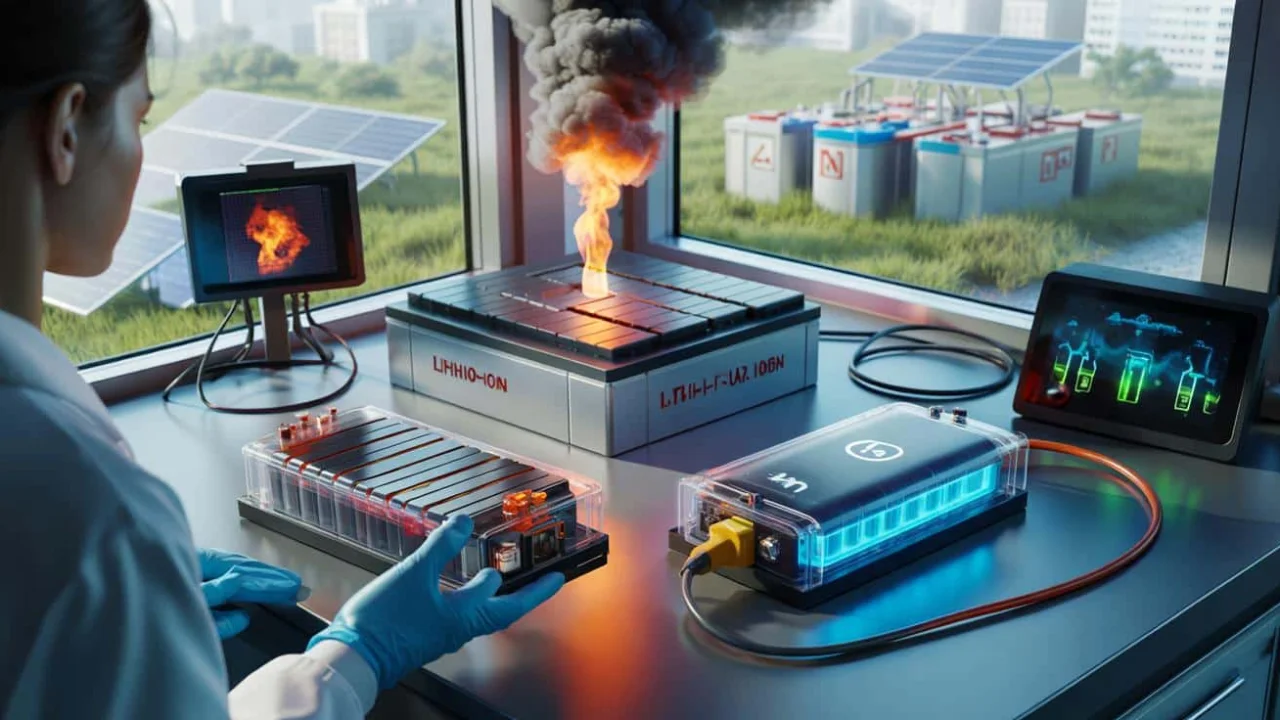
Maria Santos still remembers the day her electric car battery caught fire in her garage. The flames burned for hours, despite firefighters dousing it with thousands of gallons of water. “I thought my house was gone,” she recalls, watching helplessly as toxic smoke billowed from what was supposed to be the clean future of transportation.

Her story isn’t unique. Across the world, lithium-ion batteries are sparking fires in phones, laptops, cars, and even massive storage facilities. Fire departments now classify these batteries as “high risk” materials, requiring special equipment and training to handle safely.
But scientists in Japan believe they’ve found a way to make these dangerous incidents a thing of the past. Their breakthrough with sodium-ion batteries could fundamentally change how we power our devices – and eliminate the fire risk that’s making everyone nervous about lithium technology.

Why Lithium-Ion Technology Is Starting to Show Its Age
Lithium-ion batteries are everywhere. They’re in your smartphone, your laptop, your car if it’s electric, and increasingly in power grids storing renewable energy. These batteries transformed modern life by making portable electronics possible and kickstarting the electric vehicle revolution.
Yet beneath this success story, serious problems are mounting. Lithium is expensive and getting more so as demand skyrockets. The metal comes from just a handful of countries, creating supply chain vulnerabilities. Mining lithium often requires massive amounts of water in already dry regions, sparking environmental and social conflicts.

Then there’s the safety issue. When lithium-ion batteries fail, they don’t just stop working – they can enter thermal runaway, a chain reaction that generates intense heat and toxic gases. “We’re seeing fires that burn for days and require specialized foam to extinguish,” explains Dr. Sarah Chen, a battery safety researcher. “Traditional firefighting methods often make the situation worse.”
Now researchers at Tokyo University of Science say sodium-ion batteries could solve these problems while matching lithium’s performance. Their breakthrough addresses the main weakness that has kept sodium batteries in the laboratory: slow charging speeds.

The Science Behind the Sodium Solution
Sodium-ion batteries work on the same basic principle as lithium batteries, but swap lithium for sodium – a metal that’s literally everywhere. Table salt, ocean water, and countless mineral deposits contain abundant sodium, making it cheap and easy to source responsibly.
The key difference lies in the anode, the electrode that stores energy when the battery charges:

- Lithium-ion batteries use graphite anodes that store lithium ions in neat, ordered layers
- Sodium-ion batteries use “hard carbon” anodes with countless tiny pores that can hold sodium ions
- Hard carbon is made from renewable materials like agricultural waste, making it more sustainable
- Sodium batteries operate safely at room temperature and don’t risk thermal runaway
The problem has always been speed. While hard carbon offers plenty of storage space, sodium ions create traffic jams at the entrance to those tiny pores during fast charging. This bottleneck made sodium batteries charge much slower than lithium ones.
“It’s like having a huge parking garage but only one narrow entrance,” says Dr. Michael Rodriguez, an energy storage specialist. “All the cars pile up trying to get in at once.”
The Japanese team solved this by mixing aluminum oxide into the hard carbon, creating more pathways for sodium ions to enter the pores. Their composite anode eliminated the traffic jam, allowing sodium batteries to charge as fast as lithium ones.
| Battery Type | Charging Speed | Safety Risk | Material Cost | Fire Risk |
|---|---|---|---|---|
| Lithium-ion | Fast | High | Expensive | Thermal runaway possible |
| Traditional Sodium-ion | Slow | Low | Cheap | Minimal |
| New Sodium-ion | Fast | Low | Cheap | Minimal |
What This Means for Your Daily Life
If sodium-ion batteries deliver on their promise, the changes could be dramatic and immediate. Your next smartphone might charge just as quickly but never risk catching fire. Electric vehicles could become significantly cheaper while eliminating the fear of battery fires that still haunts many potential buyers.
The impact goes far beyond consumer devices. Energy companies are desperately seeking safe, affordable ways to store renewable energy from solar and wind farms. “Lithium battery fires at storage facilities have caused millions in damage and raised serious safety questions,” notes industry analyst Jennifer Park. “Sodium batteries could remove that risk entirely.”
Manufacturing could shift closer to home too. While lithium comes primarily from South America and Australia, sodium can be extracted almost anywhere. This could reduce dependence on volatile supply chains and lower battery costs across the board.
The environmental benefits are equally compelling. Sodium mining doesn’t require the intensive water use associated with lithium extraction. Hard carbon anodes can be made from agricultural waste that would otherwise be burned or thrown away. And when sodium batteries reach end-of-life, they’re much easier to recycle safely.
Early adopters are already taking notice. Several Chinese companies have begun manufacturing sodium-ion batteries for electric vehicles and grid storage. Major automakers are quietly testing the technology. Even consumer electronics companies are exploring how sodium batteries might reduce fire liability while cutting costs.
“The writing is on the wall,” predicts Dr. Lisa Thompson, who studies battery technology trends. “Once sodium batteries prove they can match lithium on performance while beating it on safety and cost, the transition could happen remarkably quickly.”
The timeline for widespread adoption remains unclear. Sodium-ion batteries still need to prove themselves in real-world conditions over many charge cycles. Manufacturing infrastructure will need time to scale up. But the Japanese breakthrough has removed the final major technical barrier that kept sodium batteries from competing directly with lithium technology.
For people like Maria Santos, who experienced firsthand how dangerous lithium batteries can be, the promise of safer alternatives can’t come soon enough. As she puts it: “I just want my car to get me where I’m going without burning my house down.”
FAQs
Are sodium-ion batteries actually safer than lithium-ion batteries?
Yes, sodium-ion batteries operate at lower voltages and don’t experience thermal runaway, virtually eliminating fire and explosion risks that plague lithium batteries.
Will sodium-ion batteries cost less than lithium-ion batteries?
Sodium is abundant and cheap compared to lithium, and sodium battery materials don’t require expensive mining operations, potentially making them significantly less expensive to produce.
When will I be able to buy a device with a sodium-ion battery?
Some Chinese electric vehicles already use sodium-ion batteries, but widespread adoption in consumer electronics will likely take 3-5 years as manufacturing scales up.
Do sodium-ion batteries last as long as lithium-ion batteries?
Current sodium-ion batteries have slightly lower energy density than lithium batteries, but recent breakthroughs are rapidly closing this gap while maintaining superior safety.
Can sodium-ion batteries work in cold weather?
Yes, sodium-ion batteries actually perform better in cold temperatures than lithium-ion batteries, making them ideal for electric vehicles in northern climates.
Will my current chargers work with sodium-ion batteries?
The charging infrastructure would need updates, but the transition could be gradual as sodium batteries can be designed to work with existing voltage standards.
About the Author