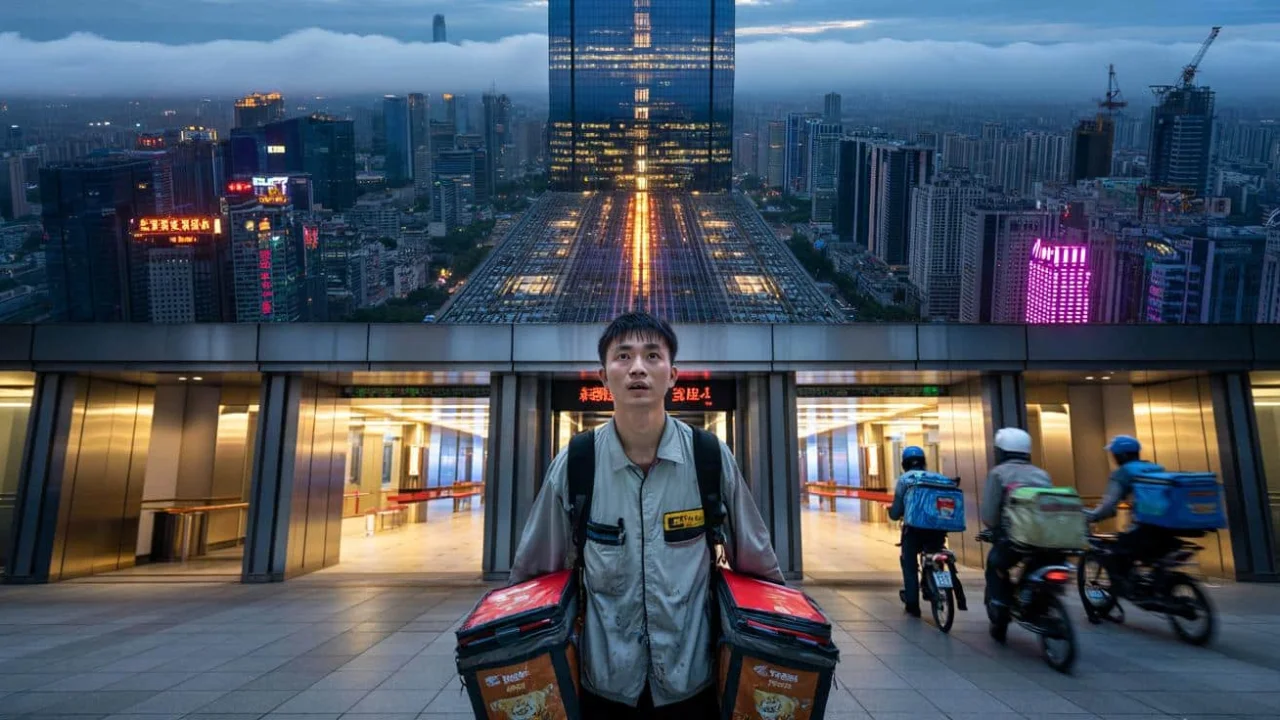
Zhang Wei checks his phone one more time before stepping into the gleaming lobby of the Ping An Finance Centre in Shenzhen. It’s 12:47 PM, and he’s got six orders for floors 72 through 89. The regular delivery guy on his motorbike handed him the thermal bags downstairs with a knowing nod. “Good luck up there,” he said.
Zhang isn’t your typical food delivery worker. He doesn’t weave through traffic or race against red lights. Instead, he navigates elevator systems, sky lobbies, and security checkpoints that most people never see. His territory starts where the motorcycles stop – at the point where buildings become so impossibly tall that getting food to the top requires a completely different skill set.
Welcome to the world of China’s skyscraper meal delivery specialists, where lunch doesn’t just travel horizontally through city streets, but vertically through the clouds.
Why Regular Delivery Workers Can’t Handle Super-Tall Buildings
China’s cities are reaching new heights – literally. With over 2,000 buildings taller than 150 meters and counting, the country has become home to some of the world’s most complex vertical structures. But there’s a problem that architects didn’t fully anticipate: how do you get a bowl of hot soup to the 90th floor?
“Traditional delivery riders work on volume and speed,” explains Li Ming, a logistics consultant in Shanghai. “They need to complete 15-20 orders per hour to make decent money. Spending 45 minutes on a single building doesn’t work for their business model.”

The challenge isn’t just about time. These mega-structures often feature:
- Multiple elevator systems with transfer points every 20-30 floors
- Security checkpoints that require ID verification
- Separate residential and office elevator banks
- Sky lobbies that serve as mandatory transfer points
- Access cards needed for different building sections
Regular delivery workers simply pass the orders to building-specific specialists who know exactly which elevator goes where, which security guard to talk to, and how to navigate the maze of corridors that exist above the clouds.
The Numbers Behind China’s Vertical Food Economy
The skyscraper meal delivery industry has quietly become a significant part of China’s gig economy. Here’s what the data reveals:

| Building Height | Average Delivery Time | Specialist Fee | Success Rate |
|---|---|---|---|
| Under 30 floors | 8-12 minutes | Standard rate | 98% |
| 30-60 floors | 15-25 minutes | +2-3 yuan | 95% |
| 60-100 floors | 25-40 minutes | +5-8 yuan | 92% |
| Over 100 floors | 40-60 minutes | +10-15 yuan | 88% |
Wang Xiaoli has been doing skyscraper meal delivery in Guangzhou for three years. She covers five buildings in the Pearl River New Town district, each over 80 stories tall. “I know every elevator, every security desk, every shortcut,” she says. “Some days I deliver to the same office three times, but I might take three different routes depending on which elevators are working.”
The work requires physical stamina and mental mapping skills that regular delivery workers don’t need. Wang can carry up to 12 orders at once, timing her routes to minimize elevator waiting periods during lunch and dinner rushes.
Major Chinese cities now employ thousands of these vertical delivery specialists:
- Shenzhen: Approximately 3,200 specialists covering 400+ tall buildings
- Shanghai: Over 4,000 specialists in the financial district alone
- Beijing: About 2,800 specialists focused on CBD and tech corridors
- Guangzhou: Around 2,200 specialists serving mixed-use towers
How This Changes City Life and Work
The rise of skyscraper meal delivery is reshaping how people live and work in China’s vertical cities. Office workers in buildings over 50 floors now have access to the same variety of food options as their ground-level counterparts, something that seemed impossible just five years ago.
“Before these specialists existed, we had maybe three or four restaurants that would deliver to our floor,” says Chen Lu, who works on the 67th floor of a Shanghai office tower. “Now we can order from anywhere in a 3-kilometer radius. It’s completely changed our lunch culture.”
Property developers are taking notice too. Buildings that guarantee reliable food delivery access are commanding higher rents. Some new developments are even designing dedicated delivery elevator systems and staging areas specifically for food orders.
Dr. Sarah Johnson, an urban planning expert at Beijing University, believes this trend reflects a broader shift in how cities function. “We’re seeing the emergence of true vertical neighborhoods,” she explains. “These aren’t just tall buildings anymore – they’re self-contained ecosystems that need their own specialized services.”
The economic impact extends beyond convenience. Many skyscraper delivery specialists earn 20-30% more than traditional delivery workers due to the specialized nature of their work. The job has attracted former office workers, retired security guards, and students who appreciate the indoor work environment and steady customer base.
But challenges remain. Weather delays, elevator maintenance, and building access restrictions can significantly impact delivery times. Some specialists report that during peak lunch hours, they might spend more time waiting for elevators than actually moving between floors.
Food safety is another consideration. Orders that take 45 minutes to reach their destination require better packaging and temperature control systems. Several Chinese food delivery apps have started offering “vertical delivery” options with enhanced thermal containers specifically designed for long elevator journeys.
As China continues building upward, the skyscraper meal delivery industry shows no signs of slowing down. Major cities are planning even taller residential and office complexes, some reaching 200 stories or more. These structures will likely require even more sophisticated delivery logistics and specialized workers who can navigate increasingly complex vertical spaces.
FAQs
How much do skyscraper meal delivery specialists earn in China?
Most specialists earn 6,000-9,000 yuan per month, which is 20-30% more than traditional delivery workers due to the specialized skills required.
What’s the tallest building where food delivery is available in China?
Food delivery services currently reach floors above 100 stories in several Chinese cities, with some specialists regularly delivering to the 120th floor and higher.
Do customers pay extra for skyscraper meal delivery?
Yes, delivery fees typically increase by 2-15 yuan depending on the building height and complexity, though many customers consider this reasonable for the convenience.
How long does it take to become a qualified skyscraper delivery specialist?
Most specialists need 2-4 weeks to learn the elevator systems and security procedures for their assigned buildings, plus ongoing training as buildings add new access requirements.
Are there any safety concerns with this type of work?
The work is generally considered safe, though specialists must be physically fit to handle multiple heavy bags and navigate stairs during elevator outages.
Will robots eventually replace human skyscraper delivery specialists?
While some buildings are testing automated delivery systems, the complex security and navigation requirements of most skyscrapers make human specialists necessary for the foreseeable future.
About the Author