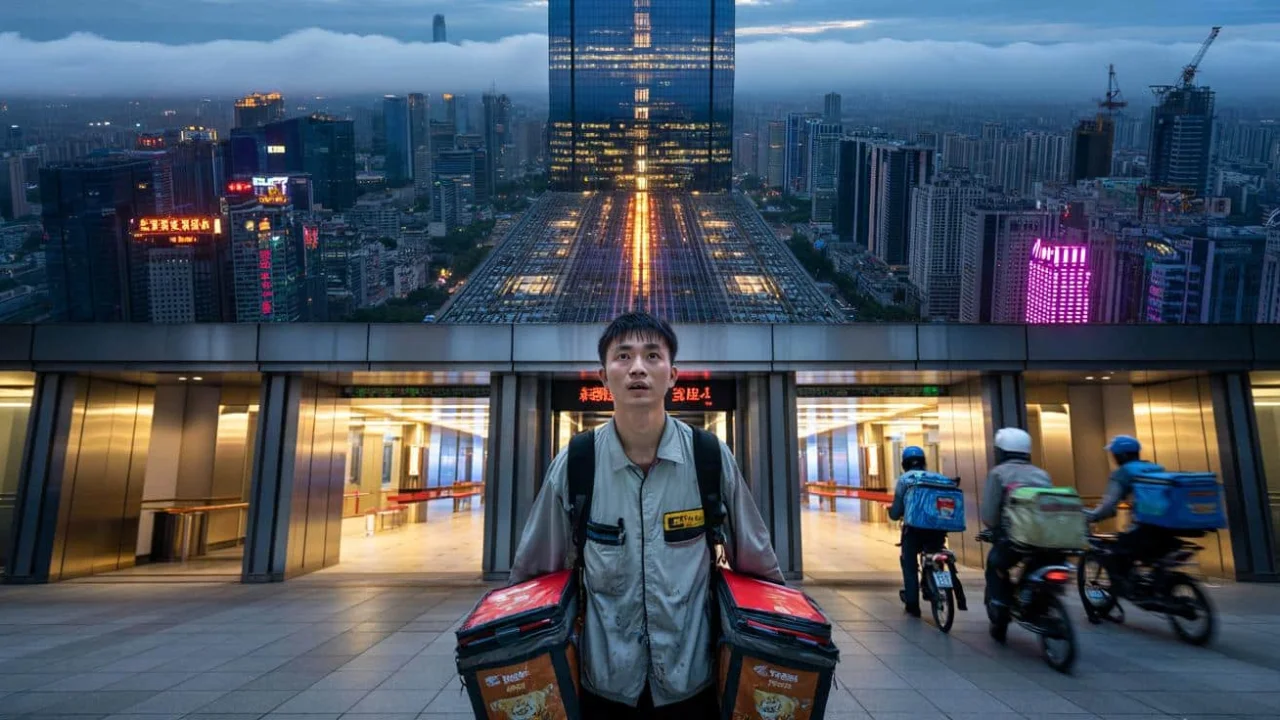
Li Wei checks his phone one more time before stepping into the elevator. The order screen shows “Floor 73 – Apartment 7305” and the customer has been waiting 25 minutes already. As the numbers climb past 40, then 50, then 60, he shifts the hot soup containers in his insulated bag, hoping they’re still warm when he finally arrives.

This isn’t your typical food delivery story. Li doesn’t ride a scooter through busy streets or navigate traffic jams. His route is vertical – straight up through the clouds of China’s mega-tall buildings, where a new breed of delivery specialist has emerged to solve a problem nobody saw coming.
Welcome to the world of skyscraper food delivery, where getting lunch to your desk might require a specialist trained in elevator systems, security protocols, and the patience to spend half an hour just going up.
When Buildings Become Too Tall for Regular Delivery
In cities like Shenzhen, Chongqing, and Guangzhou, buildings don’t just scrape the sky – they pierce right through it. We’re talking about residential and office complexes that stretch 80, 90, even 100+ floors into the air. For perspective, that’s taller than the Empire State Building, and people live and work at the very top.
Here’s where things get complicated for food delivery. A regular delivery rider racing through the city to complete 15 orders in two hours can’t afford to spend 30 minutes figuring out elevator transfers and security gates in a single building. That’s where skyscraper food delivery specialists come in.
“The building systems are so complex now that you need someone who understands them full-time,” explains Chen Ming, who works as an upstairs courier in a Shenzhen tower. “It’s not just pressing a button anymore – there are transfer lifts, sky lobbies, security scans, and multiple towers within one address.”
The process works like a relay race. Street delivery riders bring food to the lobby, where specialized upstairs couriers take over. These building specialists know every shortcut, every elevator quirk, and exactly which security guard to smile at for faster access.
The Numbers Behind Vertical Food Delivery
The scale of this industry is staggering when you break it down. Here’s what skyscraper food delivery looks like in real numbers:
| Building Height | Average Delivery Time | Extra Fee | Daily Orders |
|---|---|---|---|
| 50-70 floors | 15-20 minutes | 3-5 yuan | 200-300 |
| 70-90 floors | 20-30 minutes | 5-8 yuan | 150-250 |
| 90+ floors | 30-45 minutes | 8-12 yuan | 100-200 |
The challenges these delivery specialists face daily include:
- Navigate multiple elevator systems with different access cards
- Handle security protocols that change without notice
- Manage peak-hour elevator congestion where waits can exceed 10 minutes
- Coordinate with building management for after-hours deliveries
- Balance speed with food temperature during long vertical journeys
- Deal with facial recognition systems that sometimes glitch
“On busy days, I might ride elevators for 6-8 hours straight,” says Wang Lei, who delivers to three different 80+ floor complexes in Guangzhou. “My legs don’t get tired, but my ears pop constantly from all the altitude changes.”
Some buildings have become so delivery-intensive that they’ve installed dedicated service elevators just for food couriers. Others have created staging areas where upstairs specialists can sort multiple orders before making the journey up.
How This Changes City Life and Work Culture
The emergence of skyscraper food delivery reflects something bigger happening in Chinese urban planning. Cities are building up instead of out, creating vertical neighborhoods where thousands of people live and work in what’s essentially a small town stacked 100 floors high.
This shift impacts daily life in unexpected ways. Office workers on the 85th floor can order bubble tea at 3 PM and expect it delivered hot, just like someone in a ground-level shop. Families living on the 92nd floor don’t have to plan dinner around a trip downstairs – they can order from restaurants 30 minutes away and have it arrive faster than if they walked to the building’s lobby restaurant.
“It’s created this new layer of urban convenience,” notes Dr. Sarah Liu, who studies urban logistics at Beijing University. “People can live completely vertical lives now – work on the 60th floor, live on the 80th floor, and never touch the ground for days.”
The economic impact is significant too. Buildings that invest in efficient upstairs delivery systems attract more residents and office tenants. Property managers market “seamless delivery access” as a premium amenity, right alongside gyms and rooftop gardens.
But there are growing pains. Some residents complain about delivery traffic clogging elevators during peak hours. Others worry about security when dozens of strangers access their building daily. Building management companies are still figuring out how to balance convenience with safety and efficiency.
The job itself is evolving rapidly. Early upstairs couriers were often just people who knew a building well. Now, major delivery companies are training specialists who understand elevator mechanics, peak traffic patterns, and customer service protocols for high-end residential towers.
“Five years ago, this job didn’t exist,” reflects Zhang Min, who manages upstairs delivery teams for a major Chinese delivery app. “Now we have people who are elevator navigation experts, building security specialists, and customer service professionals all rolled into one.”
The trend shows no signs of slowing. As Chinese cities continue building upward and residents embrace convenience culture, skyscraper food delivery is becoming as essential as traditional street-level service. The next frontier? Some companies are already testing drone delivery systems for ultra-high buildings, though navigating urban airspace presents its own unique challenges.
FAQs
How much extra does skyscraper food delivery cost?
Customers typically pay an additional 3-12 yuan (roughly $0.50-$2) depending on building height and complexity.
How long does it take to deliver food to the top floors?
Delivery times range from 15 minutes for 50-floor buildings to 45 minutes for 100+ floor complexes, depending on elevator wait times and security protocols.
Do these delivery specialists work for specific buildings?
Some work exclusively for one building while others cover multiple towers in the same area. Major delivery apps now employ roving specialists who know several buildings well.
What happens if elevators break down?
Most ultra-tall buildings have backup elevator systems, but during major outages, deliveries may be suspended or customers receive partial refunds.
Are there weight limits for what these specialists can carry?
Most upstairs couriers limit themselves to 15-20 kg per trip to maintain speed and avoid elevator weight restrictions.
Is this job model spreading to other countries?
Similar systems are emerging in other Asian cities with super-tall residential buildings, but China remains the primary market due to the scale of vertical urban development.
About the Author
