Maria watches from her second-floor window as city workers jack up another section of sidewalk outside her Jakarta apartment. It’s the third time this year. Her grandmother used to walk to the market on level ground. Now the path dips and rises like a concrete wave, and the old woman needs help navigating what used to be a simple stroll.

This isn’t just poor urban planning. Maria’s neighborhood is sinking—literally dropping into the earth at a rate that would have seemed impossible to previous generations. And she’s not alone.
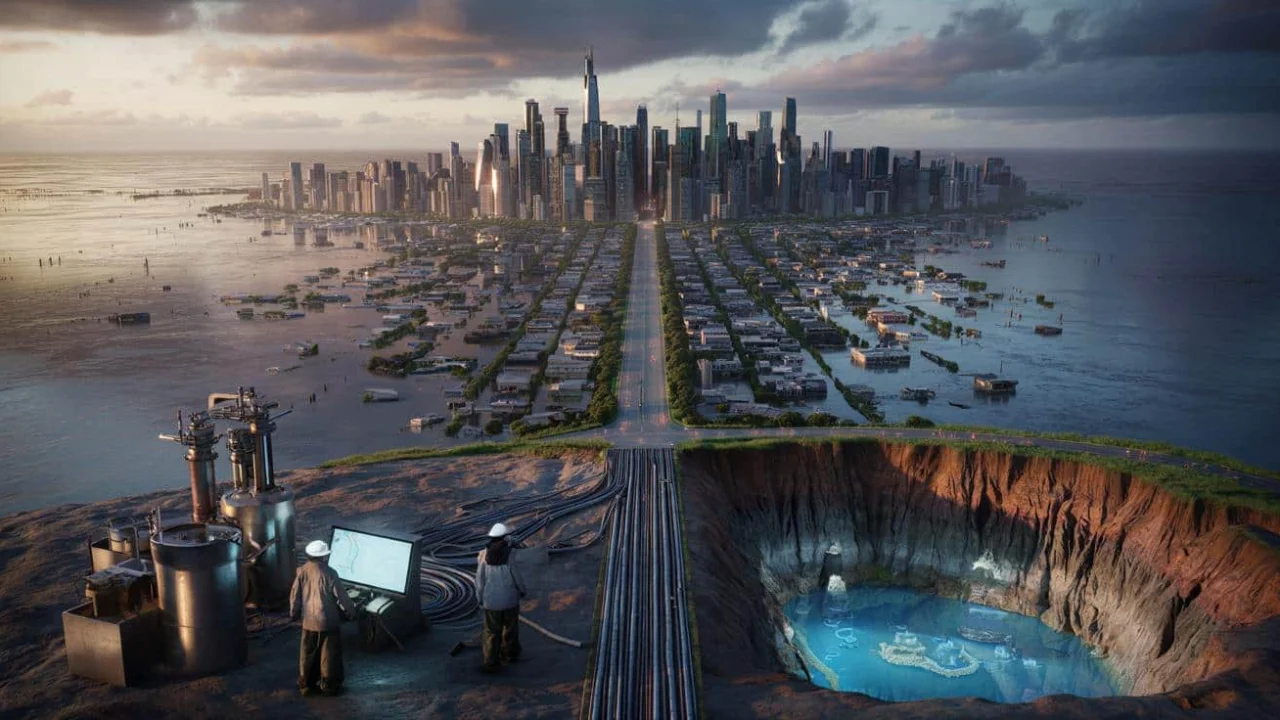
Across the globe, engineers are racing against gravity itself, claiming they’ve found a way to lift sinking megacities back toward the surface. Their solution? Pump water into the hollow spaces left behind by decades of oil and gas extraction. It sounds like science fiction, but the stakes are devastatingly real.

The Underground Battle Against Gravity
Sinking megacities represent one of the most urgent yet invisible crises facing urban populations worldwide. When we extract groundwater for drinking and pumping oil for energy, we’re essentially pulling the foundation out from under our feet.
“Think of the subsurface like a sponge,” explains Dr. Sarah Chen, a geophysical engineer who has studied subsidence in Asia. “When you squeeze out all the water and oil, the sponge compresses. The problem is, once compressed, it rarely bounces back to its original size.”

The numbers tell a sobering story. Jakarta leads the pack with some districts dropping 25 centimeters annually. Mexico City has sunk over 10 meters since the early 1900s. Shanghai’s airport requires constant elevation adjustments to keep runways functional.
What makes this crisis particularly challenging is its slow-motion nature. Unlike earthquakes or floods, subsidence creeps up on communities gradually, making it easier to ignore until the damage becomes irreversible.

The Water Injection Gamble
Engineers have developed what they call “managed aquifer recharge” to combat subsidence in sinking megacities. The concept involves injecting treated water into depleted underground reservoirs—particularly old oil and gas fields—to restore pressure and potentially lift the ground.
Here’s what the process looks like in practice:

- Identify suitable depleted reservoirs beneath urban areas
- Drill injection wells into these underground formations
- Pump treated water under controlled pressure
- Monitor ground elevation changes using satellite technology
- Adjust injection rates based on geological response
| City | Annual Subsidence Rate | Water Injection Status | Estimated Cost |
|---|---|---|---|
| Jakarta | 25 cm/year | Pilot phase | $40 billion |
| Mexico City | 8 cm/year | Testing | $15 billion |
| Shanghai | 2 cm/year | Operational | $8 billion |
| Bangkok | 3 cm/year | Planning | $12 billion |
Early results from Shanghai show promise. Parts of the city have experienced measurable ground lifting after systematic water injection programs began in 2019. However, the process remains experimental on the massive scale required for megacities.
“We’re seeing encouraging signs in controlled areas,” notes Dr. Michael Rodriguez, who leads subsidence research at the International Institute for Urban Geology. “But scaling this up to protect millions of people? That’s where we enter uncharted territory.”
Real Stakes for Real People
The human cost of sinking megacities extends far beyond inconvenient sidewalk repairs. Families like Maria’s face a cascade of problems that touch every aspect of daily life.
Infrastructure breakdown happens faster in sinking areas. Water pipes crack more frequently, creating service disruptions and contamination risks. Buildings develop structural problems as their foundations shift unevenly. Flooding becomes more severe as storm drains lose their proper gradient and coastal areas drop closer to sea level.
Economic impacts ripple through communities in unexpected ways. Property values plummet in the most affected neighborhoods, trapping lower-income families who can’t afford to relocate. Business owners face mounting costs for foundation repairs and infrastructure adaptations.
Jakarta is sinking so fast that the capital is being moved to Borneo. Meanwhile, engineers are trying experimental water injection to save other megacities from the same fate. The race is on ⏰🏙️ #climatechange#urbanplanning
— Urban Geography Today (@UrbanGeoToday) March 15, 2024
Public health concerns multiply as sanitation systems fail and flood risks increase. Children in affected areas show higher rates of respiratory problems due to increased flooding and mold growth in homes with compromised foundations.
“We’re not just talking about engineering challenges,” emphasizes Dr. Lisa Park, who studies urban resilience. “These are human stories about families losing their neighborhoods, their sense of place, their economic security.”
The water injection solution offers hope, but it comes with significant risks. Pumping water into underground formations could trigger seismic activity in some areas. There’s also the question of water sources—where do cities find enough clean water to reflate their foundations when many already struggle with water scarcity?
Environmental justice concerns also emerge. The communities most affected by subsidence often have the least political power to influence expensive engineering solutions. Water injection programs may prioritize high-value commercial districts over residential neighborhoods where people like Maria live.
Time is the ultimate constraint. Every day of delay means more permanent damage to the underground structure of sinking megacities. Unlike surface infrastructure that can be rebuilt, compressed soil layers rarely recover their original volume, even with water injection.
The engineers working on these solutions acknowledge the uncertainty. They’re essentially performing surgery on the planet’s crust beneath some of the most populated areas on earth, using techniques that have never been tested at this scale.
Success could save millions of homes and trillions of dollars in infrastructure. Failure could accelerate subsidence or create new geological hazards. For families watching their neighborhoods slowly disappear into the earth, it’s a gamble worth taking—because the alternative is certain disaster.
FAQs
How fast are sinking megacities actually dropping?
Jakarta leads with 25 centimeters annually in some areas, while other cities like Mexico City and Bangkok sink 3-8 centimeters per year.
Can water injection actually lift a city back up?
Early results from Shanghai show promise, with measurable ground lifting in pilot areas, but full-scale effectiveness remains unproven.
What causes cities to sink in the first place?
Primarily groundwater extraction and oil/gas pumping, which removes underground support and causes soil layers to compress and settle.
How much does it cost to stop a city from sinking?
Estimates range from $8 billion for Shanghai to $40 billion for Jakarta, making it one of the most expensive urban challenges ever attempted.
Are there risks to pumping water underground?
Yes, including potential seismic activity, groundwater contamination, and the challenge of sourcing enough water for injection while cities face water scarcity.
Which cities are trying this technology?
Shanghai is operational, Jakarta and Mexico City are in pilot phases, while Bangkok and other megacities are still in planning stages.
About the Author