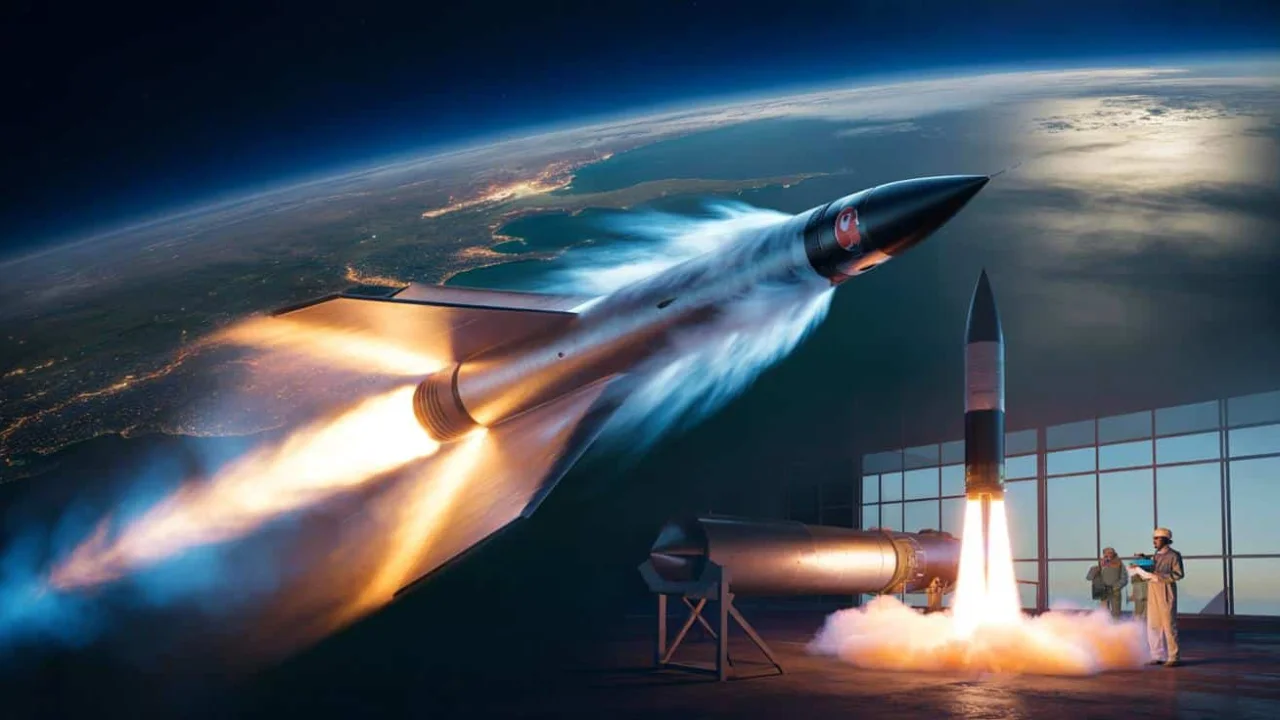
Picture this: you’re driving down a highway at 60 mph when suddenly a fighter jet screams overhead so fast it’s gone before you can even look up. That jet was moving at maybe 500 mph. Now imagine something traveling five times faster than that jet – so fast it could cross an entire country in minutes.

That’s the world India just stepped closer to entering. In a quiet laboratory in Hyderabad, engineers have been working on something that sounds like science fiction but is very much real: an engine that can power missiles at hypersonic speeds.
The successful scramjet combustor testing conducted by India’s Defence Research & Development Laboratory represents more than just another military milestone. It’s a leap into a future where the rules of warfare, defense, and even space exploration could be completely rewritten.
Breaking Down India’s Hypersonic Breakthrough
The Defence Research & Development Laboratory (DRDL) in Hyderabad recently completed what defense experts are calling a game-changing test. Their “Actively Cooled Scramjet Full-Scale Combustor” ran continuously for over 12 minutes – an eternity in the world of hypersonic engine testing.
Think about lighting a match in a hurricane. That’s essentially what scramjet combustor testing involves, except the hurricane is moving at five times the speed of sound, and instead of a gentle flame, you’re trying to maintain controlled explosions.

“The 12-minute trial represents years of theoretical work finally proving itself in the real world,” explains a senior aerospace engineer familiar with the project. “Most scramjet tests last seconds, not minutes. This duration shows the technology is maturing rapidly.”
The test used India’s specialized Scramjet Connect Pipe Test (SCPT) Facility, designed specifically for this kind of extreme engineering challenge. What makes this achievement particularly significant is that both the hardware and testing infrastructure were developed entirely within India, marking the country’s growing self-reliance in advanced defense technologies.

Understanding the Technology Behind the Headlines
So what exactly makes scramjet combustor testing so difficult? The answer lies in the physics of supersonic combustion.
Traditional jet engines slow down incoming air before mixing it with fuel. Scramjets – short for “supersonic combustion ramjets” – skip this step entirely. Air rushing through the engine never slows below the speed of sound. Fuel must be injected, mixed, and burned in this supersonic airstream within milliseconds.

Here’s what makes India’s recent test so remarkable:
- The combustor maintained stable operation for over 12 minutes
- Active cooling systems prevented the engine from melting under extreme heat
- Full-scale testing proved the design works at operational size
- Domestic manufacturing proved India can build these systems independently
| Test Parameter | Achievement | Significance |
|---|---|---|
| Duration | 12+ minutes | Far longer than typical scramjet tests |
| Scale | Full-size combustor | Proves real-world viability |
| Cooling System | Active thermal management | Enables sustained operation |
| Manufacturing | Entirely domestic | Reduces foreign dependency |
“What people don’t realize is that scramjet engines essentially turn the entire missile into a controlled explosion flying through the sky,” notes a hypersonics researcher. “The fact that India kept this running for 12 minutes shows they’ve solved some incredibly complex engineering problems.”
What This Means for the Real World
India’s scramjet combustor testing success isn’t just about military capabilities – though those implications are significant. This technology could revolutionize several fields that affect everyday life.
For defense, hypersonic missiles powered by scramjets could respond to threats anywhere within a region in minutes rather than hours. But beyond military applications, scramjet technology could transform civilian aerospace.
Imagine flights from New York to Tokyo taking two hours instead of fourteen. Or cargo deliveries anywhere in the world within the same day. The same engines being tested for missiles could eventually power passenger aircraft or space launch vehicles.
“We’re looking at technology that could make intercontinental travel as routine as domestic flights are today,” explains an aerospace industry analyst. “India’s progress puts them in position to be a major player in this transformation.”
The economic implications are equally profound. Countries mastering hypersonic technology early could dominate future aerospace markets worth hundreds of billions of dollars. India’s domestic development approach means they won’t need to pay licensing fees or face technology export restrictions.
For neighboring countries, India’s advancement in scramjet combustor testing represents a shift in regional power dynamics. The ability to deploy hypersonic weapons changes military planning and defense strategies across South Asia and beyond.
Perhaps most significantly, this achievement demonstrates that hypersonic technology is no longer limited to superpowers like the United States, China, and Russia. Mid-tier nations with sufficient technical expertise can develop these capabilities independently.
“What India has accomplished shows that the hypersonic club is expanding,” observes a defense technology specialist. “This isn’t just about one country’s military capabilities – it’s about how warfare and aerospace technology are becoming more democratized.”
The successful test also highlights India’s growing confidence in indigenous defense production. Rather than importing foreign technology, Indian engineers proved they could develop, build, and test world-class scramjet systems entirely within their borders.
Looking ahead, this scramjet combustor testing success likely represents just the beginning. Future tests will probably focus on integrating the combustor with complete engine systems, followed by actual flight tests of hypersonic vehicles.
FAQs
What makes scramjet engines different from regular jet engines?
Regular jets slow down incoming air before burning fuel, while scramjets burn fuel in supersonic airflow without slowing it down.
How fast do hypersonic missiles actually travel?
Hypersonic weapons move faster than five times the speed of sound, or roughly 3,800 mph at sea level.
Why is the 12-minute test duration so significant?
Most scramjet tests last only seconds due to extreme conditions, so 12 minutes proves the technology can work for extended periods.
Could this technology be used for civilian purposes?
Yes, scramjets could eventually power ultra-fast passenger aircraft or more efficient space launch vehicles.
How does India’s achievement compare globally?
This places India among a small group of nations developing practical hypersonic propulsion systems independently.
What happens next in India’s hypersonic program?
The next steps likely involve integrating this combustor into complete engines and conducting actual flight tests.
About the Author