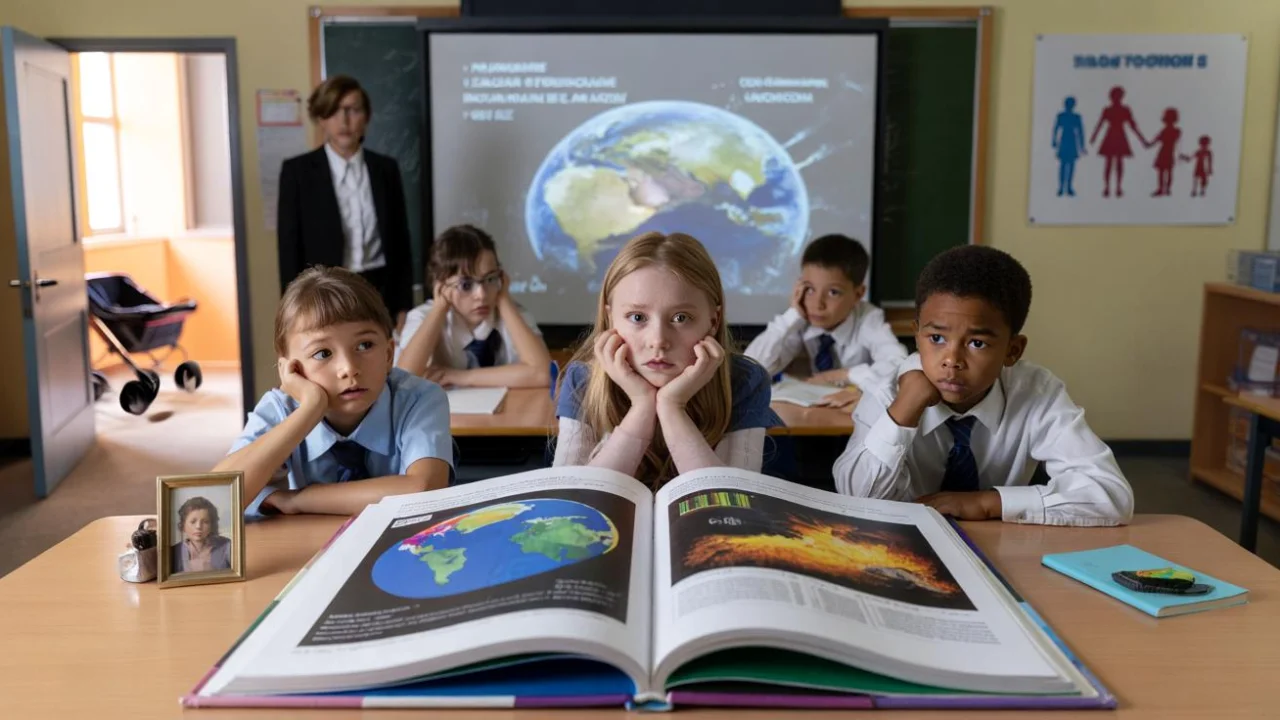
Marie Dubois was helping her 16-year-old daughter with biology homework when she stumbled across something that made her pause. There, in a crisp chart about carbon footprints, sat a recommendation that felt deeply personal: “have one fewer child” ranked as the top climate action, more effective than giving up cars or flights.

“I looked at my daughter and wondered what message we’re sending her,” Marie recalls. “Are we telling teenagers that their future families are the problem?”
This moment of confusion in a French family’s living room has exploded into a national debate. The school textbook controversy now divides parents, politicians, and educators across France.
When Climate Science Meets Family Planning
The storm centers on a widely-used biology textbook published by Nathan in 2020. Inside its pages, French high school students studying “Sciences de la vie et de la Terre” encounter a seemingly innocent chart about reducing carbon emissions.
David Lisnard, mayor of Cannes and leader of the Nouvelle Énergie party, discovered this chart and immediately raised alarm bells. He argues that French schools are quietly pushing an anti-natalist agenda under the guise of environmental education.

“We’re not just teaching science anymore,” Lisnard stated in a recent interview. “We’re telling young people that their desire to have children is destroying the planet.”
The controversial chart presents a hierarchy of climate actions. While most items seem reasonable—recycling, energy-efficient lightbulbs, public transport—the number one recommendation stands out starkly: having one fewer child saves 58.6 tons of CO2 equivalent per year.

Educational psychologist Dr. Laurent Moreau explains the potential impact: “When teenagers see this kind of messaging repeatedly, it can fundamentally shape how they view their future roles as adults and potential parents.”
Breaking Down the School Textbook Controversy
The Nathan textbook incident reveals deeper tensions about how climate education should be taught in French schools. Here’s what parents and educators need to know:

| Climate Action | CO2 Reduction (tons/year) | Controversy Level |
|---|---|---|
| Have one fewer child | 58.6 | High |
| Live car-free | 2.3 | Low |
| Avoid transatlantic flight | 1.6 | Medium |
| Eat plant-based diet | 0.8 | Medium |
| Recycle | 0.2 | Low |
Key concerns raised by critics include:
- Age-inappropriate messaging for teenagers still forming life goals
- Potential psychological impact on students from large families
- Blurring lines between scientific data and policy recommendations
- Cultural insensitivity in a country already facing population decline
- Lack of context about demographic challenges facing France
Supporters of the textbook argue that it simply presents peer-reviewed research without advocating for specific choices. Environmental scientist Dr. Claire Rousseau defends the inclusion: “Students deserve access to complete scientific data, even when it makes adults uncomfortable.”
The controversy has exposed fundamental disagreements about education’s role. Should textbooks present raw scientific findings, or should they consider the broader social implications of their messaging?
Real Families, Real Concerns
Beyond political debates, this school textbook controversy affects real families navigating complex decisions about their futures. Parents report feeling caught between environmental consciousness and natural desires for family growth.
Sarah Martinez, mother of three in Lyon, describes her dilemma: “My eldest daughter came home asking if having her baby brother was bad for the environment. How do you explain to a 14-year-old that her family isn’t the enemy?”
The timing feels particularly sensitive given France’s demographic challenges. The country’s birth rate has declined to 1.8 children per woman, below replacement level. Some argue that discouraging reproduction could worsen economic and social problems tied to an aging population.
Teachers find themselves in difficult positions too. Biology instructor Jacques Bernard notes: “We’re trained to present scientific facts, but students inevitably ask what this means for their personal choices. The textbook doesn’t provide guidance for those conversations.”
The controversy highlights broader tensions in environmental education. While climate change demands urgent action, critics worry about creating anxiety or guilt in young people still developing their identities and life plans.
Family counselor Dr. Sophie Leroy has observed changes in her teenage clients: “Some express genuine worry about whether having children is morally acceptable. That’s a heavy burden for adolescents to carry.”
Meanwhile, educators struggle with balance. They want students to understand climate science’s urgency while avoiding messages that could harm mental health or family relationships.
The debate has spread beyond France’s borders, with similar textbook controversies emerging in other European countries. This suggests deeper questions about how societies should discuss population, environment, and individual choice with younger generations.
Lisnard continues pushing for textbook reforms, arguing that climate education should focus on technological and behavioral solutions rather than discouraging family formation. His campaign has gained support from parent groups and conservative politicians who see this as government overreach into private family decisions.
As the school textbook controversy evolves, it forces uncomfortable questions about education, environment, and personal freedom. Where should schools draw the line between presenting scientific data and shaping students’ life choices?
FAQs
What exactly does the controversial textbook say about having children?
The Nathan biology textbook includes a chart ranking climate actions by CO2 reduction, with “have one fewer child” listed as the most effective action at 58.6 tons of CO2 saved annually.
Is this textbook still being used in French schools?
Yes, the Nathan textbook remains in circulation in French high schools, though some schools have requested alternative materials following the controversy.
What is David Lisnard’s main complaint about the textbook?
Lisnard argues that the textbook inappropriately influences students’ personal life choices by presenting family planning as primarily an environmental issue rather than a personal decision.
Are other countries experiencing similar textbook controversies?
Yes, similar debates about population and climate messaging in educational materials have emerged in Germany, Sweden, and other European nations.
How are teachers responding to student questions about this topic?
Many teachers report feeling unprepared to handle student questions about whether having children is environmentally responsible, leading to calls for better training and clearer guidelines.
What alternatives are critics proposing for climate education?
Critics suggest focusing on technological solutions, renewable energy, and sustainable consumption rather than discouraging family formation as climate action.
About the Author