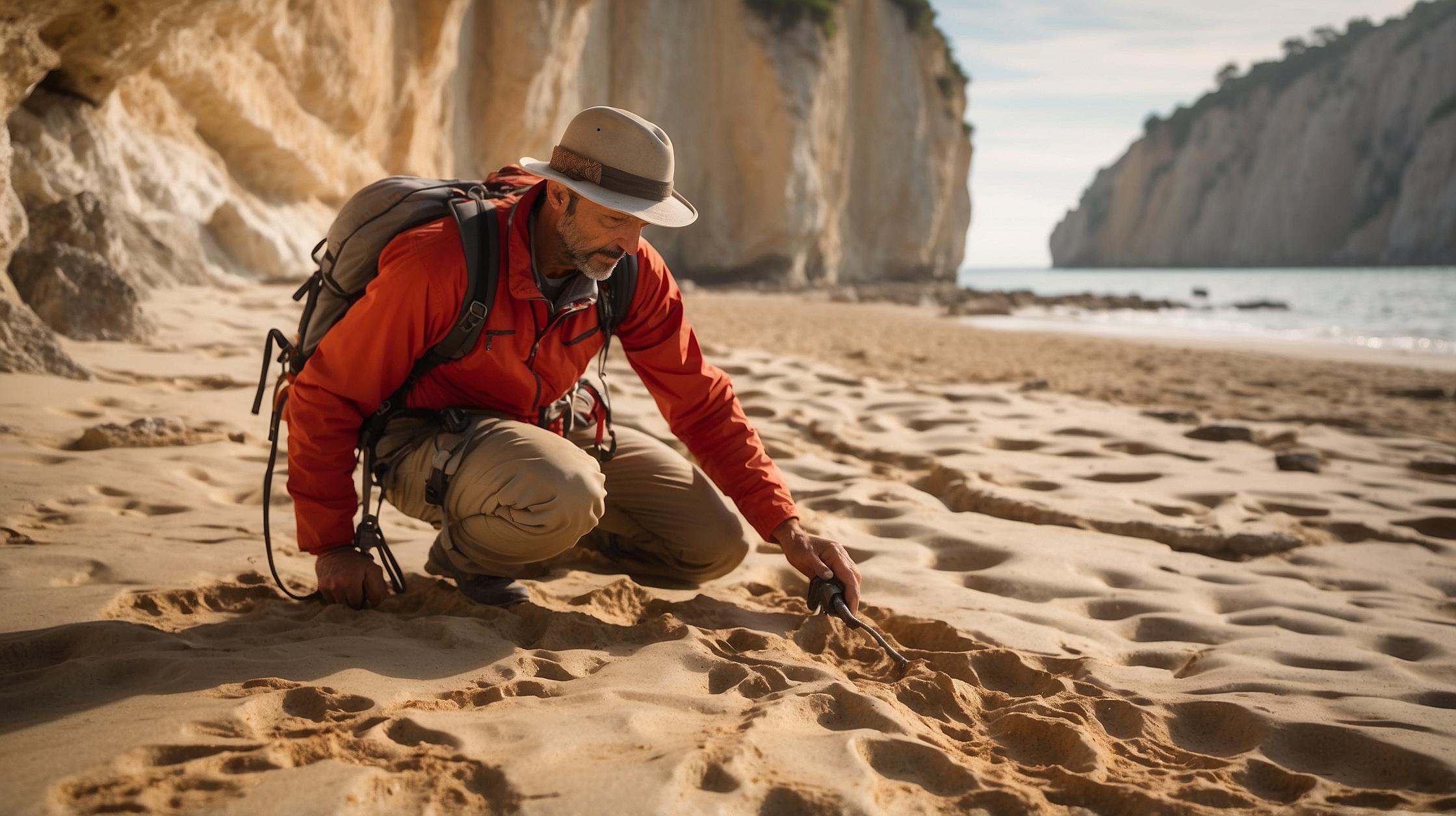

In an astonishing stroke of luck, a group of rock climbers scaling the cliffs in the Italian Alps have unknowingly stumbled upon one of the most extraordinary paleontological finds in recent memory — a series of fossilized sea turtle tracks estimated to be over 80 million years old. The ancient pathways, dubbed a “stampede” by researchers due to their grouping and overlapping patterns, offer a rare glimpse into the behavior and migration of prehistoric marine reptiles during the Late Cretaceous period.

The climbers were ascending a remote limestone wall in the Lombardy region when they noticed unusual, repetitive patterns embedded in the rock layers. Initially thought to be mere discolorations or cracks, the formations were soon recognized by paleontologists as a set of well-preserved trackways created by large sea turtles. This discovery has not only extended the known range of these ancient animals but also revealed insight into their social behavior — something rarely captured in the fossil record.
What makes this discovery truly exceptional is that sea turtle fossils themselves are uncommon and only a handful of trackway fossils have ever been identified globally. This is the first time such a formation has been discovered in this part of Europe, and certainly the first of its kind to provide such dynamic and intertwined movement patterns suggesting mass migration or social congregation.

Overview of Ancient Sea Turtle Track Discovery
| Date Discovered | 2024 |
| Location | Lombardy region, Italian Alps |
| Estimated Age | Approximately 80 million years (Late Cretaceous) |
| Discovered By | Group of amateur rock climbers |
| Type of Fossils | Trackways of extinct marine turtles |
| Scientific Significance | First evidence of mass movement behavior in ancient sea turtles |
How the fossil tracks were identified
Once the rock climbers reported their unusual sighting, a team of paleontologists and geologists from the University of Milan made a field visit to verify the discovery. Using 3D scanning technology and drone mapping, the team documented dozens of trackways crossing each other across a wide, inclined slab of exposed limestone that had once formed a seafloor during the Cretaceous Period.
The tracks consist of distinct impressions resembling flipper marks—rounded front limb prints followed by elongated, more subtle rear flipper movements. The multiple overlapping directions of travel further fueled speculation of simultaneous turtle activity, potentially akin to modern nesting migrations.

“We were stunned not only by their clarity but also their density. We’ve never seen this many anatomical footprints of marine reptiles in such close proximity.”
— Dr. Giulia Ferraro, Lead Paleontologist, University of Milan

What makes this site globally unique
Typically, fossil records of sea turtles include carapace fragments or isolated bones. Fully preserved footprints that provide actual locomotive information are exceedingly rare. Only three other comparable fossil trackways of sea turtles exist worldwide — none of which display the multitude and arrangement found in the Lombardy region.
This location not only showcases exceptional preservation but also reveals directional information. The turtles appear to have moved from the ancient shoreline into deeper waters or vice versa, and the overlapping depth of the impressions may indicate varying weights and sizes — hinting at age and gender diversity within the group.
“This site could become a global reference point for understanding the locomotion strategies and social behaviors of Cretaceous marine reptiles.”
— Dr. Lorenzo Capitani, Geological Survey of Italy
The paleontological significance of group movement
One of the most intriguing theories scientists are exploring is the possibility of a prehistoric ‘turtle stampede’ — an event where numerous individuals moved together across shallow marine environments, likely in response to breeding, predation, or migration stimuli. This behavior closely mimics modern-day sea turtle movements, where hundreds of animals congregate on nesting beaches at once.
This trackway offers the first physical fossil evidence pointing toward such mass behavior in prehistoric sea turtles, potentially rewriting parts of the evolutionary narrative concerning sea turtle sociality and navigation.
“We often have to infer behavior from morphology alone. Here, we have a true fossilized moment in time that reflects real movement dynamics.”
— Dr. Emilio Mastroianni, Evolutionary Biologist
Geological conditions that preserved the tracks
The preservation of these tracks owes a lot to the unique sedimentary history of the region. Around 80 million years ago, what is now Northern Italy was part of a shallow, tropical sea dotted with carbonate platforms and lagoons. Soft marine mud provided a perfect medium for prints to embed, which over time hardened into limestone with the aid of continued sedimentation and mineralization.
The uplift of the Alps through tectonic activity later exposed these ancient seabeds — lifting them thousands of meters above sea level, making them accessible for climbers and researchers today.
Planned excavation and preservation efforts
The Italian Ministry of Culture has since declared the site as a “geoheritage preservation zone.” Plans are underway to commission excavations, protective coverings, and documentation, ensuring that the delicate prints aren’t lost to erosion, tourism, or vandalism.
A nearby regional museum has expressed interest in creating a life-size 3D replica of the trackway for educational and public engagement purposes. Guided hikes and scientific tours may also be developed to help inform visitors while preserving the site’s integrity.
“This isn’t just a national treasure — it’s a global paleontological legacy.”
— Elena Bruni, Director, Italian National Heritage Council
Winners and Losers
| Winners | Losers |
|---|---|
| Scientific community | Unauthorized fossil hunters |
| University research teams | Unregulated tourism activities |
| Italian cultural heritage | Competing fossil interpretation models |
Ongoing research directions
Experts are now examining the possibility that similar trackways remain undiscovered in nearby rock strata. Drone lasers, magnetometry, and thermal imaging will be used in upcoming expeditions to map submerged and exposed fossils in adjacent ridgelines.
Isotopic analysis and sediment dating are also underway to better understand the climate conditions, sea chemistry, and ecological stressors that influenced marine life behaviors during the Late Cretaceous. These insights might contribute to our understanding of how current sea turtle populations could respond to climate change.
Public excitement and next steps
Public fascination with dinosaurs and ancient life has translated into widespread excitement over the find. Social media buzz from local climbing communities has already begun to stir interest in the region as a geological hotspot. Calls to balance access with conservation are growing amid the anticipated tourism spike.
Above all, the discovery serves as a potent reminder that nature still hides incredible stories beneath layers of stone — just waiting for curious eyes to spot them. And sometimes, the most astonishing finds aren’t uncovered by seasoned scientists armed with tools, but by thrill-seekers climbing toward new heights, guided only by instinct and awe.
Frequently Asked Questions (FAQs)
What exactly did the climbers find?
The climbers discovered fossilized footprints — or trackways — of ancient sea turtles preserved in an exposed limestone wall, estimated to be 80 million years old.
Where was the discovery made?
The tracks were found in the Lombardy region of Northern Italy, within elevated cliffs that were once part of a shallow marine ecosystem during the Late Cretaceous period.
Why is this discovery important?
These are among the best-preserved sea turtle trackways ever found and the first evidence suggesting mass migration behavior in ancient marine turtles.
How old are the tracks?
They are approximately 80 million years old, dating back to the Late Cretaceous era when dinosaurs still roamed the Earth.
What happens to the site now?
Italian authorities are working with scientists to preserve the site, study the fossils in depth, and potentially create replicas for educational outreach.
Is the trackway open to the public?
As of now, the site remains closed for controlled scientific research, but plans are underway to provide guided access in the future.
Are there other similar sites in Europe?
None with this level of preservation and density. This discovery makes the Lombardy region a new hub for marine paleontology in Europe.
Can this help modern turtle conservation?
Yes, understanding ancient behavior patterns can inform how modern turtles might respond to environmental changes and threats.
About the Author