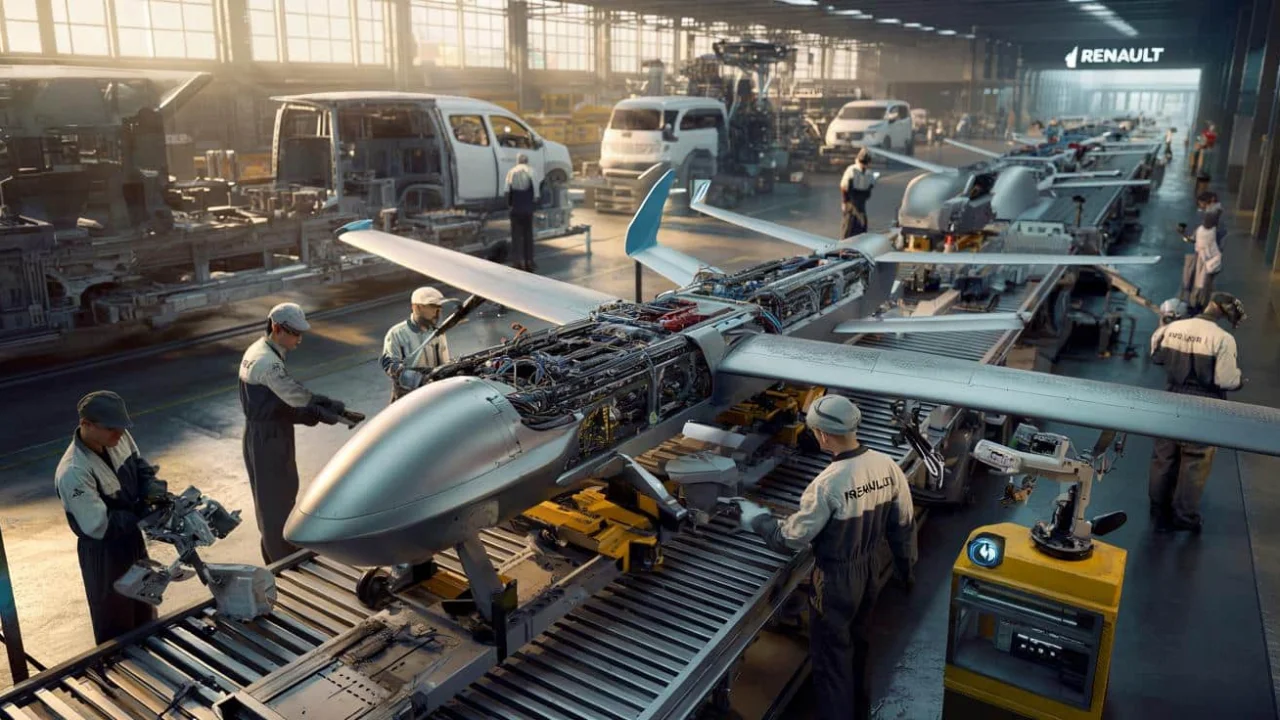
Marie Dubois never thought she’d trade her Renault Clio for something that could fly. As a quality control supervisor at Renault’s Le Mans plant for twelve years, she’s witnessed the factory produce thousands of reliable family cars. But last month, during a staff meeting that felt more like a scene from a spy thriller, management announced something extraordinary.

“We’re not just building cars anymore,” her supervisor explained, barely containing his excitement. “We’re moving into drones. Military drones.” Marie’s coffee went cold as she processed the news. The same production lines that once churned out her beloved Clios would soon assemble flying machines designed for France’s defense forces.
This isn’t just another corporate pivot. It’s a glimpse into how traditional industries are adapting to a world where the lines between civilian manufacturing and military needs blur more each day.

From Assembly Lines to Flight Lines
Renault military drones represent a dramatic shift for France’s most recognizable automaker. The company has partnered with the French Defence Procurement Agency (DGA) to transform its Le Mans facility into a high-volume drone production center. Under the contract codenamed “Chorus,” the plant will manufacture up to 600 aerial drones monthly once fully operational.
The partnership brings together Renault’s industrial expertise with Turgis & Gaillard, a specialized French defense contractor. While Renault contributes manufacturing scale and production efficiency, Turgis & Gaillard provides the military technology and defense sector connections.

“We’re essentially applying automotive production principles to defense manufacturing,” explains defense industry analyst Philippe Laurent. “The precision, quality control, and rapid scaling capabilities that make great cars can also make effective military systems.”
French authorities see this collaboration as strategically vital. Rather than building new defense facilities from scratch, they’re leveraging existing automotive infrastructure to rapidly boost domestic drone capabilities. The approach makes economic sense while strengthening France’s defense industrial base.

Technical Specifications and Production Details
These aren’t consumer quadcopters with cameras. The Renault military drones fall into the category of “long-range remotely operated munitions” – sophisticated aerial systems designed for defense applications. Here’s what we know about the production plan:
| Production Aspect | Details |
|---|---|
| Monthly Capacity | 600 drones at full production |
| Production Partner | Turgis & Gaillard (Defense Systems) |
| Contract Name | Project Chorus |
| Primary Customer | French Defense Forces |
| Factory Location | Le Mans, France |
The drones will incorporate several advanced features:

- Long-range operational capability for extended missions
- Remote operation technology for safe distance control
- Military-grade construction suitable for defense applications
- Integration with French military command systems
- Precision targeting and navigation capabilities
“The beauty of this approach is that automotive manufacturing already demands the precision and reliability military systems require,” notes defense contractor Jean-Luc Moreau. “You’re talking about systems that must work perfectly every time, whether it’s starting your car on a cold morning or executing a critical military operation.”
The production timeline remains classified, but industry sources suggest initial deliveries could begin within 18 months. The flexible manufacturing approach means production can scale up or down based on military requirements and geopolitical conditions.
Broader Impact on Industry and Defense
This move signals a fundamental shift in how European nations approach defense manufacturing. Instead of relying solely on traditional military contractors, governments are increasingly turning to civilian manufacturers with proven production capabilities.
For Renault workers, the transition brings both opportunities and uncertainties. New jobs will emerge in drone assembly and military systems quality control, but employees need retraining for these specialized roles. The company has committed to comprehensive training programs to help existing staff adapt to defense manufacturing requirements.
The broader automotive industry is watching closely. Other European carmakers face similar pressures to diversify as electric vehicle competition intensifies and defense spending increases across NATO countries. Renault’s success with military drones could inspire similar partnerships throughout the sector.
“This could be the beginning of a new era where automotive expertise regularly supports defense needs,” suggests industry strategist Elena Rosetti. “We’re seeing the boundaries between sectors become more fluid as governments prioritize rapid defense capability expansion.”
The timing isn’t coincidental. European nations are urgently modernizing their military capabilities following geopolitical tensions and conflicts that highlight the importance of advanced drone technology. France wants domestic production capacity rather than relying on foreign suppliers for critical defense systems.
From an economic perspective, the partnership offers Renault new revenue streams while supporting French strategic autonomy in defense technology. The company can leverage its existing infrastructure investments while accessing the typically lucrative defense contracting market.
Workers like Marie Dubois are adapting to this new reality. “It’s strange to think that the same hands that build family cars will now build military systems,” she reflects. “But if it helps protect France and keeps our factory running, I’m ready to learn something completely new.”
The success of Renault military drones could reshape how we think about industrial capacity during uncertain times. When civilian manufacturers can quickly pivot to defense production, nations gain flexibility in responding to emerging threats without massive infrastructure investments.
FAQs
How many drones will Renault produce monthly?
The Le Mans plant will manufacture up to 600 military drones per month once reaching full production capacity.
What type of military drones will Renault build?
These are long-range remotely operated military systems, not consumer drones, designed specifically for French defense forces.
Who is partnering with Renault on this project?
Renault is working with Turgis & Gaillard, a specialized French defense contractor, and the French Defence Procurement Agency.
Will this affect regular car production at Renault?
The drone production is taking place at the Le Mans facility, with the company managing both automotive and defense manufacturing operations.
When will the first military drones be delivered?
While exact timelines remain classified, industry sources suggest initial deliveries could begin within 18 months.
Could other car companies start making military equipment?
Yes, this partnership could inspire similar collaborations as European governments seek to rapidly expand defense manufacturing capabilities using existing industrial infrastructure.
About the Author