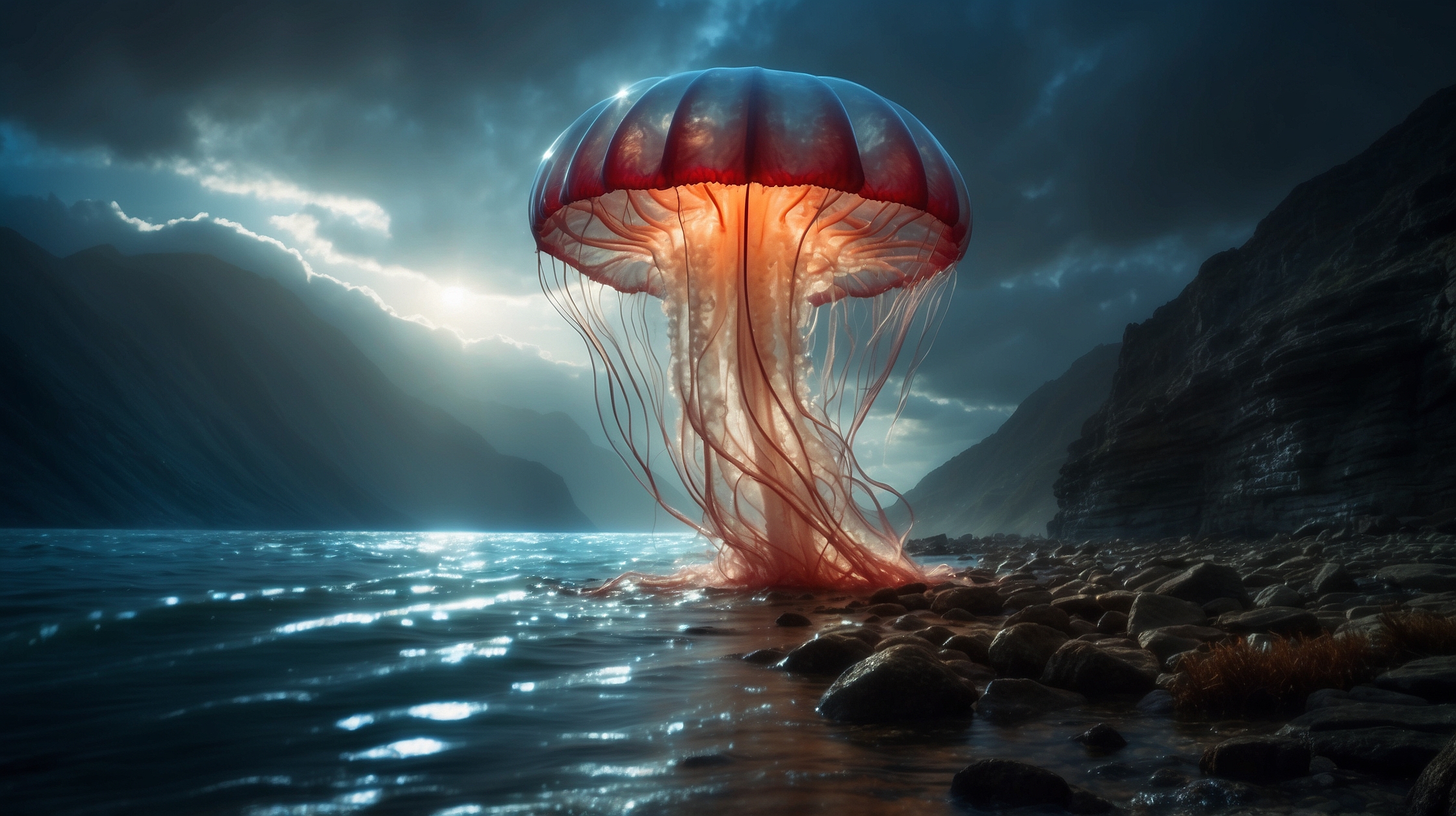
In a spectacular and rare underwater sighting, scientists have captured new footage of the elusive giant known as the **“phantom” jellyfish**—a ghostly deep-sea creature that seems to float in from another world. Spanning an estimated length comparable to that of a **city bus**, this encounter is one of only a handful ever documented. Spotted by explorers descending into the darkness of the deep sea, the jellyfish glided gracefully through the abyss, its massive, ribbon-like arms undulating like a surreal ballet performed in the pitch-black ocean depths.
This encounter gives researchers and the public alike a breathtaking glimpse into the **mysterious ecosystems** far below the ocean surface—regions we still know very little about. The phantom jellyfish, first described over a century ago, has remained largely a mystery due to its **extreme habitat depths**, often making its home thousands of feet below the surface in conditions nearly impossible for conventional observation. Advances in submersible drone technology and deep-sea imaging have finally begun to open a window into this hidden aquatic world.
Key details about the recent phantom jellyfish discovery
| Species Name | Stygiomedusa gigantea |
| Common Name | Phantom jellyfish |
| Estimated Size | Up to 33 feet (10 meters) |
| Habitat Depth | Typically 3,000 to 6,000 feet deep |
| Number of sightings to date | Fewer than 130 worldwide |
| Method of Study | Remotely operated vehicle (ROV) footage |
Why this sighting matters in marine biology
The recent discovery adds a crucial piece to the puzzle for scientists seeking to understand deep-sea biodiversity. The **Stygiomedusa gigantea** is part of a group of jellyfish that elude standard research methods due to their habitat depth and fragility. Capturing clear high-resolution imagery enables researchers to study its morphology, behavior, and possible interactions with other deep-sea organisms, like its suspected close association with the fish species **Thalassobathia pelagica**.

Because so few specimens are encountered—and virtually none are captured or preserved—the data gleaned from these ROV encounters is invaluable. Every frame of movement, arm positioning, and undulation tells a story that biological models and AI-assisted simulations can then extrapolate further.
“Each time we spot a Stygiomedusa, it’s an opportunity to broaden our understanding of deep-sea evolutionary adaptations.”
— Dr. Helena Cortez, Marine BiologistAlso Read Ser titular de una cuenta de fallecido no te libra del problema: el Banco de España ya avisa
Meet Stygiomedusa gigantea: The ghost of the deep
The **phantom jellyfish** isn’t just rare—it’s otherworldly. With its bell-shaped body and long curtain-like arms that can extend more than 30 feet, it presents a haunting but mesmerizing appearance. It lacks the stinging tentacles seen in many related species, leading scientists to believe it uses its **long arms to ensnare prey** drifting in the water current.

The name “Stygiomedusa” draws from *Stygian*, referencing the River Styx from Greek mythology—an apt metaphor for its murky and mysterious deep-sea realm. Despite its eerie name, there’s no evidence the jellyfish poses any danger to humans. Its limited accessibility makes it an unlikely encounter for all but the most dedicated deep-diving researchers.
Technological tools that revealed the jellyfish
This latest sighting was made possible using **remote operated vehicles (ROVs)** equipped with sophisticated deep-sea cameras. Unlike traditional manned submarines, ROVs can reach greater depths, stay submerged longer, and operate in high-pressure environments without risking human lives. Data transmissions from these vehicles are live-streamed to surface ships, enabling real-time scientific observations.

As more exploratory missions are deployed into poorly understood marine regions, **ROVs are revolutionizing deep-sea biology**, enabling consistent footage collection of rarities like the phantom jellyfish for comparative, long-term study.
“Without ROVs, species like Stygiomedusa gigantea would remain myth to most of us. Technology is increasingly bridging the gap between human curiosity and aquatic anonymity.”
— Dr. Marcus Yeates, Lead Oceanographic Engineer
Who else lives in the jellyfish’s deep-sea neighborhood
The jellyfish’s bathypelagic zone—the so-called “midnight zone” of the ocean—is considered one of the planet’s least explored ecosystems. Alongside Stygiomedusa gigantea, this dark expanse plays host to strange bioluminescent fish, enormous squid, and even more enigmatic lifeforms like deep-sea siphonophores and ctenophores. Temperature, pressure, and light conditions here demand extreme evolutionary specialization.
Interestingly, scientists have sometimes observed a small fish—**Thalassobathia pelagica**—swimming near or even in the vortex of the phantom jellyfish’s bell. Speculative theories propose a **commensal relationship**, where the fish gains protection or mobility without harming its host.
How rare sightings advance climate and ecosystem models
Although they may seem like isolated anomalies, sightings like this span far beyond simple curiosities—they **inform critical oceanographic models**. Deep-sea species like Stygiomedusa gigantea play roles in **carbon sequestration**, transferring organic material from surface levels deep into the ocean during their vertical migrations or natural decline. Understanding their population dynamics and behaviors can yield insights into how climate change and pollution may affect global carbon cycles.
Furthermore, each new image and video offers training material for AI systems designed to scan enormous archives of underwater footage. Machine learning models learning from robotic deep dives can soon autonomously detect and catalog rare species—automatically updating biodiversity indexes and increasing knowledge dissemination exponentially.
A long way to go in uncovering deep-ocean mysteries
Despite advances in deep-sea exploration, researchers estimate as much as **80% of our ocean remains unmapped and unexplored**. The incredible find of a Stygiomedusa gigantea highlights just how much remains hidden beneath the waves—and underscores why continued funding for marine research remains essential.
With each mission and each sighting, we come one step closer to understanding the Earth’s **largest habitat**. Whether it’s a jellyfish the size of a bus or microscopic larvae, the ocean keeps revealing secrets that shape our understanding of life, evolution, and Earth’s health.
“Deep-sea exploration isn’t just about discovery—it’s about understanding our planet in three dimensions, from mountaintops to the ocean floor.”
— Dr. Karen Matsui, Oceanographer
Frequently asked questions about the phantom jellyfish
How big can a Stygiomedusa gigantea grow?
This jellyfish can reach up to 33 feet (10 meters) across, with trailing arms that resemble sheer curtains floating in the water.
Where was the latest sighting of the phantom jellyfish?
The jellyfish was spotted deep in the ocean via a remotely operated vehicle. The exact location was not disclosed due to research protocols but confirmed to be within the creature’s known depth range.
How many times has this jellyfish been seen by scientists?
Fewer than 130 confirmed sightings have occurred over more than a century of deep-sea research, making this an extraordinarily rare event.
Does the Stygiomedusa gigantea sting?
Unlike many jellyfish, it appears not to rely on stinging tentacles. Instead, it likely captures prey with its wide-reaching, muscular arms.
What does the phantom jellyfish eat?
Though its diet isn’t well documented, researchers believe it preys on smaller deep-sea animals, possibly small fish and planktonic creatures.
Can humans see a phantom jellyfish in the wild?
Highly unlikely. Because of its deep-sea habitat—thousands of feet below the surface—encounters are typically only made through ROV technology.
Why is it called a “phantom” jellyfish?
Its haunting appearance, translucency, and rarity underpin the nickname. It drifts almost ghost-like through deep, dark waters.
What role does this jellyfish play in the ecosystem?
It may contribute to carbon cycling by transporting organic matter deeper into the ocean, influencing ocean chemistry and nutrient flows.
About the Author