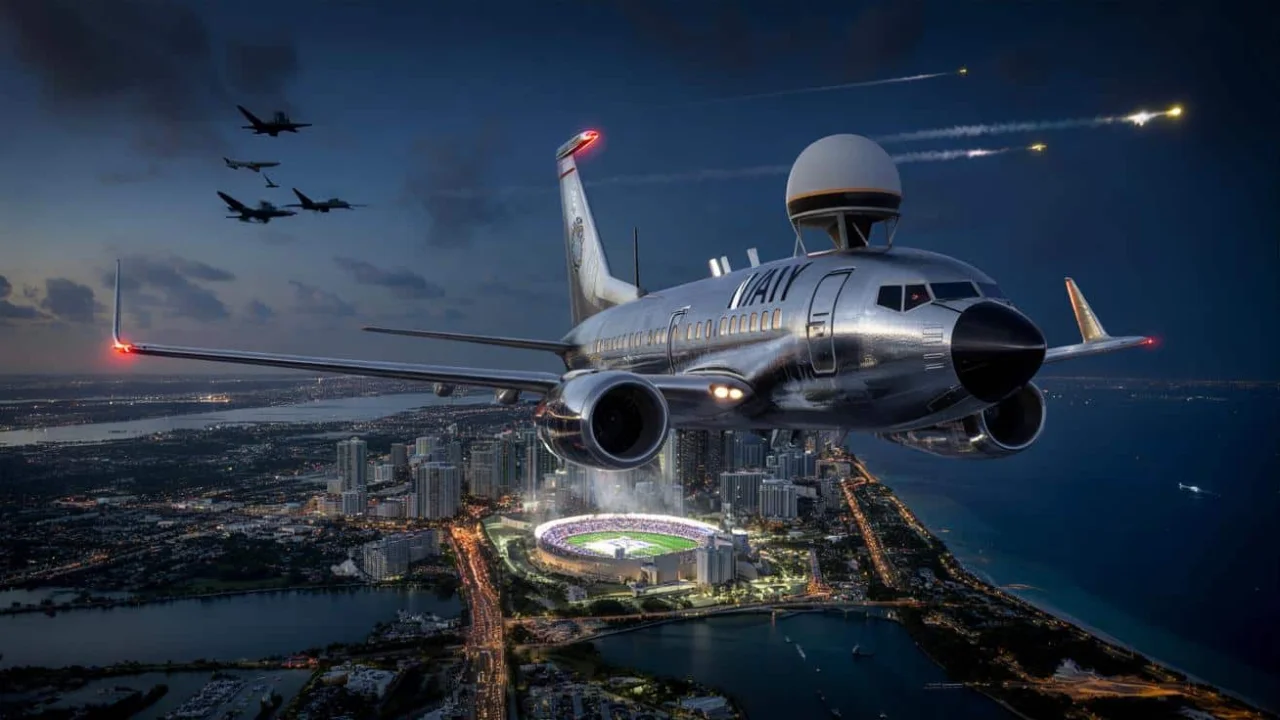
Picture this: You’re settling into your seat at Hard Rock Stadium, ready to watch college football history unfold. The crowd roars as teams take the field, but high above the stadium lights, something extraordinary is happening that most fans will never know about. A massive Navy aircraft is quietly circling overhead, armed not with weapons, but with some of the most advanced surveillance technology on the planet.
That’s exactly what happened during the College Football Playoff National Championship in Miami Gardens. While 65,000 fans cheered below, a U.S. Navy P-8 Poseidon maritime patrol aircraft was performing one of the most unusual presidential protection missions in recent memory.
This wasn’t your typical fighter jet escort. The Navy P-8 Poseidon found itself in a role it rarely plays – guardian angel for the President of the United States.

When Ocean Hunters Become Sky Guardians
The Navy P-8 Poseidon is normally found skimming over ocean waves, hunting submarines and conducting maritime surveillance missions. But on this February evening, U.S. Northern Command pulled one of these aircraft from its usual duties for something completely different – presidential Combat Air Patrol support.
As President Trump and his family enjoyed the championship game between the Indiana Hoosiers and Miami Hurricanes, the Poseidon circled overhead as part of a complex security bubble that few people even knew existed.

“The Navy jet was folded into the presidential security stack not as a fighter, but as a high-end sensor and communications hub,” explained a defense official familiar with the operation.
NORTHCOM confirmed the aircraft was providing “incident awareness assessment” support to the U.S. Secret Service, essentially serving as an airborne command center that could see everything happening for miles around the stadium.
What makes this mission so remarkable is how rarely the Navy P-8 Poseidon gets called for this type of work. Officials noted that using a Poseidon for presidential CAP duties “doesn’t happen very often,” highlighting just how exceptional this assignment was.
Inside the Mission: What Made This Flight Special
The P-8 Poseidon that flew over Miami that night came from Naval Air Station Jacksonville, operating under a military callsign that aircraft trackers quickly spotted. Here’s what made this mission stand out from typical presidential security operations:

| Mission Aspect | Standard CAP | P-8 Poseidon CAP |
|---|---|---|
| Primary Aircraft | Fighter jets (F-16, F-22) | Maritime patrol aircraft |
| Main Capability | Air-to-air combat | Advanced surveillance & communications |
| Mission Duration | 2-3 hours typical | 8+ hours endurance |
| Crew Size | 1-2 pilots | 9-person specialized crew |
| Sensor Package | Basic radar | Multi-spectral surveillance suite |
The key advantages of using a Navy P-8 Poseidon for this mission included:
- Extended flight endurance allowing hours of continuous coverage
- Advanced radar and electro-optical sensors for wide-area surveillance
- Sophisticated communications equipment for coordinating with ground teams
- Large crew capacity for managing complex security scenarios
- Ability to process and relay real-time intelligence data
“Think of it as having a mobile command center in the sky,” said a former Navy pilot familiar with P-8 operations. “While fighters provide the muscle, the Poseidon brings the brains and the eyes.”
The aircraft’s normal maritime patrol sensors, designed to spot submarines and surface vessels across vast ocean areas, proved perfectly suited for monitoring ground activity around the stadium and airspace for potential threats.
Why This Mission Matters Beyond Miami
This unusual deployment of a Navy P-8 Poseidon reveals important shifts in how presidential security adapts to modern threats. The choice to use a maritime patrol aircraft for inland security duties shows military planners thinking creatively about available resources.
The implications extend far beyond one football game. This mission demonstrates how the military can repurpose specialized aircraft for homeland security when needed, potentially changing how future presidential protection operates.
“We’re seeing military units become more flexible in their roles,” noted a defense analyst who tracks aviation security trends. “A submarine hunter becomes a presidential guardian – that adaptability is exactly what modern security demands.”
For the Secret Service, having a Navy P-8 Poseidon overhead provided capabilities that traditional Combat Air Patrol fighters simply can’t match. The aircraft’s ability to simultaneously track multiple ground vehicles, monitor communications, and coordinate with other security assets makes it an ideal aerial command post.
The mission also highlights growing cooperation between different military branches for domestic security. Navy aircraft supporting presidential protection traditionally handled by Air Force units shows how boundaries between service roles continue to blur when national security is at stake.
From a practical standpoint, this deployment proves that unconventional solutions often work best. Rather than pulling fighter jets from other critical missions, commanders found a creative way to enhance security using available resources.
“Sometimes the best tool for the job isn’t the obvious one,” observed a retired Secret Service agent. “A big, slow aircraft with amazing sensors might be exactly what you need over a crowded stadium.”
The success of this mission could lead to more Navy P-8 Poseidon aircraft being called for similar duties in the future, especially for events in coastal areas where these aircraft are already stationed.
As presidential travel becomes increasingly complex, expect to see more innovative uses of military assets. The Navy P-8 Poseidon over Miami might just be the beginning of a new era in aerial security operations.
FAQs
What is a Navy P-8 Poseidon aircraft normally used for?
The P-8 Poseidon is primarily designed for maritime patrol missions, including submarine hunting, surface vessel tracking, and ocean surveillance operations.
How is a P-8 different from typical presidential escort fighters?
Unlike fighter jets built for air combat, the P-8 is a surveillance platform with advanced sensors, longer flight endurance, and larger crew capacity for complex missions.
Why would they use a submarine hunter for presidential security?
The P-8’s sophisticated surveillance equipment and long flight time make it ideal for monitoring large areas and coordinating security operations from the air.
How often do Navy aircraft support presidential protection?
This type of mission is quite rare, with officials noting that using a P-8 for presidential Combat Air Patrol “doesn’t happen very often.”
Could we see more of these unconventional security missions?
Given the success of this operation, military planners may increasingly use specialized aircraft like the P-8 Poseidon for unique homeland security challenges.
How long can a P-8 Poseidon stay airborne compared to fighter jets?
The P-8 can fly for over 8 hours continuously, significantly longer than most fighter aircraft, making it ideal for extended security coverage.
About the Author