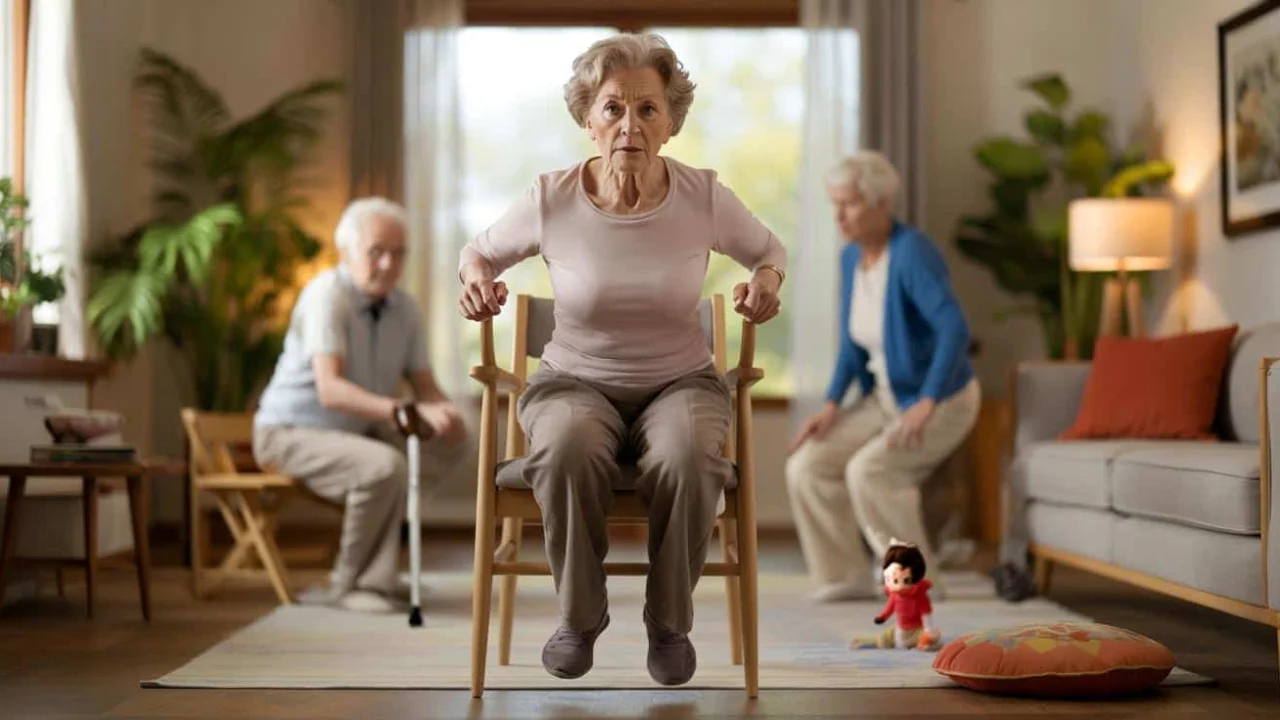
Martha stared at her favorite armchair like it had betrayed her. Just last month, she’d been bouncing up to answer the phone, grab her reading glasses, check on dinner. Now each rise felt like a negotiation between her body and gravity, with gravity winning more often than she cared to admit.

Her daughter noticed during Sunday lunch. “Mom, you’re using your hands to push off the chair every time.” Martha felt her cheeks flush. She hadn’t even realized she was doing it.
That evening, Martha called her doctor. Not about pain or illness, but about a creeping fear that her body was quietly retiring without her permission.

The movement pattern that determines your future independence
Most people over 70 focus on the wrong movements. They count steps, track swimming laps, measure garden hours. All valuable activities, but researchers have discovered something more fundamental: your ability to transition between positions predicts whether you’ll be living independently a decade from now.
The critical movement pattern isn’t about endurance or distance. It’s about control during transitions – sitting to standing, standing to sitting, getting down to the floor, and rising back up. Scientists call these “transition movements,” but they’re really the choreography of daily life.

“We’ve been obsessing over cardio and missing the movements that actually matter for aging,” explains Dr. Sarah Chen, a geriatric physiotherapist who’s spent fifteen years studying mobility in older adults. “A person who can’t get up from a chair without using their hands is already losing their independence, one small compromise at a time.”
The evidence is stark. A landmark Brazilian study followed over 2,000 adults aged 51 to 80, testing their ability to sit on the floor and stand back up using minimal support. Those who struggled with this simple movement pattern had significantly higher mortality rates over the following years, even after accounting for age and existing health conditions.
Why this specific movement pattern matters more than your daily walk
Think about your day. How many times do you need to stand up from sitting? Get out of bed, rise from the breakfast table, exit your car, leave your desk chair, get off the toilet, stand up from your evening armchair. Each transition requires a complex coordination of strength, balance, and joint mobility.
When this movement pattern starts failing, your world begins shrinking in ways you might not immediately notice:

- You avoid restaurants with low chairs or booths
- Air travel becomes stressful because airplane seats feel like traps
- You stop visiting friends with firm couches
- Social invitations get declined more often
- Fear of falling keeps you from activities you once enjoyed
“The sit-to-stand movement is like a master key,” notes physical therapist Dr. James Rodriguez. “It unlocks your ability to participate in life. Lose it, and doors start closing everywhere.”
Here’s what makes transition movements so powerful as health predictors:
| Body System | What Transition Movements Test | Why It Matters |
|---|---|---|
| Leg Muscles | Quadriceps and glute strength | Power to lift your body weight |
| Core Stability | Deep abdominal and back muscles | Control during movement |
| Balance System | Inner ear and proprioception | Prevents falls during transitions |
| Joint Mobility | Hip, knee, and ankle flexibility | Range of motion for full movement |
| Coordination | Brain-body communication | Smooth, controlled movement patterns |
The chair-based training that can add years to your healthspan
The beautiful irony? You can rebuild this crucial movement pattern using the same piece of furniture that’s been quietly testing you every day – your chair.
Start with what researchers call the “assisted sit-to-stand” progression:
- Week 1-2: Sit down and stand up 10 times, using your hands on the armrests for support
- Week 3-4: Same movement, but try to use less pressure on your hands
- Week 5-6: Cross your arms over your chest and stand up without hand support
- Week 7-8: Add a pause – stand up, pause for 2 seconds, sit down slowly
The key is control, not speed. “I tell my patients to think of it as a dance, not a sprint,” says Dr. Rodriguez. “The goal is smooth, controlled movement in both directions.”
For those ready to advance, the floor-to-stand progression offers the next level:
- Start seated on the floor with legs crossed
- Place one hand on the ground for support
- Shift to kneeling position
- Step one foot forward into a lunge
- Push through your front leg to stand
- Reverse the movement to return to the floor
Dr. Chen emphasizes patience: “This isn’t about proving you’re still young. It’s about maintaining the movement patterns that let you stay independent. Some people need months to build up to unassisted floor transitions, and that’s perfectly fine.”
The practice schedule that works best involves short, frequent sessions rather than marathon training. Five minutes of transition movements, three times per day, beats a 45-minute weekly gym session for building functional strength.
Real transformation happens when you start viewing every chair as training equipment. Waiting at the doctor’s office? Practice slow, controlled sits and stands. Watching television? Use commercial breaks for movement practice. The chair becomes your gym, and daily life becomes your training program.
Research shows people who maintain strong transition movements past age 70 preserve their independence an average of 3-5 years longer than those who lose these patterns. That’s not just extra time – it’s extra time on your own terms, in your own home, making your own choices.
Martha, the woman from our opening story, started with chair exercises six months ago. Last week, she got up from a restaurant booth without thinking twice. Her daughter smiled. “Mom, you’re moving like yourself again.”
FAQs
How often should I practice transition movements after age 70?
Start with 5-10 repetitions three times daily, focusing on slow, controlled movement rather than speed or high repetition counts.
Is it safe to practice floor-to-stand movements if I have knee problems?
Begin with chair-based exercises first, and consult your doctor before attempting floor transitions if you have significant joint issues or balance concerns.
How long does it take to see improvement in transition movements?
Most people notice easier chair rising within 2-3 weeks of consistent practice, with significant strength gains appearing after 6-8 weeks.
Can transition movement training replace my regular walking routine?
No, walking provides important cardiovascular benefits, but transition movements train the specific strength and coordination patterns that walking doesn’t address.
What’s the most important transition movement to master first?
The sit-to-stand movement from a standard chair without using your hands is the foundation – master this before progressing to floor-based movements.
Should I be concerned if I need to use my hands to stand up from chairs?
Using hands occasionally is normal, but if you can’t stand from a standard-height chair without hand support, it indicates declining leg strength that benefits from targeted training.
About the Author