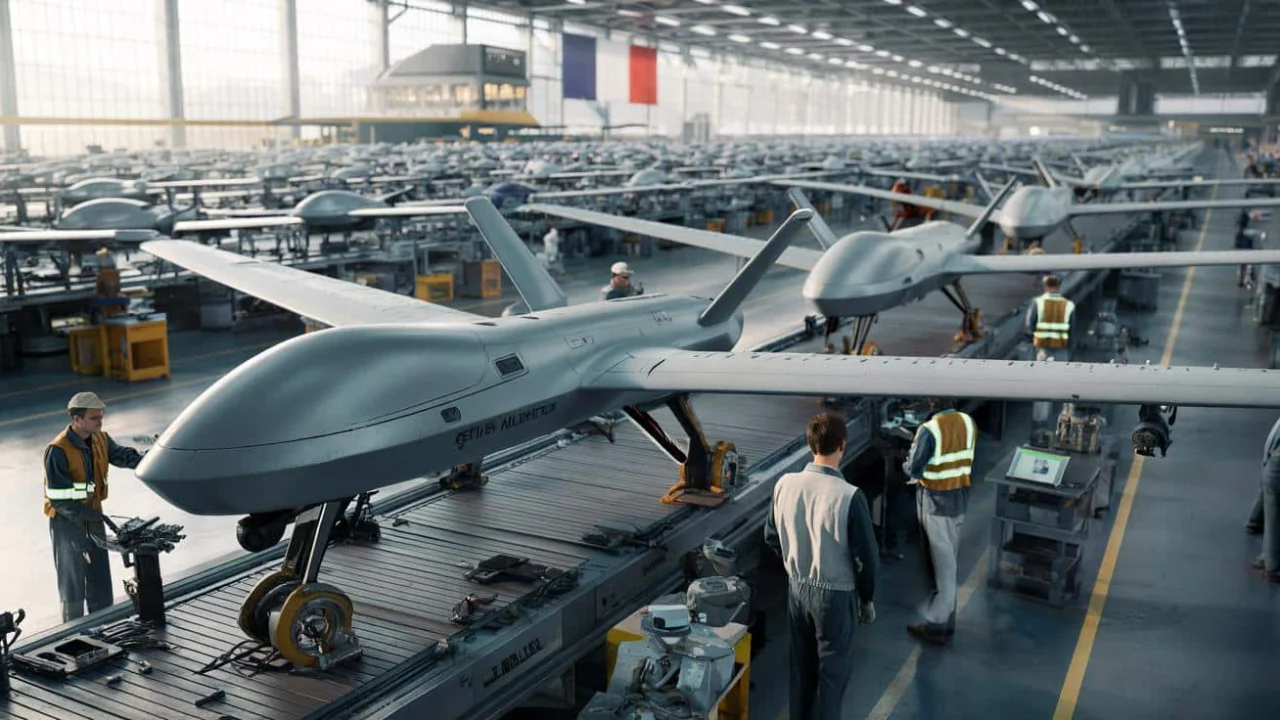
When Marie Dubois first heard that Renault might start making military drones, she laughed out loud. “The same company that built my old Clio is going to make war machines?” she asked her husband over dinner. But as a logistics manager at a French manufacturing plant, Marie quickly realized something deeper was happening.

This wasn’t about Renault suddenly becoming a weapons company. This was about France waking up to a harsh reality: in modern warfare, you need to build military drones the same way you build cars — fast, cheap, and in massive quantities.
The war in Ukraine changed everything. European defense officials watched in shock as both sides burned through thousands of drones in months, not years. Traditional aerospace thinking — where each aircraft takes years to design and costs millions — simply doesn’t work when you need hundreds of military drones delivered next month, not next decade.

Why France Picked a Car Company for Military Drones
Renault’s entrance into military drone manufacturing isn’t as strange as it first sounds. The French government approached the automaker for one simple reason: they know how to build things quickly and affordably at scale.
“We’re not trying to become a defense contractor,” explains a Renault spokesperson familiar with the project. “We’re bringing automotive manufacturing principles to an industry that desperately needs them.”

The Ministry of Armed Forces maintains strategic oversight of the entire program, while the Direction générale de l’armement (DGA) handles technical specifications. Specialist defense firm Turgis & Gaillard designs the actual drone systems. Renault’s job? Turn those designs into thousands of finished military drones using assembly line efficiency.
Think about it this way: Renault produces over 2.5 million vehicles annually across their global factories. They understand supply chains, quality control at volume, and how to keep costs reasonable. These are exactly the skills France needs to build military drones that cost thousands, not millions.

The shift represents a fundamental change in defense thinking. Instead of building a few hundred extremely sophisticated drones, France wants thousands of capable ones that can be replaced quickly in combat.
Breaking Down France’s Military Drone Strategy
The new approach touches every aspect of how France thinks about military drones. Here’s what makes this program different:

- Volume over perfection: Prioritizing quantity and rapid replacement over ultra-advanced systems
- Automotive supply chains: Using car industry suppliers for non-sensitive components
- Standardized production: Assembly line techniques instead of artisanal aerospace manufacturing
- Cost targets: Aiming for drone costs closer to vehicles than aircraft
- Rapid scaling: Ability to increase production quickly during conflicts
| Traditional Defense Manufacturing | Renault’s Automotive Approach |
|---|---|
| Years of development | Months to market |
| Hundreds of units annually | Thousands of units monthly |
| Millions per unit | Tens of thousands per unit |
| Specialized suppliers only | Mix of defense and automotive suppliers |
| Hand-built quality | Consistent automated quality |
“The automotive industry solved mass production decades ago,” notes a French defense analyst who requested anonymity. “Why reinvent the wheel when you can adapt proven systems?”
The military drones themselves won’t be cutting-edge marvels of engineering. Instead, they’ll be reliable, standardized platforms that troops can deploy without worrying about losing expensive equipment. This mirrors how Ukraine has successfully used relatively simple commercial drones modified for military purposes.
What This Means for European Defense
Renault’s move into military drones signals a broader shift across European defense industries. Other automotive companies are quietly exploring similar partnerships, recognizing that future conflicts will consume equipment at unprecedented rates.
For workers, this creates interesting opportunities. Factory technicians who currently install car dashboards might soon be assembling drone navigation systems. The skills transfer more easily than you might expect.
“My team already works with complex electronic systems, quality control, and tight production schedules,” explains a supervisor at a Renault plant in northern France. “Whether it’s a car or a drone, manufacturing discipline stays the same.”
The broader implications stretch beyond France. If successful, this model could reshape how European nations approach defense manufacturing. Instead of relying on traditional aerospace giants for everything, countries might start mixing automotive expertise into their military production.
European allies are watching closely. The program could influence similar initiatives across NATO countries, particularly as defense budgets increase and the need for rapid military drone production becomes more urgent.
From a taxpayer perspective, the automotive approach promises better value. Instead of paying aerospace premiums for military drones, governments could access automotive pricing for comparable capabilities. This matters when you need to replace thousands of units consumed in modern conflicts.
“We’re essentially industrializing warfare preparation,” explains a French military procurement official. “The goal is having production capacity that can surge when needed, not just peacetime manufacturing.”
The partnership also addresses European concerns about defense independence. By combining French automotive manufacturing with domestic defense expertise, the program reduces reliance on foreign military drone suppliers while building sovereign capabilities.
FAQs
Is Renault really building weapons now?
No, Renault is providing manufacturing and assembly expertise for military drones, but the weapons systems and strategic control remain with defense specialists.
How many military drones will Renault help produce?
Specific numbers haven’t been disclosed, but the program aims for automotive-scale production measured in thousands rather than hundreds of units.
Will this affect Renault’s car production?
The military drone manufacturing uses separate facilities and doesn’t impact regular vehicle production lines.
Are other car companies doing similar military drone projects?
Several European automotive manufacturers are exploring defense partnerships, though Renault’s program appears to be the most advanced publicly.
How much will these military drones cost?
The goal is significantly reducing per-unit costs compared to traditional military aircraft, though exact pricing remains classified.
When will the first Renault-manufactured military drones be ready?
Production timelines haven’t been announced, but the automotive approach aims for much faster deployment than traditional defense manufacturing.
About the Author