Sarah Mitchell was thrilled when the fibre broadband engineer knocked on her London flat door last year. Finally, after months of sluggish internet speeds, she’d have lightning-fast connectivity for her work-from-home job. The installation seemed smooth, cables were laid, and for a while, everything worked perfectly.

Then her connection started cutting out randomly. Customer service calls led nowhere. Bills kept arriving even when the service barely functioned. What Sarah didn’t know was that deep beneath London’s streets, an army of rats had been systematically destroying the very cables that promised to revolutionize her digital life.
Now she’s one of 25,000 customers caught in the crossfire of one of the most unusual corporate collapses in recent memory – a London fibre firm brought down not by market forces or financial mismanagement, but by hungry rodents with a taste for soy-based cable coatings.

When Due Diligence Reveals a Nightmare Underground
G.Network looked like a textbook rescue story waiting to happen. The London fibre firm had ambitious plans, decent customer numbers, and a rival company ready to swoop in with a takeover deal. Community Fibre, another broadband operator, saw an opportunity to expand rapidly across the capital by absorbing G.Network’s infrastructure and customer base.
The numbers seemed manageable. G.Network carried debts of around £300 million, but its fibre network covered valuable London territory. For Community Fibre, acquiring those assets could accelerate growth in one of Europe’s most competitive broadband markets.

“We thought this would be a straightforward acquisition,” explained Graeme Oxby, Community Fibre’s chief executive. “On paper, the network looked solid and the customer base was exactly what we needed.”
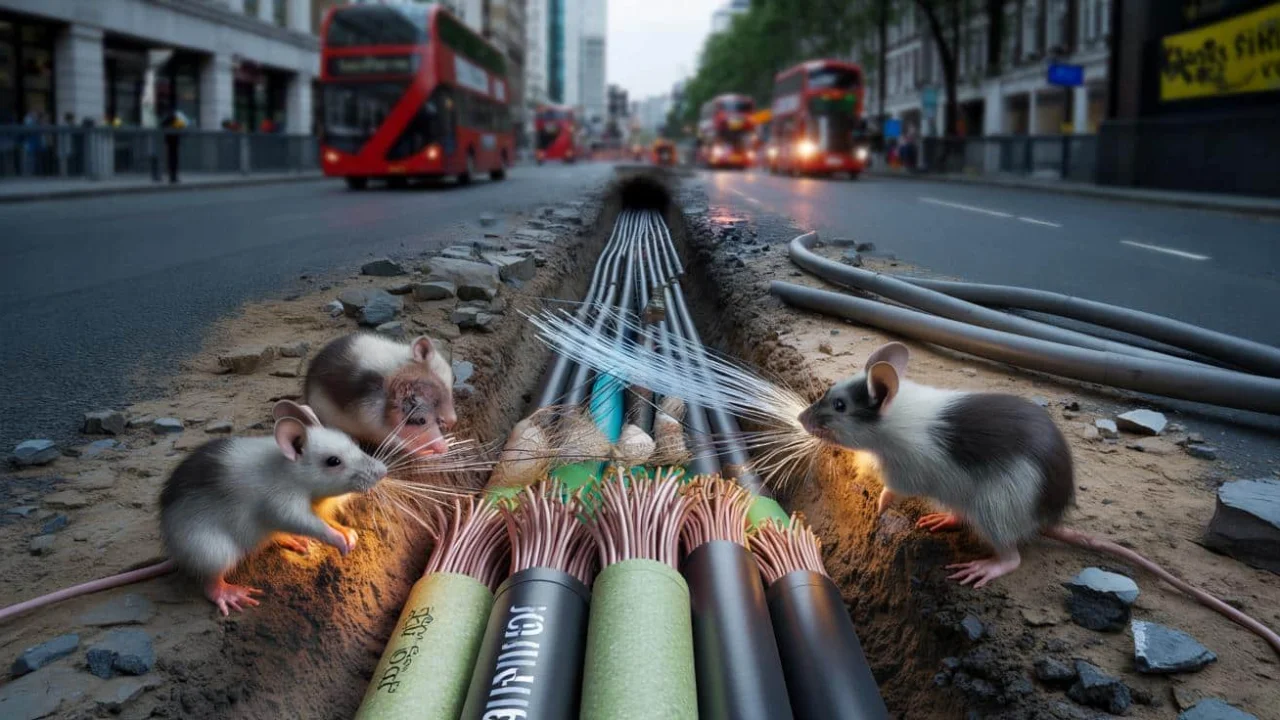
But when Community Fibre’s engineers descended into London’s underground infrastructure for technical due diligence, they discovered something that transformed a promising deal into a costly nightmare. Large sections of G.Network’s fibre cables had been systematically chewed through by rats, leaving behind what one engineer described as “a gnawed, half-rotten mess.”

The damage wasn’t isolated to a few problem areas. Rodents had attacked the network so extensively that any buyer would inherit not just a telecommunications system, but a massive reconstruction project spanning some of London’s busiest and most expensive streets.
The Soy Cable Problem That Nobody Saw Coming
Rat damage to cables isn’t new in the telecommunications world. Power companies and internet providers have dealt with rodent problems for decades. What made G.Network’s situation particularly severe was a construction choice that seemed smart at the time but created an irresistible buffet for London’s rat population.

Many modern fibre cables use soy-based materials in their protective coatings. This environmentally friendly approach reduces petroleum-based plastics and appeals to companies wanting to improve their green credentials. The problem? Rats find soy-based coatings absolutely delicious.
Here’s how the disaster unfolded:
- G.Network chose soy-based cable coatings for environmental reasons
- London’s extensive rat population discovered the tasty underground snacks
- Rodents systematically worked through miles of fibre infrastructure
- Damage occurred in hard-to-access underground locations
- Repairs would require extensive street excavation and traffic disruption
“The rats basically turned our network into their personal dining experience,” said one former G.Network engineer who asked not to be named. “Every time we fixed one section, they’d move on to the next.”
| Impact Area | Details |
|---|---|
| Customers Affected | Approximately 25,000 broadband users |
| Company Debt | £300 million owed to creditors |
| Infrastructure Damage | Extensive rat damage across London network |
| Repair Costs | Millions required for street excavation and replacement |
| Deal Status | Community Fibre acquisition cancelled |
What This Means for London’s Digital Future
The collapse of this takeover deal sends ripples far beyond G.Network’s immediate troubles. London’s fibre broadband market is fiercely competitive, with multiple providers racing to connect homes and businesses across the capital. When one major player stumbles, it affects everyone.
For G.Network’s 25,000 customers, the immediate concern is service continuity. The company remains in administration, meaning their internet connections could disappear if no alternative buyer emerges. Many customers have already started shopping for new providers, but switching isn’t always straightforward.
“We’re seeing increased inquiries from people trying to escape the G.Network situation,” confirmed a customer service representative from a rival London fibre firm. “But depending on their location, we might not have coverage in their area yet.”
The broader industry is also taking notes. Other fibre providers are reassessing their cable choices and construction methods. The environmental benefits of soy-based materials must now be weighed against the very real risk of creating rat-friendly infrastructure.
Construction practices are likely to change too. Some companies are exploring rat-resistant cable designs, while others are investing in better protective conduits and more frequent infrastructure inspections.
For London’s ambitious digital infrastructure goals, this represents a significant setback. The city has been pushing to become Europe’s best-connected capital, but major network failures like this highlight how even the most modern technology can be undone by age-old urban problems.
“This situation shows that you can have the most advanced fibre technology in the world, but if you don’t account for London’s four-legged residents, your network won’t survive,” observed telecommunications analyst David Chen. “It’s a lesson every infrastructure company will need to learn from.”
The story of G.Network serves as an expensive reminder that in the complex world of urban infrastructure, sometimes the smallest problems can bring down the biggest plans. As London continues building its digital future, the question isn’t just what technology to use, but how to protect it from the city’s hungriest inhabitants.
FAQs
What happened to G.Network’s takeover deal?
Community Fibre cancelled their acquisition after discovering extensive rat damage to G.Network’s underground fibre cables.
Why did rats target these particular cables?
G.Network used environmentally friendly soy-based cable coatings that rats found appetizing, leading to systematic damage across the network.
How many customers are affected by this situation?
Approximately 25,000 G.Network broadband customers face uncertainty about their internet service continuity.
Will other London fibre firms change their cable types?
Industry experts expect providers to reassess their cable materials and invest in better rat-resistant infrastructure.
How much would it cost to repair the damaged network?
Repairs would require millions of pounds for street excavation and cable replacement across busy London locations.
Is rat damage to cables a common problem?
Yes, but G.Network’s case is unusually severe due to the combination of soy-based materials and London’s large rat population.
About the Author
