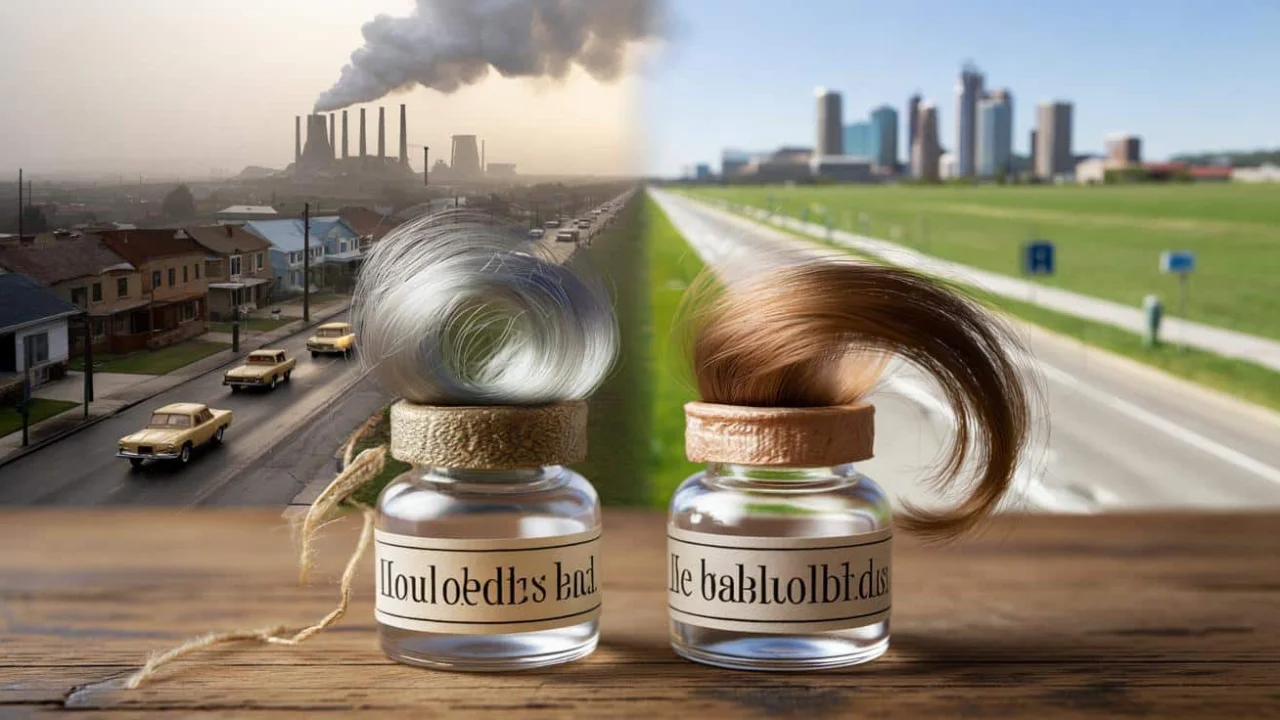
Margaret opens the weathered family album, her fingers tracing over a small envelope tucked between yellowed photographs. Inside lies a soft curl of baby hair, saved by her grandmother nearly 80 years ago. It’s a sweet keepsake that connects her to family history, but this tiny lock holds a darker secret than she ever imagined.

That precious strand of hair carries within it a troubling record of just how toxic everyday life was during the mid-20th century. What Margaret’s grandmother couldn’t have known is that this innocent memento would one day reveal the shocking extent of lead poisoning that defined an entire generation.
Scientists have just completed a groundbreaking study that transforms these family treasures into powerful evidence of how drastically lead exposure in the 20th century shaped public health. The findings paint a sobering picture of an era when toxic metals were woven into the fabric of daily life.

When Baby Hair Becomes Scientific Evidence
Researchers from the University of Utah made an unusual request to local residents: bring us your old baby hair. Not the kind of call most people expect, but 47 volunteers responded with something extraordinary. Each person had preserved locks of their own infant hair, carefully saved by loving parents and grandparents, plus they provided fresh hair samples from today.
The team used advanced mass spectrometry to measure lead concentrations in each strand, essentially turning these keepsakes into time machines. Hair acts like a natural archive, slowly absorbing metals from the environment as it grows, creating a permanent record of what people were breathing and ingesting decades ago.

“What we found was absolutely staggering,” explains Dr. Sarah Johnson, an environmental health researcher. “Lead levels in hair from early and mid-20th century Utah were, on average, about 100 times higher than they are today.”
That dramatic difference tells the story of how environmental regulations and industrial changes literally transformed what flows through our bodies. The research, published in PNAS, offers rare personal-scale evidence of how policy decisions reshape public health across generations.

The Hidden Dangers That Surrounded Our Grandparents
To understand how severe lead exposure was in the 20th century, you have to picture a world where this toxic metal was everywhere. Lead seemed like a miracle material – soft, moldable, and resistant to corrosion. Industries embraced it enthusiastically, weaving it into countless products that surrounded families every day.
The Utah study reveals just how intense that exposure became. From 1916 through the late 1960s, residents carried extraordinary lead burdens in their bodies. Two major sources drove these dangerous levels:

- Leaded gasoline: Every car and truck burned fuel containing tetraethyl lead, spewing toxic particles into neighborhood air
- Industrial smelters: Local lead processing plants pumped continuous streams of contaminated dust and fumes across communities
- Lead paint: Homes, schools, and playgrounds were coated with lead-based paints that chipped and created toxic dust
- Plumbing systems: Lead pipes and solder contaminated drinking water supplies throughout cities
- Consumer products: Everything from toys to cosmetics contained lead compounds
“Children playing in backyards during the 1940s and 50s were essentially growing up in a lead-contaminated environment,” notes Dr. Michael Chen, a pediatric toxicologist. “The levels we’re seeing in these hair samples would trigger immediate medical intervention today.”
| Time Period | Average Hair Lead Levels | Primary Sources |
|---|---|---|
| 1916-1940 | 50-80 times current levels | Early leaded gasoline, industrial emissions |
| 1940-1970 | 80-120 times current levels | Peak gasoline use, widespread lead products |
| 1970-1990 | 20-40 times current levels | Phasing out gasoline, remaining paint/pipes |
| 1990-Present | Current baseline | Regulatory controls, clean alternatives |
Leaded gasoline represented perhaps the most widespread source of contamination. Introduced in the 1920s to prevent engine knocking, this fuel additive immediately raised health alarms among doctors and scientists. Despite early warnings about worker poisonings and community health effects, leaded fuel remained standard until 1996.
The Legacy That Still Affects Families Today
The implications of severe lead exposure in the 20th century extend far beyond historical curiosity. Lead is a potent neurotoxin that affects brain development, cognitive function, and behavior. Children are especially vulnerable because their developing nervous systems absorb lead more readily and suffer more severe damage.
Families who lived through the peak lead exposure decades may still be dealing with consequences today. Research links childhood lead exposure to:
- Reduced IQ and learning disabilities
- Attention and behavioral problems
- Increased aggression and impulsivity
- Higher rates of criminal behavior in adulthood
- Cardiovascular problems later in life
“We’re essentially looking at a multigenerational public health crisis that was largely invisible at the time,” explains Dr. Lisa Rodriguez, an epidemiologist studying environmental health patterns. “These hair samples give us concrete proof of just how contaminated daily life was for our parents and grandparents.”
The Utah study also reveals how effective environmental regulations can be when properly implemented. The dramatic decline in lead levels coincides closely with major policy changes: the Clean Air Act of 1970, the phase-out of leaded gasoline, and restrictions on lead paint and plumbing materials.
Modern children face lead levels that are roughly 100 times lower than what their great-grandparents experienced. That represents one of the most successful public health interventions in American history, even though many communities still struggle with legacy contamination from old paint and soil.
The research also highlights ongoing environmental justice concerns. Communities near former industrial sites, older housing stock, and areas with aging infrastructure continue to face disproportionate lead exposure risks. Understanding historical patterns helps identify where current problems might persist.
“These family keepsakes have become powerful tools for understanding how environmental policy translates into real health outcomes,” notes Dr. Johnson. “They show us both how bad things were and how much progress we’ve made.”
FAQs
How accurate is hair testing for measuring lead exposure?
Hair testing provides a reliable indicator of lead exposure over the months when the hair was growing, making it excellent for tracking historical exposure patterns.
Why was lead used so widely if it was known to be dangerous?
Lead’s useful properties and industrial applications outweighed health concerns for decades, and the full extent of low-level lead toxicity wasn’t well understood until later research.
Are there still sources of lead exposure today?
Yes, though much reduced. Old paint in pre-1978 homes, some imported products, contaminated soil, and aging water pipes remain potential sources.
How can families test for current lead exposure?
Blood tests are the standard method for detecting current lead exposure, while hair testing can show exposure over recent months.
What areas had the worst lead contamination in the 20th century?
Urban areas with heavy traffic, neighborhoods near smelters or other lead industries, and communities with older housing typically had the highest exposure levels.
Can lead exposure effects be reversed?
While some health effects of lead exposure are permanent, especially in children, removing ongoing sources and proper medical care can prevent additional damage and support recovery.
About the Author