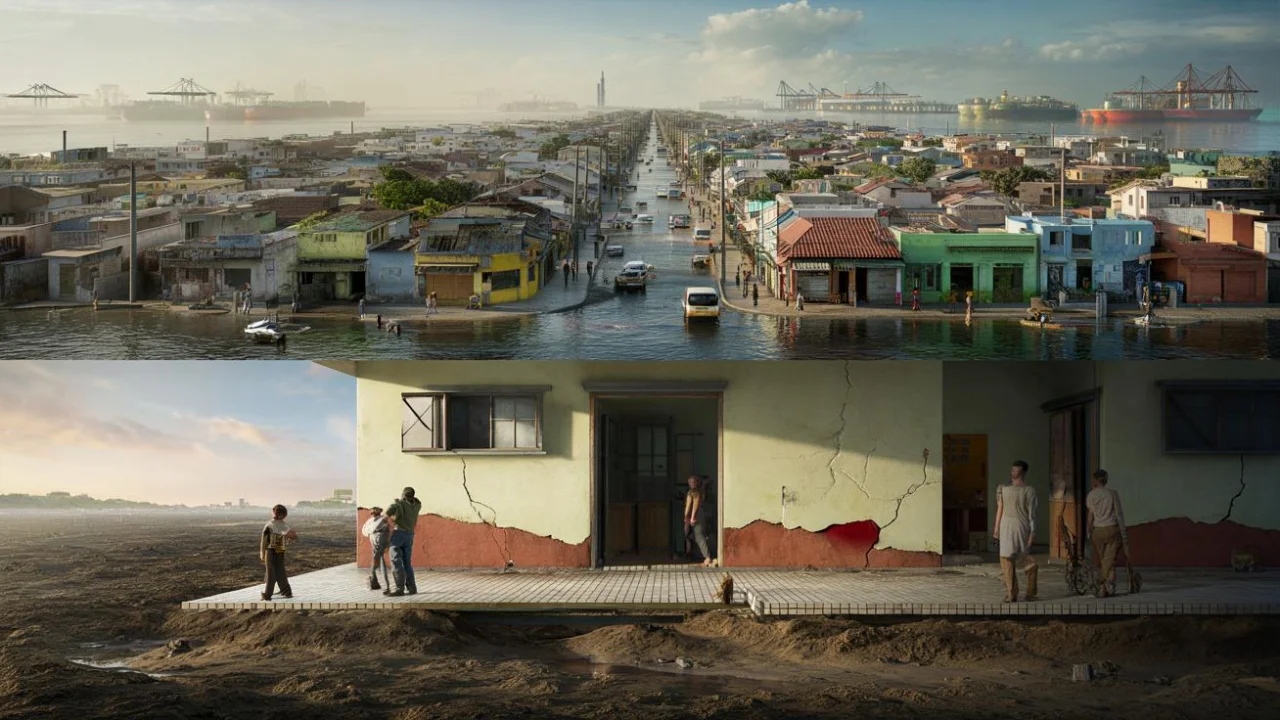
Maria Gonzalez noticed it first in her kitchen sink. The water didn’t drain quite right anymore, pooling slightly before disappearing down the pipes. Her house in Long Beach, California, had been perfect when she bought it fifteen years ago. Now, subtle cracks spider-webbed across her bathroom tiles, and the front door stuck every morning.

What Maria didn’t know was happening beneath her neighborhood. Miles underground, engineers were fighting a battle against gravity itself, pumping millions of gallons of water back into depleted oil fields that had been drained decades earlier. This wasn’t about oil anymore – it was about keeping her house, and thousands like it, from sinking into the earth.
Across the globe, this same quiet drama plays out beneath some of our largest cities, where land subsidence threatens millions of people’s homes, infrastructure, and livelihoods.

The invisible crisis beneath our feet
Land subsidence happens when the ground literally sinks. Think of it like a deflating balloon – when you remove what’s inside, the structure collapses inward. For decades, we’ve been pulling oil, gas, and groundwater from beneath major cities without thinking much about what would fill those empty spaces.
“The ground beneath cities isn’t solid rock like most people imagine,” explains Dr. Sarah Mitchell, a geological engineer who has studied subsidence in California for over two decades. “It’s more like a sponge filled with fluid. Remove the fluid, and the sponge compresses.”

Cities like Houston, Long Beach, Jakarta, and Mexico City have been sinking at alarming rates. Some areas of Jakarta drop by as much as 25 centimeters per year – fast enough that you could measure the change with a ruler if you waited long enough.
The consequences aren’t just academic. Roads crack and become impassable. Buildings develop structural problems. Flood-prone areas become even more vulnerable as the land drops closer to sea level. In coastal cities, this creates a double threat: the land sinks while sea levels rise.

Fighting gravity with water injection
The solution sounds almost too simple: pump water back into the ground. But like most engineering challenges, the devil lives in the details.
Water injection, or aquifer recharge, works by replacing the volume that was removed. Engineers identify depleted oil and gas fields, then systematically pump treated water back into those underground spaces. The goal is to restore enough underground pressure to prevent further sinking.

Here’s how different cities are tackling the problem:
- Long Beach, California: Started water injection in the 1950s after the city sank nearly 9 feet in some areas
- Houston, Texas: Implemented groundwater regulation and aquifer recharge programs in the 1970s
- Venice, Italy: Stopped groundwater pumping and began industrial water injection to stabilize the city
- Shanghai, China: Combines groundwater restrictions with strategic water injection in critical areas
| City | Maximum Subsidence Rate | Water Injection Start Date | Current Status |
|---|---|---|---|
| Long Beach, CA | 66 cm/year (1940s) | 1958 | Stabilized |
| Houston, TX | 7-10 cm/year | 1970s | Significantly reduced |
| Venice, Italy | 2-3 cm/year | 1970s | Mostly stopped |
| Jakarta, Indonesia | 25 cm/year | Limited programs | Still sinking |
The process requires careful monitoring and massive infrastructure. “You can’t just drill a hole and start pumping,” notes Dr. Mitchell. “You need to understand the geology, monitor pressure changes, and ensure the injected water is clean enough not to contaminate groundwater supplies.”
Why some cities succeed while others keep sinking
The success stories share common elements: early recognition of the problem, political will to act, and sufficient funding for long-term operations. Long Beach’s water injection program costs millions of dollars annually, but it’s prevented billions in damage.
“The key is catching it early,” says Roberto Chen, an infrastructure engineer who has worked on subsidence projects in three countries. “Once the ground compacts significantly, you can’t uncompress it – you can only prevent further sinking.”
Cities that act quickly see dramatic results. Houston reduced its subsidence rate from several inches per year to less than one inch in most areas. Venice essentially stopped sinking by the 1990s after decades of careful groundwater management.
But success requires sustained commitment. Water injection isn’t a one-time fix – it’s an ongoing process that cities must maintain indefinitely. The moment you stop, the sinking can resume.
Jakarta illustrates what happens when action comes too late or too little. Despite some water injection programs, the city continues sinking rapidly because groundwater extraction hasn’t been adequately controlled, and injection efforts haven’t matched the scale of the problem.
The human cost is enormous. In Jakarta alone, millions of people face flooding, damaged infrastructure, and the eventual possibility of relocating entire neighborhoods. The economic impact runs into billions of dollars when you factor in property damage, infrastructure repair, and business disruption.
“People don’t think about the ground beneath their feet until it starts moving,” observes Dr. Mitchell. “But subsidence affects everything – from the pipes carrying your water to the foundation holding up your house.”
Climate change adds another layer of urgency. As sea levels rise and extreme weather becomes more common, sinking cities become exponentially more vulnerable to flooding and storm damage.
The engineering challenge continues to evolve. New monitoring technologies allow more precise measurement of ground movement. Advanced modeling helps predict which areas are most at risk. Some cities are experimenting with different types of injection fluids and innovative delivery systems.
For homeowners like Maria Gonzalez, the water injection happening beneath Long Beach means her sinking problems will likely stabilize rather than worsen. Her house may never return to its original level, but the careful work of engineers underground has probably saved her from much more serious damage.
The lesson is clear: when we take something from the ground, we need to consider putting something back. The cities that learned this early are still standing strong. Those that didn’t are racing against time – and gravity – to catch up.
FAQs
What causes land subsidence in cities?
Land subsidence occurs when fluids like oil, gas, or groundwater are extracted from underground, causing the ground to compress and sink.
How fast can cities sink?
It varies dramatically – some areas sink millimeters per year while others like parts of Jakarta can drop 25 centimeters annually.
Can water injection completely stop subsidence?
Water injection can prevent further sinking but cannot reverse damage already done. The key is early intervention.
Is water injection expensive?
Yes, programs cost millions annually, but this is far less than the billions in damage prevented by stopping subsidence.
Which cities have successfully used water injection?
Long Beach, Houston, Venice, and Shanghai have all seen significant success with water injection programs.
How do engineers monitor if the treatment is working?
They use satellite monitoring, ground-based sensors, and regular surveys to measure ground elevation changes with millimeter precision.
About the Author