Imagine trying to catch raindrops with a butterfly net in a thunderstorm. That’s roughly what physicists have been attempting for decades when hunting neutrinos—those ghostly particles that zip through your body by the billions every second without you noticing.

Now picture that same impossible task, but suddenly your net becomes a massive underground sphere that can actually see those raindrops. That’s exactly what’s happening 700 meters beneath a mountain in southern China, where scientists have just achieved something remarkable.
The breakthrough comes from the JUNO neutrino detector, and the results are already turning heads in the physics community. After just 59 days of operation, this underground giant has delivered measurements so precise they’re rewriting decades of research.

When Ghost Particles Finally Reveal Their Secrets
The Jiangmen Underground Neutrino Observatory—JUNO for short—represents one of humanity’s most ambitious attempts to understand the invisible universe around us. These neutrinos are everywhere, streaming from the sun, nuclear reactors, and cosmic events, yet they interact so rarely with matter that they’ve earned the nickname “ghost particles.”
“In less than two months, JUNO has refined numbers that took half a century of global effort to pin down,” explains Dr. Sarah Chen, a particle physicist not involved with the project. “It’s like going from using a magnifying glass to having a super-powered microscope.”

The JUNO neutrino detector focuses specifically on how neutrinos “oscillate”—essentially changing their identity as they travel through space. This phenomenon proves that neutrinos have mass, something the Standard Model of physics never predicted. It’s like discovering that ghosts actually have weight.
What makes these early results so stunning is their precision. The detector has already produced the most accurate measurements of key neutrino mixing parameters, surpassing experiments that ran for decades with combined global efforts.

Inside the Underground Marvel That’s Changing Physics
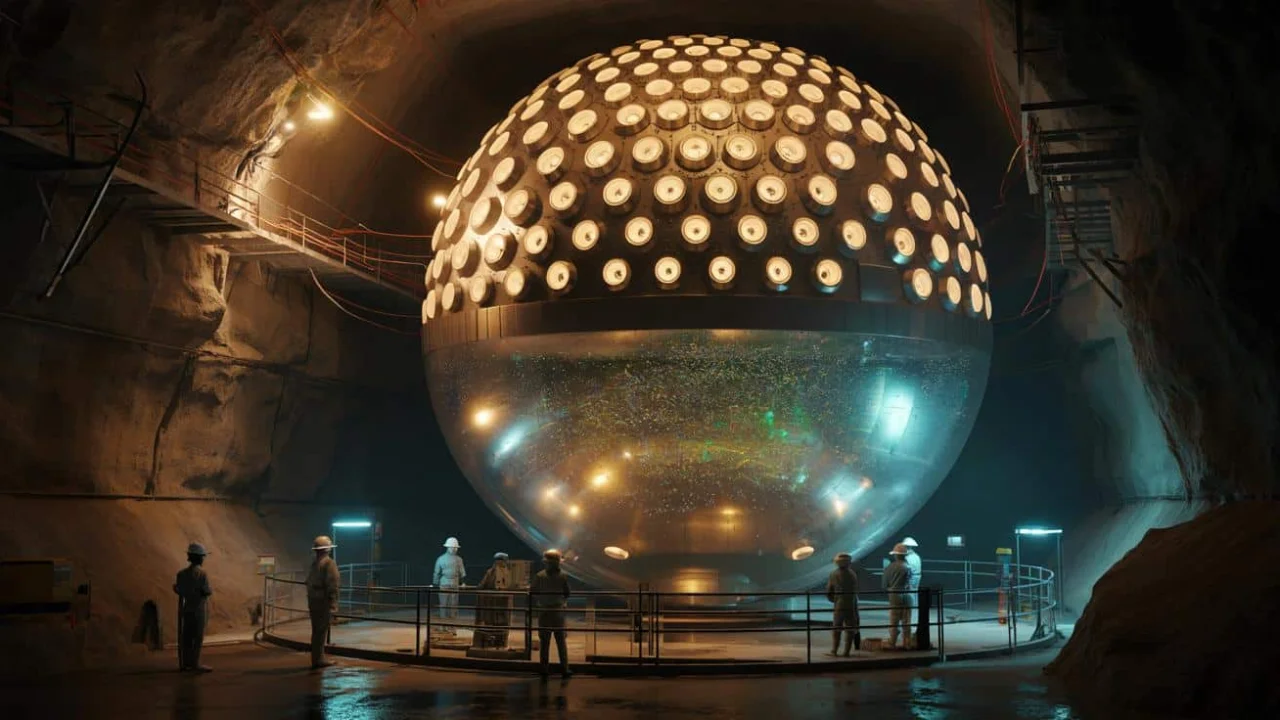
The scale of the JUNO neutrino detector is genuinely breathtaking. Picture a sphere roughly the size of a 12-story building, filled with 20,000 metric tons of special liquid, all buried deep underground to shield it from cosmic interference.
Here’s what makes this detector so revolutionary:

- Location: 700 meters underground near Jiangmen in Guangdong province
- Size: 35-meter diameter spherical tank
- Detection medium: 20,000 tons of liquid scintillator
- Sensors: Thousands of photomultiplier tubes lining the sphere’s interior
- Purpose: Detecting tiny flashes of light when neutrinos collide with atomic nuclei
| Specification | JUNO Details |
|---|---|
| Depth | 700+ meters underground |
| Detector Volume | 20,000 metric tons |
| Detection Method | Scintillation light capture |
| Data Collection Period | 59 days (first results) |
| Primary Target | Reactor neutrinos |
| Key Achievement | Most precise neutrino mixing measurements |
The detection process itself sounds almost magical. When a neutrino—traveling at nearly the speed of light—strikes an atomic nucleus in the liquid scintillator, it creates a tiny flash of light. Thousands of sensitive detectors capture this flash, measuring its timing and intensity to reconstruct exactly what happened.
“The principle is simple: ghostly neutrinos make real flashes, and enough flashes begin to tell a cosmic story,” notes Dr. Michael Rodriguez, a theoretical physicist. “But the engineering required to make this work is absolutely extraordinary.”
What sets JUNO apart from other neutrino detectors is its strategic location. Positioned roughly 53 kilometers from two nuclear power plants, it receives a steady stream of reactor neutrinos—perfect subjects for studying neutrino oscillations with unprecedented precision.
Why These Invisible Particles Could Reshape Our Reality
The implications of JUNO’s early success extend far beyond academic curiosity. These measurements are laying groundwork for discoveries that could fundamentally alter our understanding of the universe.
Neutrinos hold keys to some of the biggest mysteries in physics. Why does the universe contain more matter than antimatter? What is dark matter made of? How do stars really work? The answers might be hidden in the behavior of these elusive particles.
The detector’s remarkable precision opens doors to testing theories beyond the Standard Model—our current best description of particle physics. Scientists suspect this model is incomplete, and neutrino studies represent one of the most promising paths toward new physics.
“We’re potentially looking at a portal to physics beyond what we currently understand,” explains Dr. Lisa Zhang, a neutrino researcher. “Every improvement in precision brings us closer to discoveries that could revolutionize science.”
For the broader scientific community, JUNO’s success demonstrates how international collaboration and massive engineering projects can yield breakthrough results remarkably quickly. The detector represents years of planning, construction, and testing by teams from multiple countries.
The research team has submitted their findings to Chinese Physics C for peer review, while also posting preliminary results on the physics preprint server arXiv. While the current data align with existing theoretical predictions, the level of precision achieved sets the stage for future measurements that might reveal unexpected phenomena.
Looking ahead, JUNO will continue collecting data for years, potentially uncovering subtle effects that could point toward new fundamental physics. Each neutrino detection adds another piece to the cosmic puzzle, bringing us closer to understanding the invisible forces that shape our universe.
The success of the JUNO neutrino detector proves that sometimes the most profound discoveries come from studying the most elusive phenomena. In this case, catching ghost particles might just illuminate the deepest secrets of reality itself.
FAQs
What exactly are neutrinos and why are they important?
Neutrinos are extremely small particles that rarely interact with matter, passing through your body billions of times per second without you noticing. They’re important because they provide insights into fundamental physics and cosmic processes.
How does the JUNO detector actually catch neutrinos?
JUNO uses 20,000 tons of liquid scintillator that produces tiny flashes of light when neutrinos collide with atomic nuclei. Thousands of sensors detect these flashes to reconstruct what happened.
Why is JUNO buried so deep underground?
The 700+ meters of rock above the detector blocks cosmic rays and other particles that would create background noise, allowing scientists to detect the extremely rare neutrino interactions.
What makes JUNO’s results so significant compared to other experiments?
JUNO achieved the most precise measurements of neutrino properties in just 59 days, surpassing decades of combined work from multiple other experiments worldwide.
Could these discoveries lead to practical applications?
While the research is fundamental science, better understanding of neutrinos could eventually lead to advances in nuclear energy, medical imaging, and our understanding of stellar processes.
How long will JUNO continue operating?
JUNO is designed for long-term operation and will continue collecting data for years, with scientists expecting even more precise measurements and potential breakthrough discoveries.
About the Author