Picture this: you’re sitting in your backyard on a clear night, looking up at the stars, when suddenly you realize that somewhere out there, a visitor from another star system is putting on one final spectacular show before disappearing forever into the cosmic void. That visitor isn’t some science fiction fantasy—it’s very real, and NASA just captured something extraordinary.

This cosmic traveler goes by the name 3I/ATLAS, and it’s what scientists call an interstellar visitor comet. Unlike the comets we’re used to seeing, which orbit our Sun in predictable patterns, this one came from somewhere completely different—another star system entirely. And now, as it makes its exit from our solar neighborhood, it’s giving us a breathtaking farewell performance that has astronomers absolutely mesmerized.
The timing couldn’t be more perfect. Just as this ancient wanderer prepares to leave our solar system forever, NASA’s advanced space telescope technology caught it in the act of doing something spectacular—flaring up with unexpected brightness and activity that’s teaching us incredible things about what lies beyond our cosmic backyard.

When Space Visitors Put on a Show
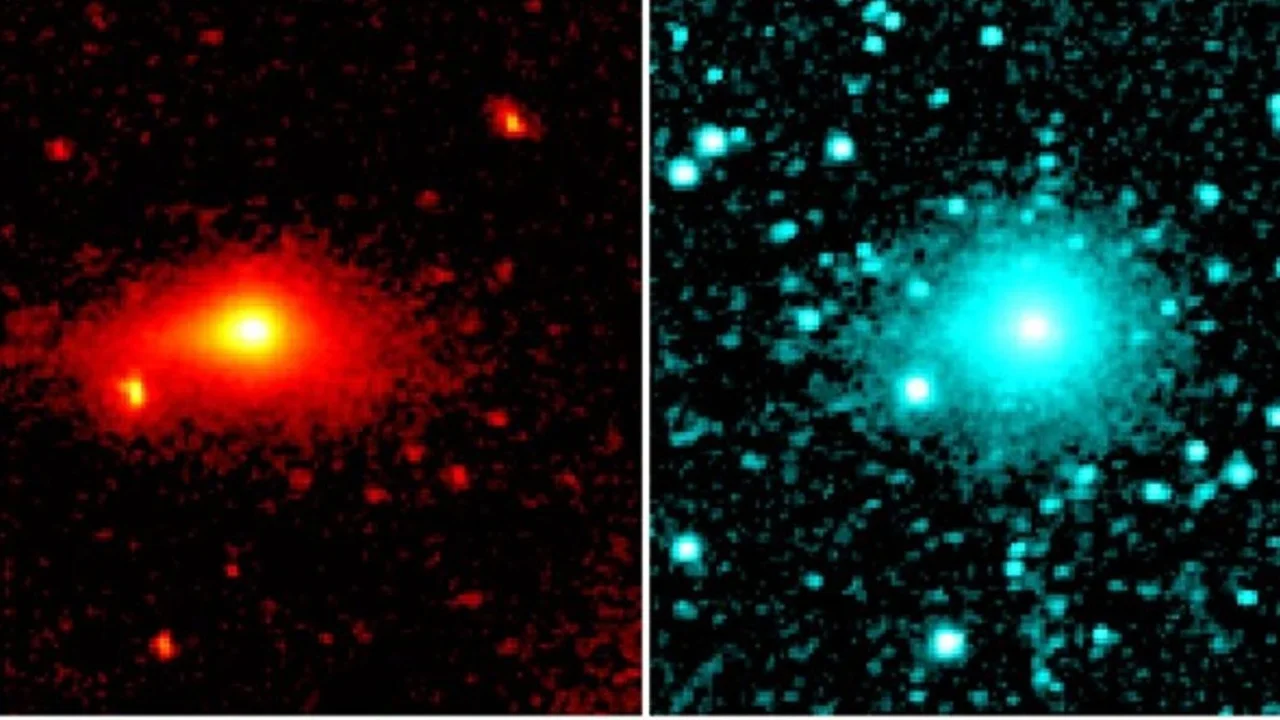
The interstellar visitor comet 3I/ATLAS has been making headlines since its discovery, but what happened recently has scientists practically bouncing off the walls with excitement. As this cosmic nomad travels away from our Sun, NASA’s SPHEREx telescope captured stunning infrared images showing the comet suddenly brightening and releasing massive amounts of material into space.
“We’re witnessing something that happens maybe once or twice per decade,” explains Dr. Sarah Chen, a planetary astronomer who has been tracking the comet’s behavior. “This flare-up is giving us a front-row seat to see exactly what this interstellar visitor is made of.”

What makes this discovery so remarkable isn’t just the spectacular light show. The infrared observations revealed that 3I/ATLAS is releasing dust, water, organic molecules, and carbon dioxide—essentially showing us the building blocks of worlds that formed around a completely different star. Think about that for a moment: we’re literally seeing pieces of another star system scattered across space.
The comet’s sudden burst of activity likely occurred when frozen gases trapped within its nucleus began sublimating, or turning directly from solid to gas, creating the dramatic coma and tail that telescopes detected. This process is similar to what happens when you put dry ice in water, except it’s happening on a scale that spans thousands of miles.

Breaking Down the Cosmic Chemistry Lesson
The data collected from this interstellar visitor comet is like receiving a detailed chemistry report from another star system. Scientists have been able to identify several key components that reveal fascinating details about where 3I/ATLAS came from and what its original home might have looked like.
Here’s what NASA’s observations uncovered about this cosmic wanderer:

- Water ice: Confirms that water exists in other star systems, supporting theories about widespread habitability
- Carbon dioxide: Shows similar atmospheric processes that we see in our own solar system
- Organic molecules: Complex carbon-based compounds that are the building blocks of life as we know it
- Silicate dust: Rocky particles that tell us about the solid materials present in the comet’s birth system
- Iron and magnesium compounds: Metallic elements that provide clues about the stellar environment where it formed
| Component Detected | Significance | Abundance Level |
|---|---|---|
| Water Ice | Universal presence of H2O | High |
| Carbon Dioxide | Common atmospheric gas | Moderate |
| Organic Molecules | Pre-biotic chemistry potential | Trace amounts |
| Silicate Dust | Rocky planet formation materials | High |
| Metal Compounds | Stellar nucleosynthesis products | Low |
“The chemical signature we’re seeing is both familiar and exotic at the same time,” notes Dr. Michael Rodriguez, who specializes in interstellar objects. “It’s like meeting a distant relative who shares some family traits but has their own unique characteristics shaped by a completely different upbringing.”
The infrared wavelengths that SPHEREx uses are particularly valuable because they can detect the heat signatures of different molecules, essentially allowing scientists to take the temperature and identify the chemical fingerprints of materials that would otherwise be invisible to optical telescopes.
What This Means for Our Understanding of the Universe
The implications of observing this interstellar visitor comet go far beyond just cataloging another space rock. This discovery is fundamentally changing how we think about the connections between different star systems and the potential for life throughout our galaxy.
For starters, the presence of organic molecules in 3I/ATLAS suggests that the chemical ingredients necessary for life might be far more common throughout the universe than we previously thought. When these building blocks can survive the incredibly harsh journey between star systems, it opens up exciting possibilities about how life might spread or develop independently across cosmic distances.
“We’re essentially seeing proof that star systems aren’t isolated islands,” explains Dr. Lisa Thompson, an astrobiologist studying interstellar chemistry. “They’re more like neighborhoods where materials and information can be shared across truly astronomical distances.”
The timing of this flare-up also provides scientists with a rare opportunity to study how interstellar objects behave as they interact with different stellar environments. As 3I/ATLAS moves away from our Sun’s influence, researchers can observe how its activity changes, providing insights into the fundamental processes that govern comet behavior across the galaxy.
From a practical standpoint, this research is helping NASA and other space agencies develop better techniques for detecting and studying future interstellar visitors. The success of the SPHEREx observations demonstrates that our current technology is capable of extracting incredible amounts of scientific data from these brief cosmic encounters.
Perhaps most importantly, discoveries like this remind us that our solar system isn’t a closed system. We’re part of a dynamic galactic community where objects regularly travel between star systems, potentially carrying information, materials, and maybe even microscopic life from one cosmic neighborhood to another.
The fact that we can now detect, track, and analyze these interstellar visitors in real-time represents a major leap forward in our ability to understand our place in the universe. Each new observation adds another piece to the puzzle of how planetary systems form, evolve, and potentially support life throughout our galaxy.
FAQs
How often do interstellar visitor comets pass through our solar system?
Scientists estimate that one or two interstellar objects pass through our solar system each year, but most are too small or faint to detect with current technology.
Will comet 3I/ATLAS ever return to our solar system?
No, this interstellar visitor comet is on a trajectory that will take it permanently away from our Sun and eventually into interstellar space, never to return.
How fast is 3I/ATLAS traveling as it leaves our solar system?
The comet is moving at approximately 44 kilometers per second relative to the Sun, which is fast enough to escape our solar system’s gravitational pull completely.
What makes this comet different from regular comets in our solar system?
Unlike solar system comets that formed here billions of years ago, 3I/ATLAS originated around a different star and carries the chemical signature of that alien stellar environment.
Could interstellar comets like this one carry life between star systems?
While possible in theory, scientists haven’t found direct evidence of living organisms on interstellar objects, though the organic molecules detected suggest the chemical building blocks for life can survive interstellar journeys.
How did NASA’s SPHEREx telescope capture these observations?
SPHEREx uses infrared technology to detect heat signatures and chemical fingerprints that are invisible to optical telescopes, allowing it to analyze the comet’s composition as it flared up.
About the Author