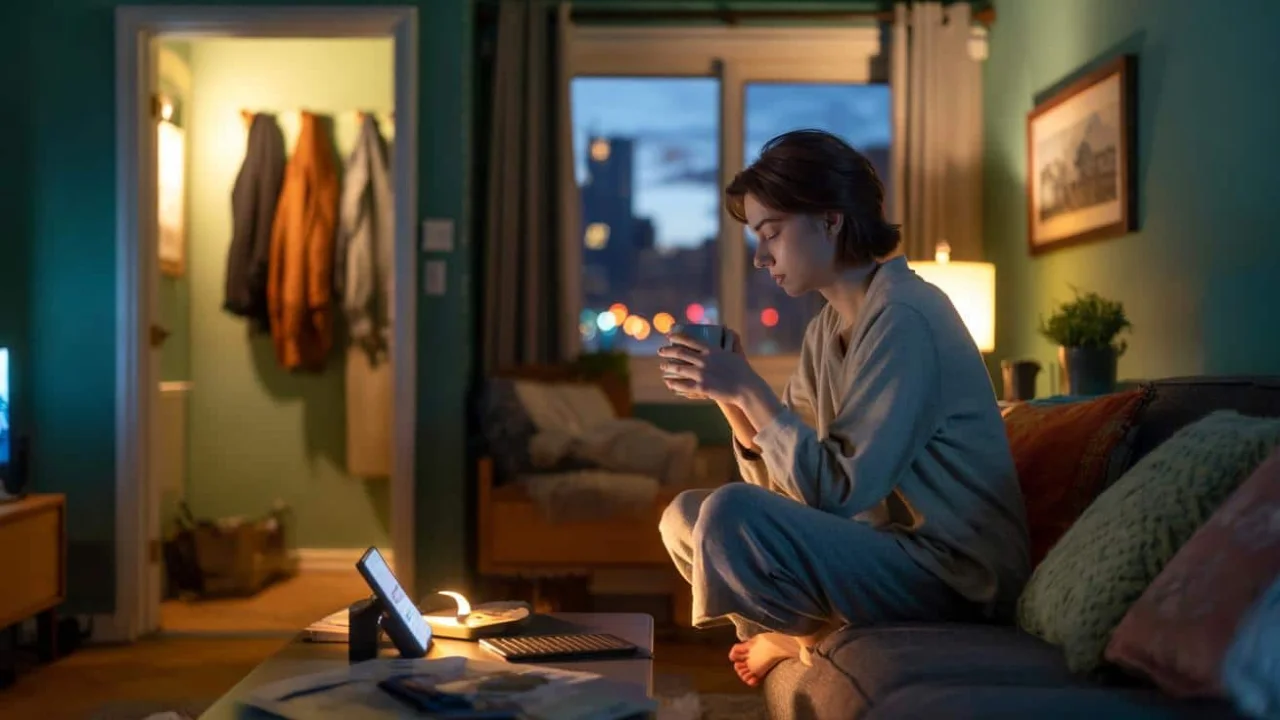
Emma had been looking forward to her best friend’s birthday party all week. She’d bought the perfect gift, planned her outfit, and genuinely wanted to celebrate. But twenty minutes into the gathering, surrounded by laughter and music, she felt that familiar knot forming in her chest. Her smile became forced, her responses automatic, and all she could think about was the quiet of her own apartment.

When she finally made her excuse and left early, the relief was immediate. Walking to her car, her shoulders dropped, her breathing deepened, and for the first time all evening, she felt like herself again. “What’s wrong with me?” she wondered, feeling guilty for wanting to escape from people she genuinely cared about.
The answer might surprise you. Nothing’s wrong at all.

The Science Behind Feeling Calmer Alone
What Emma experienced has a name in psychology: the difference between internal regulation and external regulation. When you’re alone, your emotional system operates from the inside out. Your nervous system responds to your own thoughts, feelings, and internal cues without interference.
But add other people to the mix, and something shifts. Your brain automatically begins external regulation – constantly scanning faces, reading body language, adjusting your behavior based on social cues, and monitoring everyone’s emotional temperature.
“For some people, social interaction requires tremendous cognitive and emotional resources,” explains Dr. Rachel Martinez, a clinical psychologist specializing in social anxiety. “Their nervous system treats every social encounter like a complex puzzle that needs constant solving.”
This doesn’t mean you’re antisocial or broken. Your brain is simply wired to be more sensitive to social stimuli. While some people find energy in crowds, others find themselves in a state of heightened alertness that can be mentally and physically exhausting.
The physical symptoms are real: elevated heart rate, muscle tension, shallow breathing, and that hypervigilant feeling of being “on” all the time. When you’re finally alone, your parasympathetic nervous system kicks in, allowing your body to return to its natural, regulated state.
Understanding Your Social Energy System
Not everyone experiences social situations the same way. Understanding your personal social energy patterns can help you recognize why solitude feels so restorative. Here are the key factors that influence how your nervous system responds to others:

- Sensory processing sensitivity: Some people process environmental stimuli more deeply, making crowded or noisy spaces overwhelming
- Attachment style: Those with anxious attachment may constantly monitor others’ reactions for signs of approval or rejection
- Social masking: The effort required to present a socially acceptable version of yourself can be mentally draining
- Emotional contagion: Highly empathetic individuals may unconsciously absorb others’ emotions, creating internal chaos
- Cognitive load: Processing multiple conversations, social dynamics, and unspoken rules simultaneously taxes mental resources
| Internal Regulation (Alone) | External Regulation (With Others) |
|---|---|
| Emotions flow naturally | Emotions filtered through social expectations |
| No performance pressure | Constant micro-adjustments to behavior |
| Authentic self-expression | Socially appropriate responses required |
| Energy conservation | Energy expenditure through social monitoring |
| Nervous system at rest | Nervous system in alert mode |
“The key insight is that neither mode is inherently better or worse,” notes Dr. James Chen, a researcher in social psychology. “Some people naturally thrive on external regulation, while others function optimally through internal regulation.”
When Solitude Becomes Your Sanctuary
Recognizing your preference for internal regulation can be life-changing. It helps explain why certain social situations feel draining, why you might need recovery time after gatherings, and why solitude doesn’t feel lonely – it feels necessary.
This understanding affects millions of people. Research suggests that approximately 20% of the population has heightened sensitivity to social stimuli, making them more likely to prefer internal regulation. This isn’t a disorder or something that needs fixing; it’s simply a different way of processing the world.
Consider Sarah, a marketing executive who used to force herself into after-work networking events, thinking something was wrong with her for preferring quiet evenings at home. Once she understood her need for internal regulation, she began setting boundaries that honored her nervous system’s needs.
“I stopped apologizing for leaving parties early or declining invitations,” Sarah explains. “I realized that protecting my energy wasn’t selfish – it was essential for my well-being.”
The practical implications are significant. People who understand their internal regulation needs often report better relationships, improved work performance, and reduced anxiety. They learn to schedule downtime after social events, choose smaller gatherings over large parties, and communicate their needs without shame.
Dr. Martinez adds, “When people stop fighting their natural tendencies and start working with them, they often discover they can enjoy social connections more deeply because they’re not constantly battling internal overwhelm.”
This shift in perspective can transform how you approach relationships. Instead of seeing your need for solitude as a limitation, you can view it as valuable self-knowledge. Your calm, centered presence in small groups or one-on-one interactions might be exactly what others need, even if large gatherings aren’t your forte.
The goal isn’t to avoid all social interaction, but to find the balance that allows your nervous system to thrive. Some people need daily social stimulation; others need daily solitude with occasional social connection. Both approaches are valid and healthy when they align with your internal regulation patterns.
FAQs
Is preferring solitude a sign of social anxiety?
Not necessarily. While social anxiety involves fear of judgment, preferring internal regulation is simply about energy management and nervous system sensitivity.
How can I explain my need for alone time to friends and family?
Try saying something like, “I recharge better in quiet spaces, but that doesn’t mean I value our relationship any less. I just need some downtime to be fully present when we’re together.”
Can you change your preference for internal vs. external regulation?
While you can develop coping strategies and social skills, your basic nervous system sensitivity tends to remain consistent. It’s better to work with your natural tendencies than against them.
What’s the difference between introversion and preferring internal regulation?
Introversion is about where you direct your energy and attention, while internal regulation is specifically about how your nervous system processes social stimuli. You can be an introvert who enjoys external regulation or an extrovert who needs internal regulation.
How much alone time is healthy?
There’s no universal answer. The right amount is whatever allows you to feel restored and capable of meaningful connections when you choose to have them.
Should I push myself to be more social?
Gentle challenges can be growth opportunities, but constantly forcing yourself into draining situations often backfires. Focus on finding sustainable ways to connect that honor your nervous system’s needs.
About the Author