Maria Santos steps out of her apartment in Lisbon every morning, walks to the same bus stop, and takes the exact same route to work. She has no idea that the ground beneath her feet is slowly spinning. Not in some dramatic, movie-style earthquake, but in a geological ballet so gradual that entire generations will live and die without noticing.

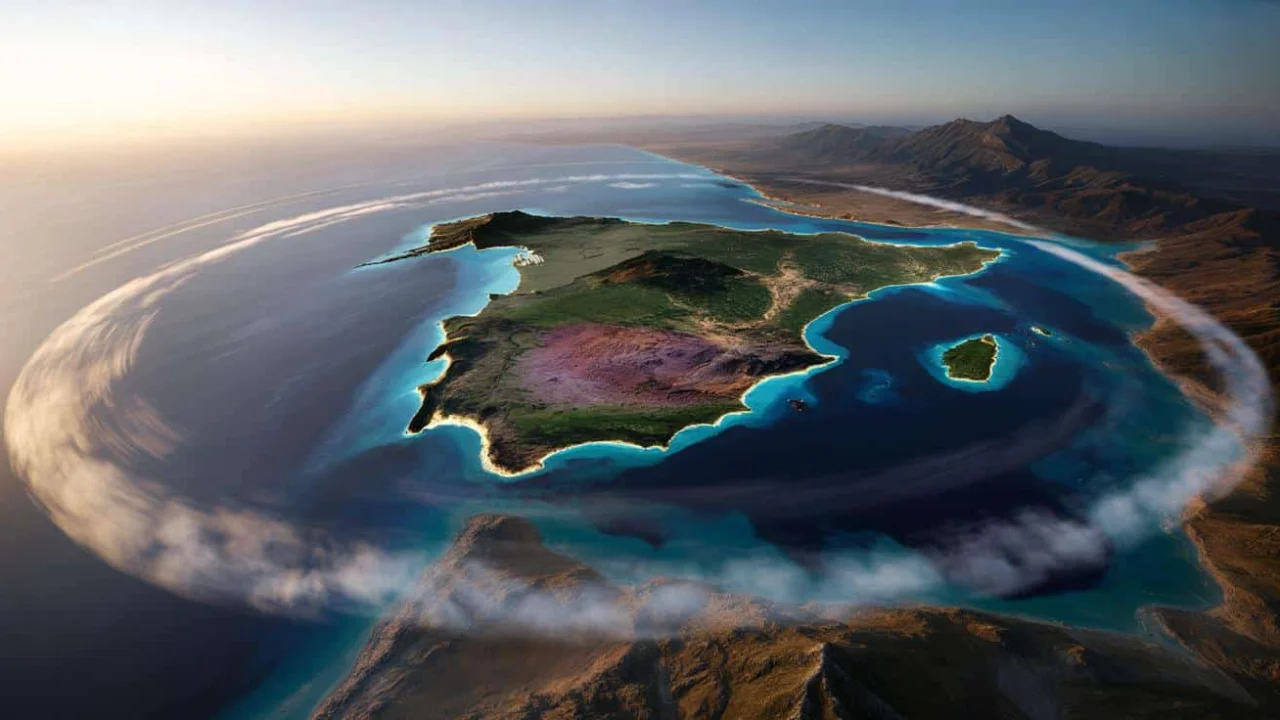
Yet this invisible dance is happening right now. The entire Iberian Peninsula—Spain and Portugal together—is rotating clockwise like a massive stone wheel, driven by forces so ancient and powerful they make human timescales seem like fleeting moments.
This discovery is rewriting what scientists thought they knew about how our planet moves and shifts beneath us.

The Iberian Peninsula Rotation That’s Changing Everything
For decades, geology textbooks painted a simple picture: tectonic plates slide past each other like slow-moving conveyor belts. Push here, slide there. Clean and predictable.
The Iberian Peninsula rotation throws that neat explanation out the window. According to a groundbreaking study published in Gondwana Research, Spain and Portugal aren’t just drifting northward with the rest of the Eurasian plate. They’re spinning.

“The Iberian Peninsula is experiencing a slow clockwise spin, generated by uneven forces from the colliding African and Eurasian plates,” explains lead researcher Dr. Asier Madarieta.
The movement is almost impossibly slow—Africa and Eurasia creep toward each other at roughly 4 to 6 millimeters per year. That’s about the same rate your fingernails grow. But this glacial pace creates something unexpected: instead of a straight collision, the uneven pressures generate a twisting motion that turns the entire peninsula like a key in a lock.

The Science Behind the Spin
Understanding why this rotation happens requires looking at the messy reality of plate boundaries. Most geology diagrams show clean lines where one plate meets another, but the western Mediterranean refuses to follow the textbook.
Here’s what makes the Iberian Peninsula rotation unique:

- Blurred boundaries: Unlike other plate margins with clear fault lines, the African-Eurasian boundary south of Spain spreads across a wide zone
- Multiple stress points: Forces push from different directions—compression from the south, lateral pressure from the Mediterranean
- Complex geology: The rock beneath southern Spain is cut by numerous smaller fault systems, each responding differently to pressure
- Distributed motion: Instead of one major break, the movement spreads across the seafloor and land masses
“Think of it like trying to push a book across a cluttered desk,” says Dr. Elena Rodriguez, a structural geologist not involved in the study. “The book doesn’t slide straight—it pivots around obstacles and catches, creating that rotating motion.”
| Geological Feature | Movement Rate | Direction |
|---|---|---|
| Iberian Peninsula rotation | 0.2° per million years | Clockwise |
| Africa-Eurasia convergence | 4-6 mm/year | Northward |
| Mediterranean compression | 3-5 mm/year | East-West |
The rotation rate might sound insignificant, but over geological time, it adds up. In just 10 million years—a blink of an eye in Earth’s history—the peninsula could rotate by 2 degrees. That’s enough to noticeably change the orientation of the entire landmass.
What This Means for Earthquakes and Risk
The discovery of Iberian Peninsula rotation isn’t just academic curiosity. It fundamentally changes how scientists assess earthquake risks across Spain and Portugal.
Traditional earthquake models assume linear motion along fault lines. But rotation creates different stress patterns, potentially explaining some of the region’s more puzzling seismic activity.
“We’re seeing earthquake swarms in places that don’t make sense under the old models,” notes Dr. Carlos Mendez, a seismologist at the University of Granada. “The rotation hypothesis helps explain why certain areas experience unexpected tremors.”
The practical implications are significant:
- Building codes: Engineers may need to account for rotational stresses when designing earthquake-resistant structures
- Risk assessment: Areas previously considered low-risk might need reevaluation
- Early warning systems: Seismic monitoring networks could be optimized for rotational rather than linear motion
- Infrastructure planning: Long-term projects like bridges and tunnels might need to consider gradual orientation changes
The cities most affected include Madrid, Barcelona, Lisbon, and Porto—all sitting on the slowly spinning peninsula. While residents won’t feel the rotation directly, the changing stress patterns could influence where and how earthquakes occur decades or centuries from now.
“It’s like the difference between pushing a door straight versus turning it on its hinges,” explains Dr. Rodriguez. “Same forces, completely different results.”
The research team used GPS measurements, satellite data, and geological mapping to track the movement. What they found challenges not just our understanding of Iberia, but similar regions worldwide where plate boundaries become complex and messy.
Other peninsulas and landmasses might be experiencing similar rotations that haven’t been detected yet. Italy, Greece, and parts of Turkey all sit in geologically complex zones where multiple plates interact.
For the millions of people calling the Iberian Peninsula home, life continues normally. The morning commute remains unchanged, the coastlines look the same, and the mountains stand exactly where they’ve always been. But deep beneath their feet, the ancient dance continues—a slow, steady rotation that connects today’s residents to geological forces that have been shaping this land for millions of years.
“We’re passengers on a spinning ship we can’t feel moving,” reflects Dr. Madarieta. “But understanding that motion helps us prepare for the journey ahead.”
FAQs
How fast is the Iberian Peninsula rotating?
The rotation occurs at about 0.2 degrees per million years—extremely slow by human standards but significant over geological time.
Can people feel the peninsula rotating?
No, the movement is far too slow to be perceptible. It’s thousands of times slower than the hour hand on a clock.
Does this rotation cause earthquakes?
The rotation itself doesn’t cause earthquakes, but it creates stress patterns that influence where and how earthquakes might occur in the region.
Is this rotation dangerous?
Not directly, but understanding it helps scientists better assess long-term earthquake risks and improve building codes and safety measures.
Are other parts of Europe rotating too?
Possibly. Similar complex plate interactions occur in Italy, Greece, and other regions where multiple tectonic plates meet.
How did scientists discover this rotation?
Researchers used GPS measurements, satellite data, and geological mapping to track tiny movements over time, revealing the clockwise spinning pattern.
About the Author
