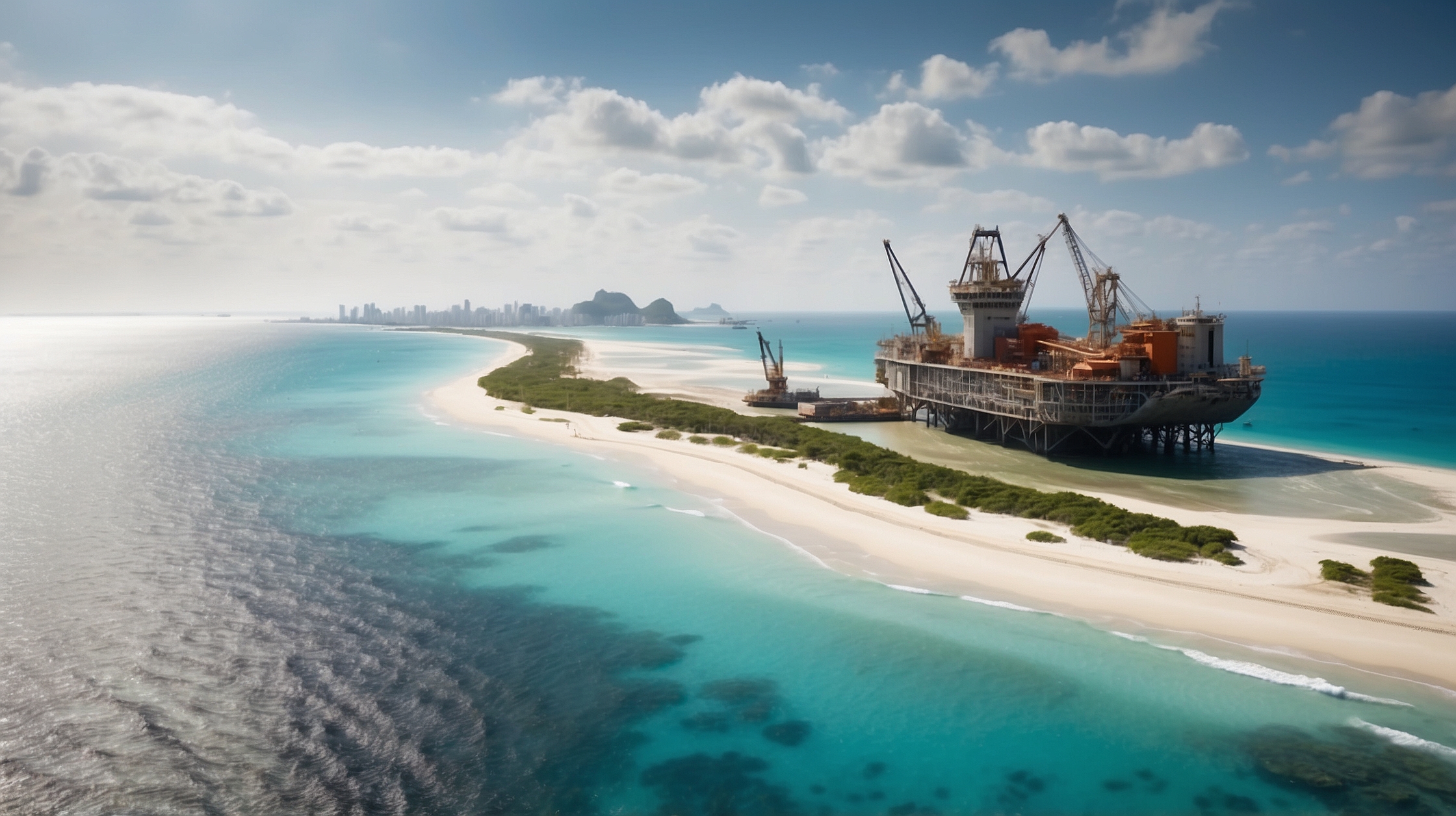

Over the past decade, **China has engineered some of the most dramatic geographical changes in modern history**, constructing artificial islands in the South China Sea by dredging and **pumping millions of tons of sand onto reefs and atolls**. These efforts have not only altered the marine landscape but significantly escalated geopolitical tensions in one of the world’s most contested maritime regions. With the creation of artificial landmasses equipped with military infrastructure, China’s actions have fundamentally changed the status quo in the South China Sea.
This ambitious expansion effort, often referred to as “**island-building**,” has seen reefs and submerged atolls in areas like the Spratly Islands transformed into sprawling military outposts, complete with runways, ports, radar systems, and weaponry. China’s reasoning centers on historical territorial claims, but the massive scale and pace of development have alarmed neighboring countries and raised deep concerns among global powers about freedom of navigation, environmental damage, and regional security.
Overview of China’s Island-Building Campaign
| Aspect | Details |
|---|---|
| Start Date | 2013–2014 (intensified in later years) |
| Key Locations | South China Sea — Spratly Islands, Paracel Islands |
| Method Used | Sand dredging and landfill on reefs and atolls |
| Primary Purpose | Territorial control, strategic military positioning |
| Global Reaction | Condemnation from neighboring states and Western powers |
| Environmental Impact | Severe coral reef damage, disruption of marine ecosystems |
How China created land where there was none
China’s island-building campaign consisted of **massive dredging operations**, primarily focused on submerged reefs and small islets. State-owned construction firms utilized powerful dredgers to scoop up sand and sediment from the ocean floor, depositing it onto existing formations. Reinforced with concrete and steel, these structures were then developed into full-fledged **man-made islands with military installations** and airstrips that can service large transport and fighter aircrafts.

One of the most notable examples is **Fiery Cross Reef**, which between 2014 and 2016 underwent a stunning transformation. It now hosts a 3,000-meter runway, hangars, radar arrays, and deep harbors capable of supporting naval vessels. Similar construction has taken place on **Subi Reef, Mischief Reef, and Gaven Reef**, among others — all part of the Spratly Island chain, over which China, the Philippines, Vietnam, Malaysia, and Brunei have overlapping claims.
Why the South China Sea is strategically vital
The motivation behind China’s actions becomes clearer when one examines the high-stakes nature of the **South China Sea**. This region is a critical maritime corridor, with roughly **$3 trillion in annual trade** passing through its waters. In addition, it is believed to be rich in untapped oil and natural gas reserves, not to mention its abundant fisheries that millions depend upon for livelihood and sustenance.

For China, asserting its control is not just about resource acquisition but also about **gaining strategic dominance**. The sea lanes are vital arteries for China’s imports and exports, and securing them from potential disruptions is a national imperative. By militarizing artificial islands, China can extend its reach across the region, monitor foreign naval traffic, and even enforce what it considers its maritime boundaries — much to the concern of surrounding nations and the international community.
Geopolitical and legal ramifications of island-building
In 2016, the **Permanent Court of Arbitration** in The Hague ruled that China’s expansive claims in the South China Sea — including its island-building efforts — had no legal basis under international law as outlined in the United Nations Convention on the Law of the Sea (UNCLOS). China, however, rejected the ruling and has continued with its activities unimpeded.

Neighboring countries such as the Philippines and Vietnam, which also claim portions of the Spratly Islands, have expressed **strong opposition**, as have the United States and several European nations. The U.S. has repeatedly conducted **freedom of navigation operations (FONOPs)**, sending warships near the artificial islands to challenge China’s claims and keep the waters international. Beijing continues to assert that its constructions are purely defensive and within sovereign territory, a position that remains highly contested.
Environmental consequences of dredging and construction
Beyond politics and military aspirations, the **environmental toll** of China’s island-building projects has been devastating. Thousands of hectares of **coral reef ecosystems have been destroyed** in order to lay the foundation for artificial landmasses. Sediment from dredging suffocates marine habitats and endangers species that depend on reef structures to survive.
Marine scientists warn that these operations have caused **irreversible damage** not just to reef colonies, but to the larger ecosystem of the South China Sea, which hosts some of the world’s most biodiverse marine environments. The loss of coral cover affects fish populations, water quality, and the livelihoods of coastal communities that rely on fishing.
The environmental damage is immense and likely permanent. What’s happening is ecological devastation on a massive scale.
— Dr. Lian He, Marine Biologist and Ecologist
Military functionality of the artificial islands
Although initially branded as civilian projects for search and rescue or meteorological research, China’s artificial islands are increasingly equipped with military-grade infrastructure. Satellite imagery and defense analysts confirm the presence of **surface-to-air missile sites**, anti-aircraft defenses, and radar surveillance equipment.
Moreover, China can now base military aircraft and naval assets in the very center of the South China Sea, allowing it to **project power across vast maritime areas**. This capability alters regional military balance dynamics dramatically, providing China with a forward-operating advantage against rivals.
These installations are unsinkable aircraft carriers. Their role goes far beyond territorial defense — they’re about regional dominance.
— Admiral James Clarke (Ret.), Defense Analyst
Winners and losers from the island-building campaign
| Winners | Losers |
|---|---|
| China: Enhanced strategic control and influence | Neighboring nations: Diminished territorial access |
| Chinese construction firms and military stakeholders | Environment and marine species |
| Chinese shipping and trade routes protection | International maritime law and arbitration mechanisms |
Global response and the road ahead
Despite widespread concern and diplomatic pressure, China shows no signs of halting its activities in the South China Sea. Efforts by ASEAN nations to form a cohesive response have been met with limited success, and the lack of enforceable international mechanisms has emboldened continued assertiveness. At the same time, the United States and its allies are increasing their **naval presence** and forging alliances to maintain a balance of power in the region.
Going forward, the South China Sea is expected to remain a flashpoint for **great-power competition**, environmental activism, and diplomatic negotiation. The artificial islands are not likely to be dismantled, meaning the international community must adapt to this altered landscape — one where new territory has reshaped old boundaries.
Short FAQs
What is China building in the South China Sea?
China has constructed artificial islands by dredging sand and soil over coral reefs and atolls, transforming them into landmasses equipped with airstrips and military infrastructure.
Why is the South China Sea important?
It’s a vital maritime route for global trade, rich in resources like oil, gas, and fisheries. Militarily, it’s strategically significant for regional and global players.
Is China’s island-building legal?
According to a 2016 ruling by the Permanent Court of Arbitration, China’s claims and constructions violate international law, but China has rejected the decision.
What environmental impacts have been caused?
The dredging and construction have caused widespread destruction of coral reefs and disrupted marine ecosystems vital to biodiversity and regional fisheries.
How does this affect neighboring countries?
Countries like the Philippines and Vietnam face reduced access to contested waters and have raised strong objections to China’s activities.
Can these islands be used militarily?
Yes, many of the artificial islands have infrastructure such as runways, radar systems, and missile sites, giving China enhanced military capabilities.
What is the global community doing about it?
While diplomatic pressure and naval operations have increased, there’s been limited success in curbing China’s activities due to a lack of enforceable international power.
About the Author