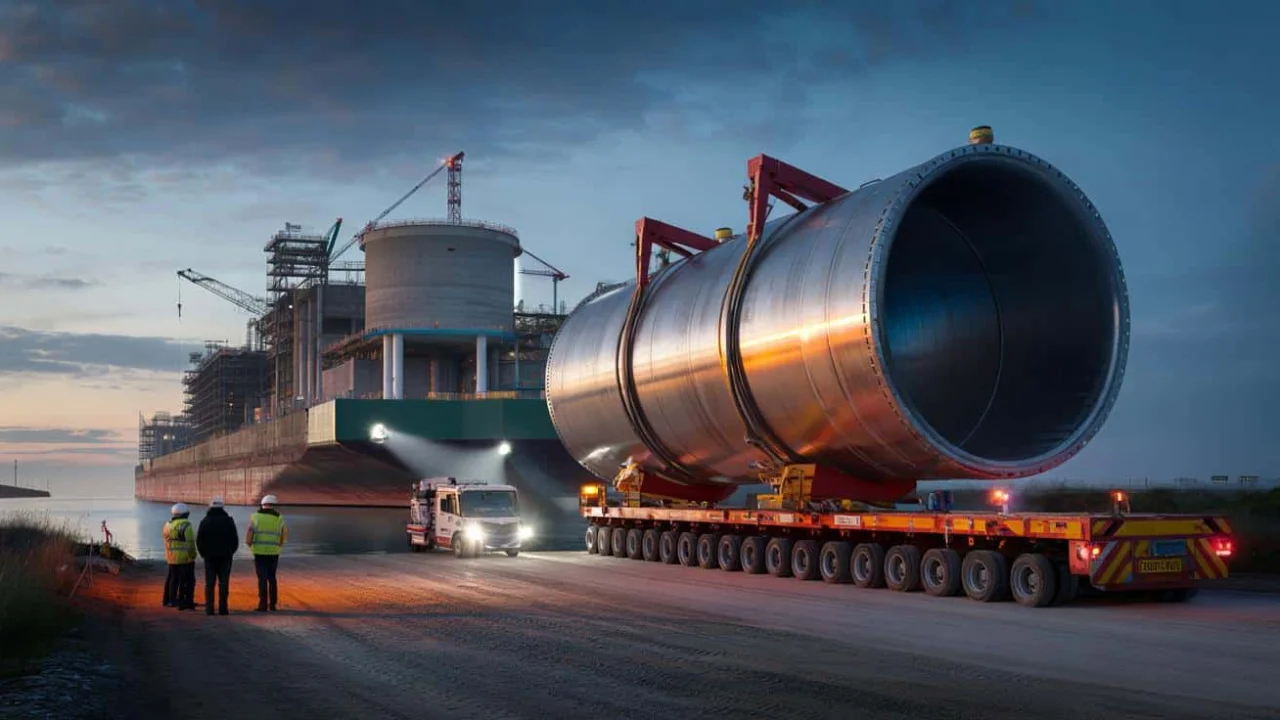
Picture this: you’re driving through quiet Somerset countryside when suddenly you’re stuck behind the slowest-moving convoy you’ve ever seen. Police cars with flashing lights escort a massive truck carrying what looks like a giant steel tube. You might wonder what on earth could be so important that it needs a police escort and moves at the pace of a leisurely walk.
That steel cylinder you just witnessed is worth more than most people’s homes and took years to build. It’s the reactor pressure vessel for Hinkley Point C, and it just completed one of the most carefully orchestrated journeys in British industrial history.
For the engineers watching this convoy inch through Somerset lanes, every pothole and every sharp turn represented months of planning. One wrong move could delay Britain’s biggest nuclear project by years.

The Heart of Britain’s Nuclear Future Arrives
On January 12th, 2026, something remarkable happened at Hinkley Point C. After travelling over 1,000 kilometres from a factory in eastern France, a 500-tonne reactor pressure vessel finally reached its destination. This isn’t just any piece of industrial equipment – it’s the absolute core of what will become one of Europe’s most powerful nuclear reactors.
Built by French nuclear specialist Framatome at their Saint-Marcel plant, this steel giant measures 13 metres in length and weighs as much as a fully loaded Boeing 747. But unlike an airplane, this component will never move again once it’s installed.

“This vessel represents the culmination of decades of nuclear engineering expertise,” explains a senior project engineer involved in the transport operation. “Everything else in the reactor is designed around this single component.”
The reactor pressure vessel will house the nuclear fuel assemblies and guide the control rods that manage the nuclear reaction. High-pressure water will flow through it at temperatures reaching 320°C, carrying heat to generate steam and ultimately electricity. Without this vessel, Hinkley Point C’s second reactor simply cannot function.

An Epic Journey Across Europe
Moving a 500-tonne piece of precision engineering across international borders isn’t like shipping a regular package. The logistics read like something from a Hollywood heist movie, except everything moves in slow motion and costs millions of pounds.
The journey began at Framatome’s Saint-Marcel facility in Saône-et-Loire, eastern France. From there, the vessel travelled on specially reinforced roads to reach a port, where it boarded a ship for the Channel crossing. After reaching Avonmouth near Bristol, it transferred to a barge for a river journey along the Parrett to Combwich port.
Then came the most nerve-wracking part: 6.4 kilometres of Somerset country roads that took six hours to complete. The convoy rarely exceeded walking pace, with engineers monitoring every metre of the route.
| Journey Stage | Distance | Transport Method | Key Challenge |
|---|---|---|---|
| Saint-Marcel to French Port | ~400km | Special Road Transport | Bridge clearances |
| Channel Crossing | ~500km | Heavy Cargo Ship | Weather conditions |
| River Journey | ~100km | Industrial Barge | Tidal timing |
| Final Road Stretch | 6.4km | Multi-axle Trailer | Rural road width |
“Every single bridge, roundabout, and sharp turn was surveyed months in advance,” notes a transport specialist familiar with the operation. “We reinforced road surfaces and even widened some sections temporarily.”
The planning process took over a year. Engineers used computer simulations to test every possible scenario, from ground clearance issues to wind loads during the sea crossing. There was simply no room for improvisation – one miscalculation could have left the convoy stranded and set back Britain’s nuclear programme significantly.
What This Means for Britain’s Energy Future
The arrival of this reactor pressure vessel represents more than just a logistics victory. It’s a crucial step toward energy independence for Britain, which currently imports much of its electricity from European neighbours.
Hinkley Point C will eventually generate enough electricity to power 6 million homes. That’s roughly equivalent to supplying all of London’s residential electricity needs. The project uses EPR (European Pressurised Reactor) technology, designed for maximum output and enhanced safety features.
But the impact goes beyond just generating electricity. The project has created thousands of jobs across Britain and established supply chains that will support future nuclear projects. Local communities around Somerset have seen significant economic benefits, from construction work to hospitality services for the thousands of workers involved.
“This isn’t just about building a power station,” explains an energy policy analyst. “It’s about rebuilding Britain’s nuclear expertise and securing our energy future for generations.”
The reactor pressure vessel now sits at Hinkley Point C, waiting for installation. Over the coming months, it will be carefully lowered into position within the reactor building, where it will begin its 80-year working life generating clean electricity.
Key benefits of the completed project include:
- Electricity for 6 million homes
- 60 years of low-carbon power generation
- Thousands of permanent jobs
- Reduced dependence on energy imports
- Enhanced energy security during global crises
The successful transport of this massive component proves that Britain can still handle complex industrial projects. It demonstrates the international cooperation needed for modern energy infrastructure, combining French engineering expertise with British project management.
“Seeing this vessel finally arrive on site feels like watching history in the making,” reflects a longtime Hinkley Point C engineer. “It’s taken years to get to this point, but now we can see the finish line.”
For residents of Somerset who watched that slow-moving convoy pass through their villages, they witnessed a piece of Britain’s energy future being carefully delivered to their doorstep. That giant steel cylinder will soon help keep the lights on across the country for decades to come.
FAQs
How much does the reactor pressure vessel weigh?
The vessel weighs approximately 500 tonnes, equivalent to a fully loaded Boeing 747 aircraft.
Why did the transport take so long?
The final 6.4-kilometre road journey took six hours because the convoy moved at walking pace to ensure safety and avoid damage to the precision-engineered component.
Where was the reactor pressure vessel manufactured?
It was built by French nuclear specialist Framatome at their Saint-Marcel plant in Saône-et-Loire, eastern France.
When will Hinkley Point C start generating electricity?
The project is expected to begin commercial operation in the late 2020s, with the reactor pressure vessel being installed over the coming months.
How many homes will Hinkley Point C power?
Once fully operational, the plant will generate enough electricity to supply approximately 6 million British homes.
How long will the reactor pressure vessel last?
The vessel is designed to operate safely for over 80 years, enduring temperatures of 320°C and extremely high pressures throughout its working life.
About the Author