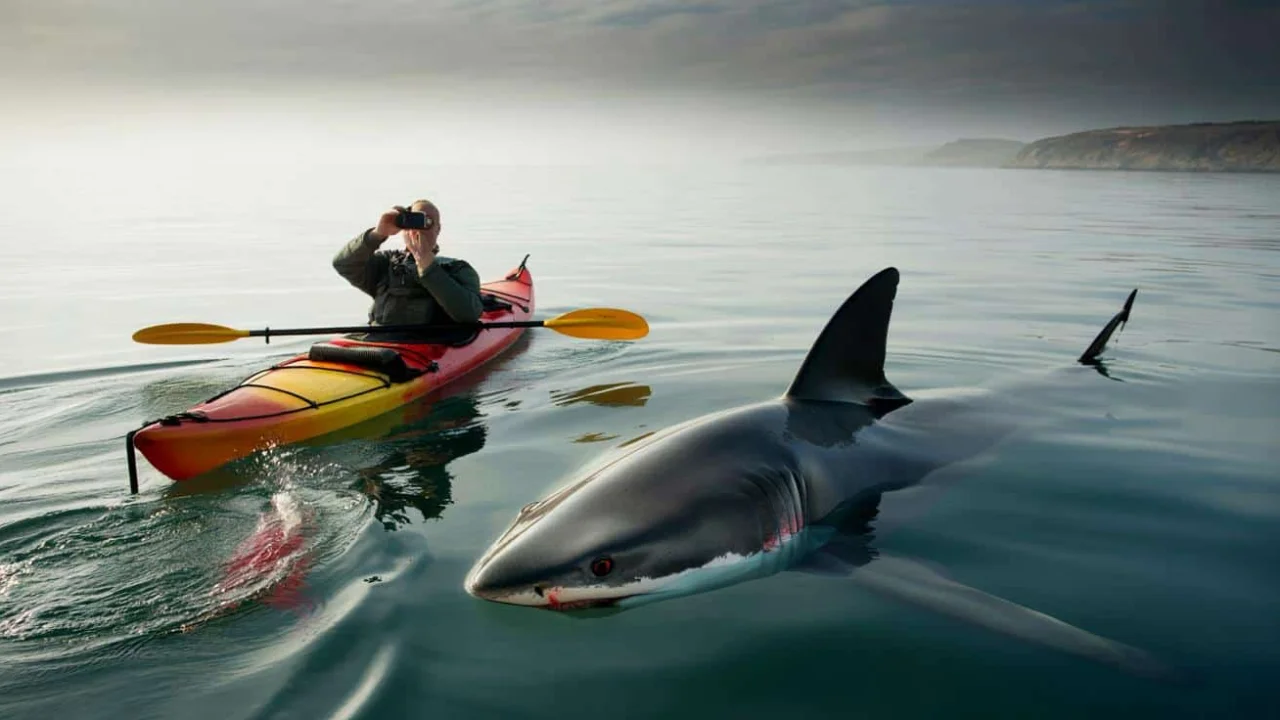
Picture this: you’re floating peacefully in your kayak, enjoying what should be a routine fishing trip with a friend. The ocean is calm, the fish are biting, and everything feels perfect. Then you notice something dark moving beneath the surface, keeping pace with your boat like a shadow you can’t shake.
That’s exactly what happened to Ian Walters, a history and science teacher who found himself face-to-face with one of nature’s most formidable predators during what started as an ordinary August morning off the California coast.
What makes this story even more incredible? He had the presence of mind to film the entire encounter, creating footage that’s now captivating viewers across social media and reminding us all just how wild our oceans really are.

When a Routine Fishing Trip Becomes a Wildlife Documentary
On August 6, 2024, Walters and his fishing buddy launched their kayaks from Half Moon Bay, that famously chilly stretch of California coastline about 30 miles south of San Francisco. They were targeting fish in the Pacific swells, several hundred meters from shore, when their peaceful morning took an unexpected turn.
The water was classic Northern California – cold enough to numb your fingers and murky enough to hide what lurks beneath. The two men had already caught a few fish, creating the perfect storm of splashing, thrashing, and blood in the water that marine biologists know can attract curious predators.

“We had been fishing for a while and caught several fish,” Walters later explained to local news stations. “I think all that activity in the water, the blood from the fish, probably drew it in.”
What “it” turned out to be was a massive great white shark kayaker encounter that would test both men’s nerves and create some of the most compelling shark footage captured by civilians in recent memory.
For several heart-stopping minutes, the great white shark shadowed their kayaks, its distinctive dorsal fin slicing through the surface just meters away. Rather than panic, Walters grabbed his camera and started filming, capturing footage that shows the apex predator pacing them like a submarine escort.
The Chilling Details Caught on Camera
The video reveals just how close this great white shark kayaker encounter really was. Walters estimated the shark’s length at between 13 to 14 feet, using his teaching experience to judge the distance between the dorsal fin and tail.
Here’s what marine experts can tell us about this incredible footage:
- The shark displayed classic great white behavior – curious but not immediately aggressive
- Its size suggests a mature adult, likely between 15-20 years old
- The grey coloration and distinctive fin shape are consistent with Carcharodon carcharias
- The shark maintained a steady distance, suggesting investigation rather than predation
| Encounter Details | Specifications |
|---|---|
| Date | August 6, 2024 |
| Location | Half Moon Bay, California |
| Estimated Shark Length | 13-14 feet (4-4.2 meters) |
| Duration of Encounter | Several minutes |
| Distance from Shore | Several hundred meters |
| Water Temperature | Cold (typical Northern California) |
“As a teacher, I’m used to estimating measurements for my students,” Walters said. “I focused on the space between the dorsal fin and the tail to get my estimate.”
What’s particularly striking about this great white shark kayaker footage is how calm both men remained. Despite being in an incredibly vulnerable position – sitting in what’s essentially a plastic bathtub next to a 2,000-pound predator – they never felt the shark intended to attack.
Why This Encounter Matters More Than You Think
This isn’t just another viral video of a scary ocean encounter. The footage provides valuable insights into great white shark behavior and highlights the complex relationship between humans and marine predators along the California coast.
California waters, particularly around areas like Half Moon Bay, are part of the “shark highway” – migration routes that great whites use to travel between feeding and breeding areas. The region’s seal populations and rich marine ecosystem make it prime hunting territory for these apex predators.
Marine biologist Dr. Sarah Chen explains, “Encounters like this show us that sharks are naturally curious animals. They investigate potential prey or unusual objects in their environment, but most interactions don’t result in attacks.”
For kayakers and ocean enthusiasts, this incident serves as both a reality check and an educational opportunity:
- Great whites are present in California waters year-round, with peak activity during summer months
- Fishing activities, especially with bleeding fish, can attract sharks to investigate
- Most shark encounters involve curiosity rather than predation
- Remaining calm and avoiding sudden movements is crucial during encounters
The economic impact extends beyond individual safety concerns. California’s coastal tourism industry, worth billions annually, depends on people feeling safe in the water. Stories like Walters’ help educate the public about shark behavior while highlighting the need for coexistence with marine wildlife.
“We’re visitors in their environment,” notes marine conservation expert Mike Rodriguez. “Understanding shark behavior helps us share the ocean responsibly.”
This great white shark kayaker encounter also underscores the importance of citizen science. Footage like Walters’ provides researchers with valuable behavioral data that would be difficult and expensive to obtain through traditional scientific methods.
The viral nature of the video – spreading rapidly across social media platforms – demonstrates public fascination with these magnificent predators while potentially reducing fear through education. When people see a shark investigating rather than attacking, it challenges Hollywood stereotypes and promotes more nuanced understanding.
For the kayaking community specifically, this incident serves as a powerful reminder about ocean awareness. While shark attacks on kayakers remain extremely rare, understanding when and where encounters are most likely can help paddlers make informed decisions about when and where to venture out.
Climate change and shifting ocean conditions are also affecting shark distributions, potentially bringing more great whites closer to shore as they follow changing food sources. Incidents like this may become more common, making education and preparedness increasingly important.
FAQs
How dangerous are great white sharks to kayakers?
Statistically very low risk. California averages only 1-3 shark attacks per year despite millions of ocean users, and most encounters involve investigation rather than aggression.
What should you do if a shark approaches your kayak?
Stay calm, avoid sudden movements, and slowly paddle toward shore. Don’t splash or make rapid motions that could trigger a predatory response.
Why do sharks follow kayaks?
Sharks are naturally curious and may investigate unusual objects in their territory. Kayaks can also resemble seals from below, triggering investigative behavior.
Are shark encounters becoming more common in California?
Reporting has increased due to social media and better documentation, but actual attack rates haven’t significantly increased. However, more people are using the ocean for recreation.
What time of day are shark encounters most likely?
Dawn and dusk are peak feeding times for many sharks, including great whites. However, encounters can happen at any time when sharks are actively hunting or investigating.
Should this video discourage people from kayaking in California waters?
No. The risk remains extremely low, and this footage actually demonstrates how most shark encounters end peacefully with no harm to humans.
About the Author
