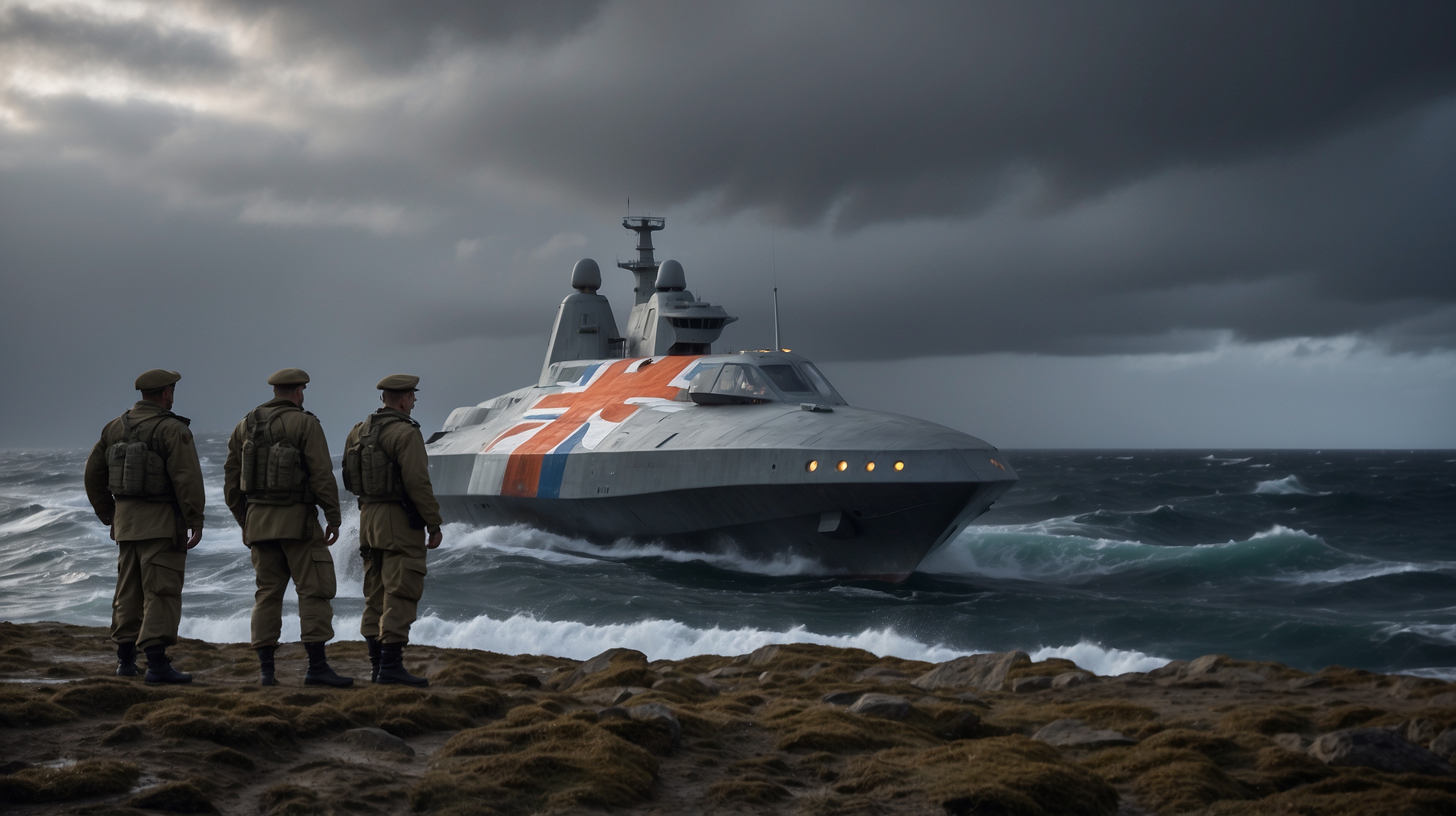
In a significant development poised to reshape naval defense collaboration in Europe, **France has committed to assisting the United Kingdom** in building a next-generation artificial intelligence (AI) system specifically designed for **mine warfare**. This strategic partnership symbolizes a renewed commitment between two of Europe’s most powerful militaries to jointly advance technological defense capabilities in an increasingly uncertain global landscape. The move suggests a future where **AI-powered defense solutions** will become a key aspect of maritime security protocols, both in NATO operations and beyond.

The UK Ministry of Defence (MoD) has been pursuing modernization across its armed forces, with a notable focus on **smart naval warfare systems**. As underwater mines remain a persistent threat to global maritime operations, particularly in heavily trafficked areas like the Strait of Hormuz or the Baltic Sea, the new AI system aims to **speed up detection, classification, and neutralization of sea mines**. By leveraging France’s cutting-edge expertise in naval software development and integrating British advanced AI algorithms, the fusion is expected to radically increase the efficiency and safety of naval mine countermeasures.
Overview of the UK-France AI Mine Warfare Collaboration
| Partnership Announced | 2024 |
| Countries Involved | United Kingdom and France |
| Primary Objective | Develop AI system for mine detection and clearance |
| Military Departments Leading | UK Ministry of Defence & French Direction Générale de l’Armement |
| Funding Source | Joint military/defense innovation budgets |
| Technological Focus | Artificial Intelligence, Autonomous Underwater Vehicles (AUVs) |
| Expected Deployment | Pilot testing in 2025, full deployment by 2027 |
Why sea mines pose an escalating maritime threat
Despite their decades-old design, **sea mines remain one of the most lethal underwater weapons**, often costing exponentially more to clear than to deploy. Used extensively in conflicts from World War I to modern times, sea mines are now enhanced with stealth and pressure-sensitive detonation technologies. As global shipping lanes continue to face heightened risk from state and non-state actors, the presence of sea mines has surged, particularly in strategic chokepoints.
With increasing geopolitical tensions in regions such as the Indo-Pacific and the Black Sea, maritime forces are under pressure to adopt smarter and more autonomous systems. Conventional systems deployed by NATO and partner navies often rely heavily on lower-speed, high-risk mechanical methods. This is where **next-generation artificial intelligence plays a transformative role**—enabling rapid deployment and accurate real-time decision-making in mine clearance operations.
What the joint system will do
The collaborative AI initiative will focus on enabling **underwater drones and robotic vehicles** to autonomously detect, identify, and eliminate both old and modern mines with minimal human intervention. The AI system is designed to do the following key tasks:

- Utilize machine learning to distinguish between harmless undersea debris and real threats.
- Coordinate a swarm of autonomous vessels for strategic area coverage.
- Integrate situational awareness data from sonar, satellite, and bathymetric data.
- Provide real-time updates to commanders using a secure communication backbone.
“These AI capabilities will revolutionize our mine warfare approach. It’s not just about clearance—it’s about **predictive threat analysis** and decision superiority.”
— Lt. Commander Michael Hayes, Royal Navy AI Systems DivisionAlso Read This Simple Daily Habit Makes Tasks Feel Smaller and Easier to Finish
Why France’s involvement is pivotal
France brings to the table not only **deep naval AI expertise** but also significant prior experience with **autonomous undersea systems**, having developed its own unmanned vehicles through Naval Group’s efforts. Some of these platforms are already in operational testing in the Mediterranean, giving France a head start in practical application of autonomous nautical tech.
Moreover, France and Britain already share a longstanding maritime intelligence-sharing agreement under the **Lancaster House treaties**, which facilitate fast-track military coordination on joint projects. France’s defense procurement agency, the Direction Générale de l’Armement (DGA), has hinted at deploying shared test facilities and simulators to accelerate software-hardware integration for the new mine warfare AI tools.
“We are leveraging French technology with British artificial intelligence to ensure that **both navies remain world leaders in autonomous mine warfare capabilities**.”
— Col. Jacques Fournier, AI Integration Lead, DGA
Winners and losers in this new defense alignment
| Winners | Losers |
|---|---|
| Royal Navy & French Navy | Legacy mine clearance systems vendors |
| AI & defense tech startups in both countries | Manual mine detection crews (reduced deployment) |
| NATO interoperability frameworks | Adversaries using legacy or hidden mines |
| Marine safety in international waters | Insurgents & maritime sabotage groups |
What changed this year
The rapid evolution and reliance on commercially available AI models by non-state actors have heightened the need for **military-grade AI systems protected against adversarial attacks**. The UK’s Defense Artificial Intelligence Strategy, launched earlier this year, called for joint ventures with allied nations, and this partnership with France represents the most concrete outcome so far.
Additionally, this is the first time both nations are co-developing a **single unified AI model tailored for naval defense**, as opposed to independent systems exported on bilateral terms. That shift marks a notable departure from the defense industrial competition that previously defined Franco-British military relations.
What comes next and timeline to watch
According to insiders from the MoD, the AI software will enter a **simulation-heavy prototyping phase** in late 2024. Live underwater testing will commence in French and British training zones through 2025. If benchmarks are met, both navies seek operational deployment by 2027, making them among the first in Europe to hold **AI-native undersea warfare capabilities**.
The project team has also left room for expansion into coalition interoperability, meaning NATO allies like Germany, Norway, and the United States could plug into the standardized system under development. This would significantly enhance **joint response capabilities in maritime crises**, including rapid deployment in mine-laden zones post-conflict or during peacekeeping operations.
Frequently asked questions
What is the purpose of the UK-France AI mine warfare system?
The system aims to detect, classify, and neutralize underwater mines using autonomous vehicles powered by AI, making mine warfare safer and more efficient.
When will the new system be operational?
Prototype testing is set for 2025, with full deployment expected by 2027 across key British and French naval units.
How does artificial intelligence help in mine detection?
AI enables faster identification of threats by analyzing large datasets from sonar and sensors, distinguishing real threats from harmless debris in real-time.
Is this system intended for NATO operations only?
While developed by the UK and France, the system could be shared with NATO allies, enhancing broader coalition capabilities.
Will this reduce the need for human divers?
Yes. One of the main goals is to limit human exposure to dangerous environments by using autonomous vessels for high-risk detection and clearance missions.
How is this system different from current mine warfare technologies?
It incorporates real-time AI decision-making, predictive analytics, and autonomous swarm coordination—capabilities lacking in most current systems.
What kind of threats do sea mines still pose today?
Modern sea mines can be activated by pressure, acoustic, or magnetic triggers, posing hidden threats to both military and commercial vessels.
Could other countries join the collaboration later?
Yes, the architecture is being designed for interoperability, allowing allied nations to integrate similar systems in the future.
About the Author