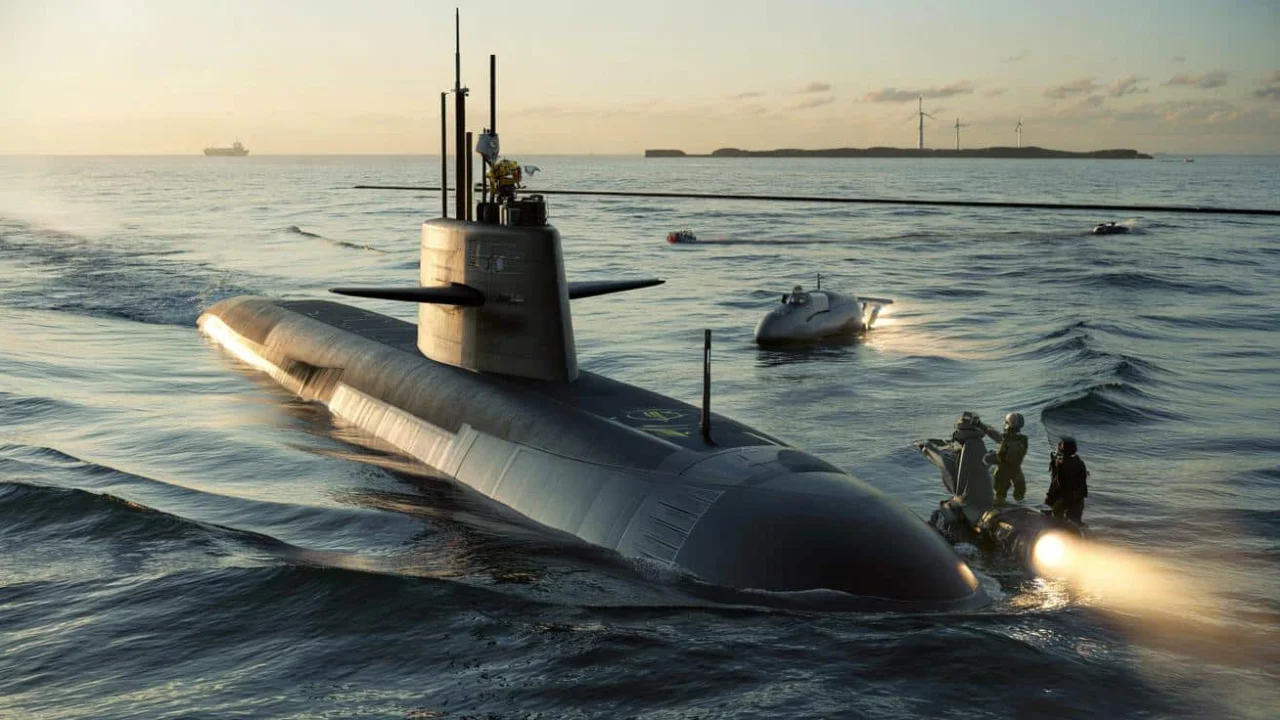
Captain Erik Lindqvist had been patrolling these Baltic waters for fifteen years, but he’d never seen anything like this. Through his periscope, the Swedish naval officer watched what looked like an ordinary fishing vessel suddenly deploy a small underwater drone. Within minutes, that drone was communicating with something much larger lurking beneath the surface—something that shouldn’t have been there.
“That’s when I realized we weren’t just dealing with traditional submarines anymore,” Lindqvist later told his colleagues. “The entire game had changed overnight.”
What Captain Lindqvist witnessed that day represents the future of underwater warfare—a future that Swedish defense giant Saab is now bringing to reality with their groundbreaking A26 Blekinge-class submarine.
Sweden’s Revolutionary Underwater Game-Changer
Saab has officially unveiled what they’re calling the world’s first fifth generation battle submarine, and it’s unlike anything we’ve seen before. The A26 Blekinge-class isn’t just a submarine—it’s a complete underwater command center that can coordinate drones, support special operations, and gather intelligence while remaining virtually invisible.
Built specifically for the challenging conditions of the Baltic Sea, this fifth generation battle submarine represents a complete departure from traditional submarine design. Instead of simply being a vessel that hides and fires torpedoes, the A26 functions as a mobile underwater base that can launch, control, and coordinate multiple systems simultaneously.
“We’re not just building a submarine; we’re creating an entire undersea ecosystem,” explains Saab’s lead submarine engineer. “The A26 can operate as the brain of a network that includes unmanned vehicles, sensors, and even human operatives.”
The timing couldn’t be more critical. With tensions rising across Europe and underwater activity increasing dramatically in contested waters, navies need submarines that can do more than just patrol and attack. They need platforms capable of complex, multi-domain operations.
What Makes This Fifth Generation Different
The term “fifth generation” might sound like marketing speak, but Saab’s engineers have packed genuine innovations into this design. Here’s what sets the A26 apart from conventional submarines:
- Air-Independent Propulsion (AIP): Allows extended underwater operations without surfacing
- Modular payload sections: Can be reconfigured for different mission types
- Advanced sensor integration: Connects to external drone networks and intelligence systems
- Special forces deployment capability: Dedicated systems for covert operations
- Multi-domain coordination: Links underwater, surface, and aerial assets
- Enhanced stealth technology: Near-silent operation in shallow, crowded waters
| Specification | A26 Fifth Generation | Traditional Submarine |
|---|---|---|
| Length | 63 meters | 50-70 meters |
| Underwater endurance | 18+ days | 5-7 days |
| Crew size | 26 personnel | 30-40 personnel |
| Drone integration | Full network capability | Limited or none |
| Mission flexibility | Modular reconfiguration | Fixed configuration |
“The A26 represents the first submarine designed from the ground up for network-centric warfare,” notes a defense analyst familiar with the project. “Previous generations focused on individual platform capabilities. This one thinks in terms of systems of systems.”
The submarine’s modular design allows it to be reconfigured for different missions without returning to port. Need to switch from anti-submarine warfare to special operations support? The A26 can adapt its payload and sensor configuration while at sea.
Real-World Impact on Modern Naval Operations
For naval commanders worldwide, the A26 fifth generation battle submarine represents a fundamental shift in how underwater operations work. Instead of deploying single submarines on isolated missions, navies can now coordinate complex, multi-asset operations from a single underwater platform.
The implications extend far beyond military circles. Maritime security, search and rescue operations, and even scientific research could benefit from the A26’s capabilities. Its ability to remain submerged for extended periods while coordinating surface and aerial assets makes it ideal for protecting critical underwater infrastructure like internet cables and energy pipelines.
“We’re already seeing interest from countries that never considered submarine operations before,” reveals a Saab marketing executive. “The A26’s versatility opens up possibilities that weren’t practical with traditional platforms.”
NATO allies are particularly interested in the submarine’s ability to operate in contested waters without the massive logistical footprint of nuclear-powered vessels. The A26 can be deployed closer to home ports while still providing extended operational capability.
The commercial maritime industry is also watching closely. The submarine’s advanced sensors and communication systems could revolutionize how we monitor shipping lanes, detect environmental threats, and coordinate rescue operations in areas where surface vessels face restrictions.
For smaller navies, the A26 offers capabilities previously available only to major powers. Countries with limited naval budgets can now access sophisticated underwater warfare and surveillance capabilities without the enormous costs associated with nuclear submarine programs.
“This levels the playing field in ways we haven’t seen since the introduction of diesel-electric submarines in World War II,” observes a former submarine commander now working as a defense consultant.
The A26’s impact on international maritime law and naval doctrine will likely be significant. Its ability to coordinate multiple platforms while remaining submerged challenges traditional concepts of submarine operations and territorial waters.
As tensions continue to rise in contested maritime regions worldwide, the A26 fifth generation battle submarine represents both an opportunity and a challenge. For allied nations, it offers unprecedented capability and flexibility. For potential adversaries, it represents a new level of underwater threat that will require entirely new countermeasures and tactics.
The first A26 submarines are expected to enter service with the Swedish Navy by 2027, with export versions available to qualified international customers shortly thereafter. Several NATO allies have already expressed interest in acquiring the platform, suggesting that Saab’s fifth generation concept may indeed represent the future of submarine warfare.
FAQs
What makes the A26 a “fifth generation” submarine?
The A26 integrates network-centric warfare capabilities, modular mission systems, and extended underwater endurance in ways that fundamentally differ from previous submarine designs.
How long can the A26 stay underwater?
Thanks to its Air-Independent Propulsion system, the A26 can remain submerged for over 18 days without needing to surface or snorkel.
Which countries are interested in buying the A26?
Several NATO allies have expressed interest, though Saab hasn’t disclosed specific customers beyond Sweden’s confirmed order.
How does the A26 compare to nuclear submarines?
While smaller than nuclear subs, the A26 offers greater operational flexibility, lower costs, and the ability to operate in shallow waters where nuclear vessels cannot.
When will the first A26 submarines be operational?
The Swedish Navy expects to receive their first A26 submarines in 2027, with export versions available to qualified international buyers afterward.
Can the A26 operate in all ocean environments?
The A26 is optimized for operations in coastal and semi-enclosed seas like the Baltic, but its systems are adaptable to various maritime environments worldwide.
About the Author