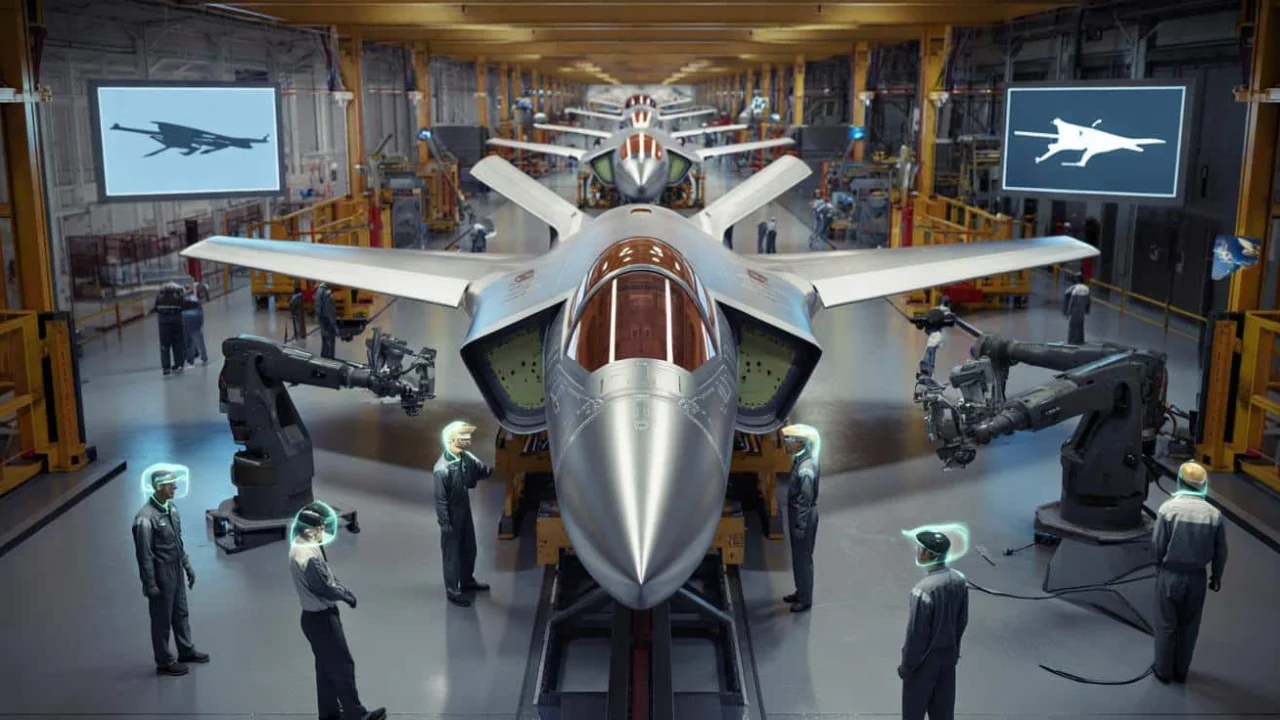
Picture walking into a factory where robots and humans work side by side, building something that will soar through the sky at twice the speed of sound. The air smells of metal and precision oil, while sparks fly from welding stations. Every 30 hours, another critical piece of America’s most advanced fighter jet rolls off the line.
This isn’t science fiction. It’s happening right now in Palmdale, California, where Northrop Grumman just hit a milestone that most people will never hear about but should definitely care about.
The defense contractor recently delivered its 1,500th center fuselage for the F-35 Lightning II fighter jet. While that might sound like just another manufacturing number, it represents something much bigger: proof that America can still build incredibly complex things at massive scale.
Why This Piece of Metal Matters More Than You Think
The F35 center fuselages aren’t just chunks of aluminum. Think of them as the backbone of one of the world’s most sophisticated flying machines. These sections connect the cockpit to the wings and rear of the aircraft, housing critical systems that keep pilots alive and missions successful.
Every center fuselage must withstand forces that would crush a car. During high-G maneuvers, carrier landings, or combat operations, these structures experience stress levels that push engineering to its absolute limits. The fuselage must handle everything from supersonic speeds to vertical landings on aircraft carriers, all while protecting sensitive electronics worth millions of dollars.
Each center fuselage contains approximately 1,800 parts, from titanium structural components to advanced composite materials. The manufacturing process requires tolerances measured in thousandths of an inch – precision that demands both cutting-edge automation and skilled human oversight.
“The center fuselage is essentially the nervous system and skeleton combined,” explains aerospace manufacturing expert Dr. Sarah Chen. “It’s where structural integrity meets advanced electronics, and there’s zero room for error. A single misaligned component could compromise the entire aircraft.”
Northrop Grumman builds these components at their Integrated Assembly Line (IAL) in Palmdale using methods that look more like car manufacturing than traditional aerospace production. The facility operates almost continuously, producing one completed center fuselage every 30 hours through three shifts of dedicated workers.
Breaking Down the Manufacturing Marvel
The numbers behind this achievement tell a fascinating story about modern manufacturing:
| Milestone | Details |
|---|---|
| Total Delivered | 1,500 F35 center fuselages |
| Production Rate | 1 fuselage every 30 hours |
| Location | Palmdale, California |
| Manufacturing Method | Integrated Assembly Line (IAL) |
| Automation Level | Semi-automated with robotic assistance |
| Floor Space | 215,000 square feet |
| Weight per Fuselage | Approximately 3,500 pounds |
The Palmdale facility represents a complete rethinking of how complex military hardware gets built. The 215,000-square-foot production floor houses seventeen work stations, each performing specific assembly tasks with military precision. Key features include:
- Continuous flow production similar to automotive assembly
- Automated drilling and fastening systems capable of placing over 10,000 fasteners per fuselage
- Real-time quality inspection at every station using laser measurement systems
- Integrated systems testing during assembly to catch problems early
- Predictive maintenance to minimize downtime and maximize efficiency
- Advanced material handling systems that move components seamlessly between stations
- Climate-controlled environment maintaining precise temperature and humidity
“We’ve essentially industrialized what used to be a craft process,” notes manufacturing analyst Mike Rodriguez. “This isn’t your grandfather’s aircraft factory. Workers use tablets to access real-time assembly instructions, robots handle the heavy lifting, and artificial intelligence helps optimize workflow.”
The transformation didn’t happen overnight. Northrop Grumman invested over $500 million in automation and worker training to achieve these production rates while maintaining the exacting quality standards military aviation demands. The company developed new manufacturing techniques specifically for the F-35 program, including automated fiber placement for composite components and robotic assembly systems that can work 24/7 without fatigue.
Each work station represents years of engineering optimization. For example, Station 7 uses a massive robotic drilling system that can position and drill holes with accuracy measured in micrometers. Station 12 features automated wire harness installation that routes thousands of feet of cables through the fuselage structure with perfect repeatability.
What This Means for Everyone
You might wonder why anyone outside the defense industry should care about F35 center fuselages. The answer touches everything from job creation to international relations, extending far beyond military applications.
This milestone represents approximately 15,000 high-skilled manufacturing jobs across multiple states. These aren’t just assembly line positions – they’re careers requiring advanced technical training in robotics, precision measurement, and aerospace materials. The average worker at the Palmdale facility earns 40% more than the regional manufacturing average, reflecting the high-skill nature of the work.
The economic ripple effects extend far beyond Palmdale. Northrop Grumman sources materials and components from over 800 suppliers nationwide, supporting thousands of additional jobs in communities from Ohio to Texas. Major suppliers include Alcoa for aluminum components, RTX for avionics systems, and dozens of smaller specialty manufacturers.
“Every center fuselage represents about $2.8 million in economic activity when you factor in all the suppliers and subcontractors,” explains defense economics researcher Dr. James Patterson. “That’s not just the direct cost – it includes wages, materials, research and development, and facility investments.”
Internationally, the F-35 program involves eight partner nations plus multiple customers worldwide. Countries like the UK, Italy, and Australia have invested billions in the program and depend on steady production to equip their air forces. The United Kingdom alone plans to purchase 138 F-35s over the next decade, requiring steady center fuselage deliveries.
The 1,500-fuselage milestone also signals that the F-35 program has moved beyond its troubled early years into mature production. Critics once called it a boondoggle plagued by cost overruns and technical problems, but steady manufacturing achievements like this demonstrate the program’s industrial viability and growing efficiency.
For taxpayers, consistent production means stable unit costs and reliable delivery schedules. The Pentagon can plan force modernization knowing that the industrial base can deliver. Recent data shows that F35 center fuselages are now being delivered 25% faster than original projections, helping drive down overall aircraft costs.
Looking ahead, Northrop Grumman expects to maintain or increase production rates as international orders continue flowing in. Several countries have recently expanded their F-35 purchases, creating demand for hundreds of additional center fuselages. Poland recently committed to purchasing 32 additional aircraft, while Finland has ordered 64 jets to replace their aging F/A-18 fleet.
The success also validates advanced manufacturing techniques that could transform other industries. Automotive companies are already studying aerospace automation methods, while other defense contractors are adopting similar integrated assembly approaches. Tesla has consulted with Northrop Grumman engineers about applying aerospace quality control methods to electric vehicle production.
“What we’re seeing in Palmdale represents the future of American manufacturing,” says industrial policy expert Dr. Lisa Chang. “It’s high-tech, high-skill, and globally competitive. More importantly, it proves that America can compete with anyone in advanced manufacturing when we combine worker skills with smart automation.”
The broader implications extend to national security strategy. Reliable, high-rate production of critical defense systems ensures America can respond to emerging threats while supporting allies worldwide. The F-35’s multi-role capabilities – air-to-air combat, ground attack, and intelligence gathering – make these aircraft essential tools for modern military operations.
Environmental considerations also factor into the success story. The Palmdale facility operates as a zero-waste-to-landfill facility, recycling 98% of production waste. Advanced manufacturing techniques reduce material waste compared to traditional aerospace production methods, while the F-35’s fuel efficiency improvements over legacy aircraft will reduce operational emissions over the aircraft’s lifetime.
FAQs
What exactly is a center fuselage?
It’s the middle section of the F-35 that connects the cockpit to the wings and tail, housing critical flight systems and weapons.
How long does it take to build one F35 center fuselage?
Northrop Grumman’s current production rate is one completed center fuselage every 30 hours using their automated assembly line.
Where are F35 center fuselages manufactured?
All F35 center fuselages are built at Northrop Grumman’s Integrated Assembly Line facility in Palmdale, California.
How much does each center fuselage cost?
While exact costs aren’t public, each center fuselage represents approximately $2.8 million in total economic activity including suppliers and materials.
Will production continue increasing?
Yes, international orders and Pentagon requirements suggest production will maintain or increase current rates for the foreseeable future, with over 3,000 total F-35s planned globally.
How many people work on F35 center fuselages?
The program supports approximately 15,000 high-skilled manufacturing jobs across multiple states, with thousands more in the supplier network spanning over 800 companies nationwide.
About the Author