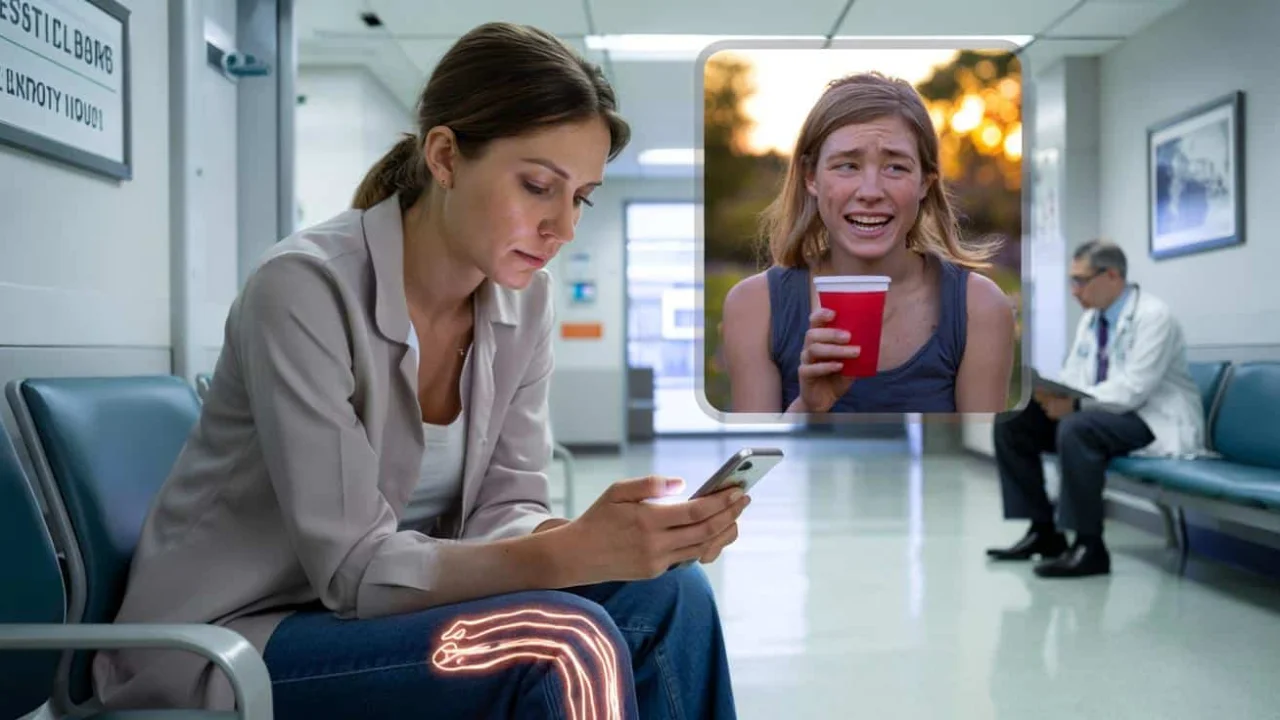
Sarah remembers the exact moment her freshman year derailed. One day she was cramming for finals, the next she couldn’t lift her head off her dorm pillow. Her roommate joked it was the “kissing disease” after Sarah mentioned making out with someone at a party the week before. Mono, they called it. Epstein-Barr virus. She spent three weeks sleeping 16 hours a day, living on soup her mom brought from home.

That was fifteen years ago. Last month, Sarah sat in a neurologist’s office learning about brain lesions and something called multiple sclerosis. The doctor mentioned new research connecting her old college virus to her current symptoms. The numbness in her hands, the fatigue that never quite went away, the vision problems that started last spring.
Suddenly, that “harmless” virus from her teenage years doesn’t feel so innocent anymore.

The connection doctors can no longer ignore
For decades, Epstein-Barr virus lived in medicine’s “annoying but harmless” category. Nearly everyone gets infected at some point, usually as teenagers or young adults. Most people recover from the initial mono symptoms and move on with their lives, never thinking about the virus again.
But the virus never really leaves. It stays dormant in your immune system, occasionally reactivating without you knowing. And now, mounting evidence suggests this common virus might be triggering multiple sclerosis in some people years or even decades later.

“We used to think EBV was just a nuisance that caused mono in college students,” says Dr. Michael Patterson, a neurologist at Johns Hopkins. “Now we’re realizing it might be one of the most important risk factors for MS that we’ve ever identified.”
The breakthrough came from a massive study that followed over 10 million US military personnel for two decades. Researchers found that people infected with Epstein-Barr virus were 32 times more likely to develop multiple sclerosis compared to those who remained uninfected. That’s not a small statistical bump – that’s a smoking gun.

What the numbers actually tell us
The research paints a clear picture of how Epstein-Barr virus and multiple sclerosis intersect. But the relationship is more complex than a simple cause-and-effect story.
| Key Finding | What It Means |
|---|---|
| 95% of MS patients have EBV antibodies | Almost everyone with MS has been infected with EBV |
| 32x higher risk after EBV infection | EBV infection dramatically increases MS chances |
| 10-15 year delay typical | MS symptoms often appear years after initial EBV infection |
| Only 0.2% of EBV-infected people get MS | Most people with EBV never develop MS |
The timing reveals something crucial about how this works. Multiple sclerosis doesn’t appear immediately after someone catches mono. Instead, there’s usually a gap of 10 to 15 years between the initial Epstein-Barr infection and the first MS symptoms.

Here’s what researchers believe happens during that silent period:
- EBV hides in immune system cells, staying dormant most of the time
- Occasionally, the virus reactivates and produces proteins
- In some people, these viral proteins look similar to brain tissue proteins
- The immune system gets confused and starts attacking both the virus and brain tissue
- This autoimmune attack on the brain’s protective covering causes MS symptoms
“Think of it like mistaken identity,” explains Dr. Sarah Chen, an immunologist studying viral triggers for autoimmune diseases. “Your immune system is trying to fight the virus, but it accidentally attacks your own brain tissue because they look too similar.”
Who should be paying attention to this research
This discovery affects millions of people, but not in the way you might expect. Since nearly everyone gets infected with Epstein-Barr virus at some point, and only a tiny fraction develop multiple sclerosis, the research doesn’t mean everyone should panic about their teenage mono.
Instead, it opens new doors for prevention and treatment. Scientists are now working on EBV vaccines that could potentially prevent multiple sclerosis before it starts. Several pharmaceutical companies have early-stage EBV vaccines in development, though they’re still years away from being available to the public.
For people already diagnosed with multiple sclerosis, this research offers hope for better treatments. If EBV is driving the disease, then targeting the virus directly might help control MS symptoms.
“We’re seeing promising results with antiviral medications in some MS patients,” notes Dr. Patterson. “It’s still experimental, but the idea is simple: if we can keep EBV completely suppressed, maybe we can slow down or stop the autoimmune attack.”
The research also changes how doctors think about MS risk factors. Family history and genetics still matter, but now EBV infection status becomes another piece of the puzzle. People with strong family histories of MS who also had severe mono as teenagers might benefit from closer monitoring for early MS symptoms.
Young adults experiencing their first EBV infection should know the warning signs of multiple sclerosis, even though the vast majority will never develop the disease. These include unexplained numbness, vision problems, persistent fatigue, and coordination difficulties that can’t be explained by other causes.
Parents might start wondering if they should try to prevent their teenagers from getting mono in the first place. But infectious disease experts caution that EBV is so common and spreads so easily that prevention is nearly impossible. Plus, getting infected as a teenager or young adult is actually safer than getting infected later in life, when EBV can cause more severe complications.
The real game-changer will be prevention through vaccination. “If we can develop an effective EBV vaccine and give it to children before they’re exposed, we might be able to prevent a significant portion of MS cases,” says Dr. Chen. “That would be one of the biggest public health victories in modern medicine.”
FAQs
Does having mono mean I’ll definitely get multiple sclerosis?
No. While EBV infection increases MS risk significantly, only about 2 out of every 1,000 people with EBV ever develop MS.
Can I get tested to see if I have the Epstein-Barr virus?
Yes, blood tests can show if you’ve been infected with EBV, but since 95% of adults have been infected, the test isn’t usually helpful for predicting MS risk.
Should I be worried if my teenager just got mono?
Most teenagers recover completely from mono with no long-term effects. The MS connection affects only a very small percentage of people with EBV.
Are there treatments that target EBV in MS patients?
Some doctors are experimenting with antiviral medications for MS patients, but these treatments are still being studied and aren’t standard care yet.
When might an EBV vaccine become available?
Several companies are developing EBV vaccines, but they’re still in early clinical trials. A vaccine likely won’t be available for at least 5-10 years.
Can stress or other factors trigger MS in people who have EBV?
Researchers believe EBV infection is necessary but not sufficient to cause MS. Other factors like genetics, vitamin D levels, and possibly stress may also play roles in triggering the disease.
About the Author