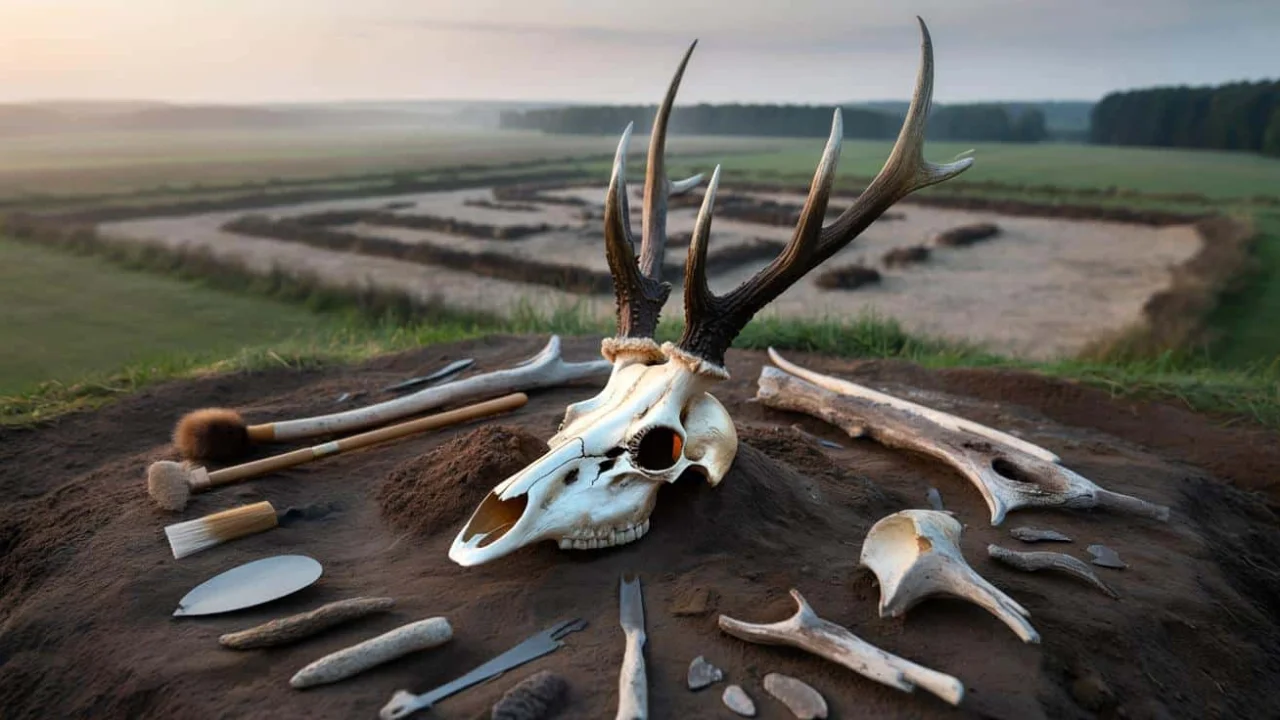
Picture this: You’re walking through a German field, metal detector in hand, when suddenly you hit something solid beneath the earth. What emerges isn’t just another piece of pottery or rusted metal—it’s a 7,500-year-old deer skull headdress that completely rewrites our understanding of ancient human connections.

That’s exactly what happened near the town of Eilsleben in northern Germany, where archaeologists uncovered one of the most intriguing artifacts of prehistoric Europe. This isn’t just any old bone fragment. This deer skull headdress represents a pivotal moment when two completely different ways of life—hunting and farming—collided and somehow found common ground.
The discovery has sent ripples through the archaeological community because it challenges everything we thought we knew about how early farmers and hunter-gatherers interacted. Instead of conflict or complete separation, this artifact tells a story of cultural exchange that happened thousands of years before we had written records.

When Two Worlds Collided in Ancient Germany
The deer skull headdress was found at what researchers now recognize as one of the largest Neolithic settlements in the region—a 20-acre site that served as a frontier outpost for early farmers. These weren’t just any farmers, though. They belonged to the Linearbandkeramik (LBK) culture, groups who had migrated from the Aegean and Anatolia, bringing revolutionary changes to Central Europe.
“The style of the headdress is clearly Mesolithic, not Neolithic, suggesting it came from or copied the tradition of local hunter-gatherers,” explains one researcher involved in the excavation. This detail is crucial because it shows that these farming communities weren’t just taking over the landscape—they were actively engaging with the people who were already there.

What makes this discovery so remarkable is where it was found. Picture longhouses, defensive ditches, and all the typical infrastructure of an early farming village. Now imagine finding a ceremonial headdress made from a roe deer skull right in the middle of it all. It’s like discovering a Native American dreamcatcher in a medieval European castle—it simply doesn’t belong according to traditional archaeological thinking.
The headdress itself was carefully crafted from an adult roe deer’s skull and antlers, modified specifically to be worn during ceremonies. This wasn’t a hunting trophy casually discarded—it was a sacred object that required skill, time, and cultural knowledge to create.
What the Evidence Really Shows Us
The Eilsleben site has been revealing its secrets since the 1970s, but new geomagnetic surveys have shown just how significant this settlement really was. The archaeological evidence paints a fascinating picture of cultural mixing:
| LBK Farmer Artifacts | Hunter-Gatherer Influences |
|---|---|
| Long rectangular house foundations | Mesolithic-style ritual headdress |
| Standard farming stone tools | Forest-adapted hunting implements |
| Defensive ramparts and ditches | Seasonal mobility patterns |
| Domesticated animal remains | Wild deer ceremonial objects |
This mixture of artifacts tells a story that’s far more complex than simple conquest or displacement. The fortifications suggest these farmers were serious about staying put—they built to last and defend their territory. But the presence of hunter-gatherer ceremonial objects and tools shows they weren’t living in isolation.

“The fortifications say ‘we are staying put,’ but the artifacts show deep contact with roaming hunter-gatherers,” notes one archaeologist studying the site. This contradiction reveals the delicate balance these communities had to strike between establishing permanent settlements and maintaining relationships with mobile groups.
Key findings from recent excavations include:
- Evidence of both permanent settlement structures and temporary occupation areas
- Stone tools that blend farming and hunting technologies
- Dietary remains showing both cultivated crops and wild game
- Burial practices that combine both cultural traditions
- Trade goods indicating long-distance exchange networks
The deer skull headdress sits at the center of this cultural puzzle. Its Mesolithic style suggests it was either made by hunter-gatherers and traded to the farmers, or created by farmers who had learned the techniques from their mobile neighbors.
Why This Changes Everything About Ancient Europe
This discovery fundamentally shifts how we understand the Neolithic transition in Europe. For decades, archaeologists debated whether the spread of farming was primarily due to migration of new peoples or the adoption of new technologies by existing populations. The Eilsleben deer skull headdress suggests the reality was far more nuanced.
The implications ripple far beyond academic circles. This artifact shows us that even 7,500 years ago, humans were finding ways to bridge cultural divides and share knowledge across dramatically different lifestyles. In our modern world of increasing polarization, there’s something deeply hopeful about evidence that our ancestors chose cooperation over conflict.
“What we’re seeing here is not replacement, but integration,” explains a leading expert in Neolithic archaeology. “These communities found ways to maintain their distinct identities while sharing technologies, rituals, and probably marriage partners.”
The practical consequences of this research extend into multiple fields:
- Anthropologists are reconsidering models of cultural change and adaptation
- Historians are revising timelines of European settlement patterns
- Geneticists are finding new ways to trace ancient population mixing
- Climate researchers are understanding how environmental changes affected human cooperation
For modern Germany, this discovery adds another layer to the country’s rich archaeological heritage. The Eilsleben site joins other significant Neolithic discoveries that show Central Europe was a major crossroads of ancient cultures, not just a peripheral area where farming eventually arrived.
The deer skull headdress also raises intriguing questions about spiritual and ceremonial life in prehistoric Europe. If farmers were adopting hunter-gatherer rituals, what other aspects of their belief systems might have been shared? The artifact suggests that religious and ceremonial practices may have been some of the first things exchanged between these different groups.
Perhaps most importantly, this discovery reminds us that cultural boundaries were more fluid in the ancient world than we often assume. The people who wore this deer skull headdress lived in a world where identity wasn’t fixed, where new ideas could be adopted and adapted, and where survival often depended on flexibility rather than rigid adherence to tradition.
As archaeologists continue to excavate the Eilsleben site, they’re likely to uncover more evidence of this remarkable cultural mixing. Each artifact adds another piece to the puzzle of how our ancestors navigated the complex process of building new societies while honoring old traditions.
FAQs
How old is the deer skull headdress found in Germany?
The deer skull headdress is approximately 7,500 years old, dating to the early Neolithic period when farming was first spreading across Central Europe.
What makes this headdress so significant to archaeologists?
It represents clear evidence of cultural exchange between hunter-gatherers and early farmers, showing these groups interacted peacefully and shared ritual practices rather than just displacing each other.
Who were the LBK people mentioned in the discovery?
The Linearbandkeramik (LBK) culture were early farmers who migrated from the Aegean and Anatolia regions, bringing agriculture and permanent settlement practices to Central Europe around 7,500 years ago.
Could the farmers have made the headdress themselves?
While possible, the Mesolithic style strongly suggests it was either made by hunter-gatherers and traded, or created by farmers who learned the techniques from their mobile neighbors.
What other evidence shows interaction between these different groups?
The site contains a mixture of typical farming tools alongside hunter-gatherer implements, combined dietary remains of both crops and wild game, and burial practices that blend both cultural traditions.
Where exactly was this discovery made in Germany?
The deer skull headdress was found near the modern town of Eilsleben in northern Germany, at what is now recognized as one of the largest LBK settlements in the region.
About the Author