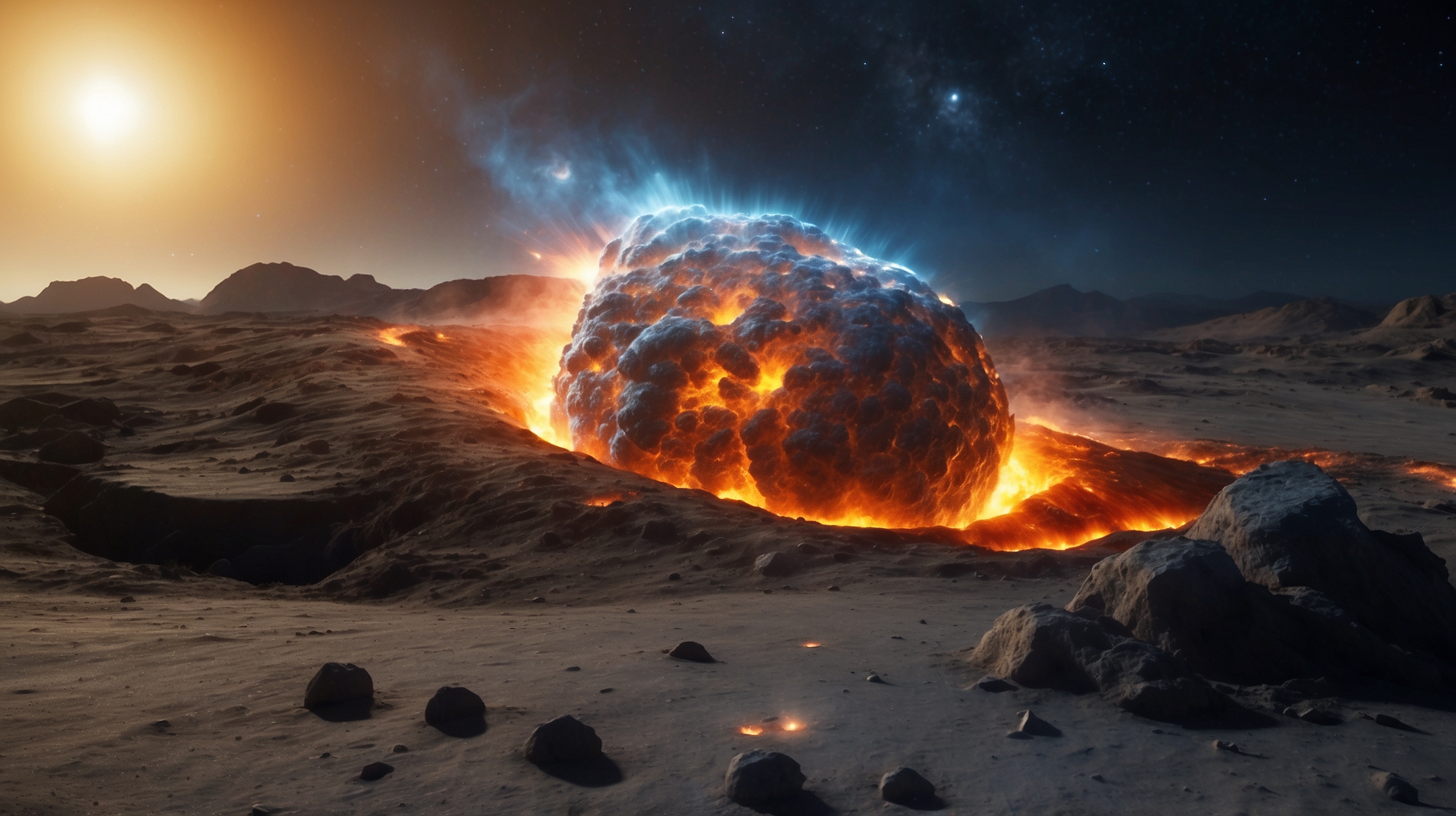
In a dramatic celestial event that has stunned astronomers and skywatchers alike, **Comet C/2025 K1 (ATLAS)** appears to be disintegrating after its perilous flyby of the Sun. This cosmic traveler, once expected to deliver a dazzling show for Earth observers, now seems to be unraveling mere days after reaching perihelion—the closest point to the Sun in its orbit. Recent high-resolution images captured from space observatories reveal telltale signs of the comet fragmenting under the immense heat and gravitational forces at play during its solar encounter.

The comet’s sudden breakup has shifted the narrative from excitement about a potential bright spectacle in the night sky to a sobering reminder of how fragile and volatile these drifting ice-and-rock bodies truly are. Comet C/2025 K1 ATLAS, originally discovered in May 2025, was orbiting in from the Oort Cloud and had shown promise of becoming visible to the naked eye. But while its trajectory allowed it to survive initial solar proximity, the latest observations suggest its nucleus has collapsed into multiple pieces, drastically diminishing its brightness and eliminating much of its potential for visibility from Earth.
Key highlights about Comet C/2025 K1’s recent activity
| Aspect | Details |
|---|---|
| Comet Name | Comet C/2025 K1 (ATLAS) |
| Initial Discovery | May 2025 by ATLAS survey project |
| Perihelion (Closest Approach to Sun) | June 30, 2025 |
| Distance from Sun at Perihelion | Approx. 0.8 AU (astronomical units) |
| Fragmentation Observed | Early July 2025 |
| Expected Visibility | Naked-eye possible before disintegration |
| Current Status | Breaking apart; visibility unlikely |
The journey and fate of Comet C/2025 K1
Comets like C/2025 K1 originate from the **distant edge of our Solar System**, possibly the Oort Cloud, and take millions of years to return. As they approach the Sun, increasing heat vaporizes their icy compositions, creating the glowing heads and tails that are visible from Earth. Not all comets survive the heat—especially not those on maiden voyages into the inner Solar System.

C/2025 K1’s journey was both exhilarating and perilous. Early modeling suggested it could brighten significantly, raising hopes of a spectacular display. Instead, the comet began showing signs of structural failure shortly after rounding the Sun. Close-up imaging has revealed multiple condensation points along its path—an indication of the nucleus breaking into separate fragments. This event significantly reduces the amount of reflected sunlight and hence, visible brightness.
“We were tracking the comet closely and saw its expected light curve flatten and then plunge—classic signs of a breakup event.”
— Dr. Lien Chen, Astrophysicist, Planetary Science InstituteAlso Read El pueblo de Ciudad Real que tiene 47 vecinos pero su propio aeropuerto: así es la curiosa realidad
What causes a comet to break apart
The disintegration of comets is far from rare, but each case teaches astronomers more about their structure and behavior. In this instance, C/2025 K1 likely succumbed to a combination of **solar radiation pressure**, tidal forces, and **internal gas pressure buildup**. The immense solar heat triggers rapid sublimation—where frozen gases inside the comet turn directly to vapor—and over time, these forces can crack and split the comet’s nucleus.

Experts believe that K1’s **structural cohesion was relatively weak**, possibly a ‘contact binary’—two looser bodies held together by gravity. If that’s the case, intense thermal and mechanical stresses during perihelion would have been enough to tear it apart. Once fractured, the clouds of ice and dust released dramatically reduce optical brightness, essentially fading the comet into the cosmic background.
A missed cosmic spectacle for observers
Many amateur astronomers and astrophotographers were eagerly awaiting the comet’s solar exit and possible evening sky appearances. Initial predictions suggested C/2025 K1 had the potential to become as bright as magnitude +2, easily visible to the naked eye under clear dark skies. However, now that the nucleus has disintegrated, these expectations have dimmed accordingly.

What remains in the sky will most likely be **a diffuse cloud of dust and gas**, with some fragments perhaps still intact but no longer cohesive enough to maintain brilliance. For now, telescopic observations will focus on studying how the fragments disperse and interact with the solar wind in coming weeks.
Scientific gains from a disappointing turn
Despite public disappointment, the breakup of C/2025 K1 offers a scientific bonanza. Studying fragmenting comets helps astronomers evaluate their internal structure, composition, and dynamic behavior under extreme stress. The current and upcoming **space telescope passes** through the remnant trail will yield valuable spectroscopic data.
For missions like the **James Webb Space Telescope and ground-based observatories**, such a break-up provides a rare opportunity to witness and measure disintegration pathways in real time. These insights feed directly into comet modeling that supports risk assessments for Near-Earth Objects (NEOs) and planetary defense initiatives.
“It’s unfortunate from a skywatcher’s point of view, but scientifically, this is a goldmine. We’re now seeing pristine interiors exposed that tell us more about the early Solar System.”
— Dr. Priya Malhotra, Comet Dynamics Lead, NASA JPL
Comparisons to historic cometary events
Historically, many celebrated comets have met similar fates. Comet ISON in 2013 disintegrated shortly after perihelion, despite initial expectations of a brilliant display. Likewise, Comet C/1999 S4 (LINEAR) broke up before it reached its closest approach. These precedents reflect the extreme vulnerability of certain comet nuclei, especially first-time visitors to the inner Solar System.
C/2025 K1 now joins this list—its legacy not marked by brilliance in the night sky but by a **textbook case of solar-induced fragmentation**. For researchers, these events are more consistent than the occasional showstoppers like Comet Hale-Bopp or NEOWISE, proving that cosmic drama often unfolds invisibly, billions of kilometers from Earth.
Impacts on future comet expectations
All eyes were on C/2025 K1 partly because the next major bright comet may not appear until later in the decade. With its breakup, hopes are now pinned on alternative newly-discovered celestial travelers to fill the gap. Nonetheless, the event underscores that **comet brightness predictions are notoriously unreliable**, especially for dynamically new comets venturing close to the Sun for the first time.
Space agencies are continuing deep-sky scans for emerging candidates, and each passing fragment teaches scientists how to better model trajectories, compositions, and survival odds for future cometary visits.
Frequently asked questions about Comet C/2025 K1
What is Comet C/2025 K1 ATLAS?
It is a long-period comet discovered in May 2025 by the ATLAS survey system, originating likely from the Oort Cloud.
Why did Comet C/2025 K1 break apart?
The comet encountered intense solar radiation near perihelion, causing sublimation and mechanical stress that likely fractured its nucleus.
Can I still see any part of the comet?
Possibly. Some faint fragments may still be observable with high-powered telescopes, but naked-eye visibility is no longer plausible.
Was this comet visible from Earth before it broke apart?
It showed promising brightness before perihelion but began fading rapidly soon after breaking into fragments.
Are comet breakups like this common?
Yes, especially among new comets that orbit close to the Sun for the first time. Many do not survive their first pass.
What can scientists learn from this event?
The disintegration provides vital data on the comet’s structure, composition, and erosion process, contributing to better models of cometary behavior.
Does this pose any threat to Earth?
No. The fragments from C/2025 K1 pose no impact risk to Earth as their trajectories are distant and well understood.
Will there be another major comet soon?
Currently, no comparable comet is expected imminently, but new discoveries could change the outlook quickly.
About the Author