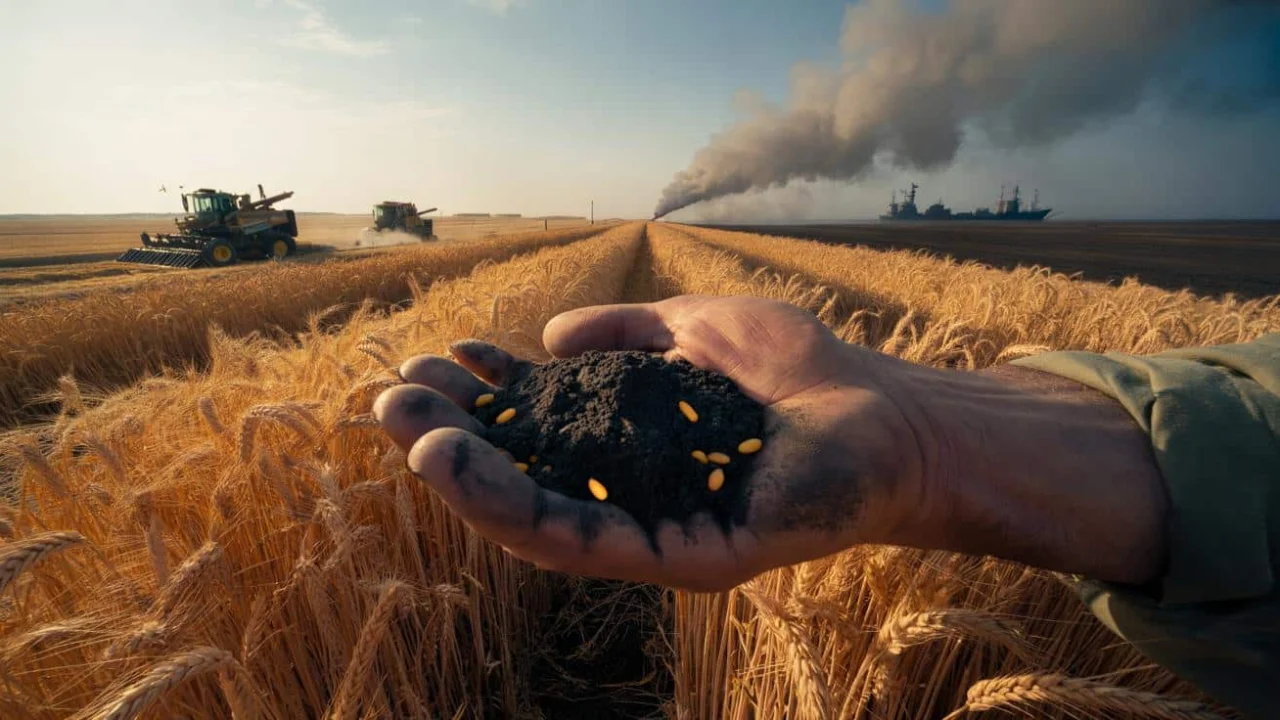
Maria Petrenko remembers the exact moment she realized her family’s wheat farm wasn’t just about feeding her neighbors anymore. Standing in her kitchen in central Ukraine, she watched the morning news as bread riots erupted in Tunisia. The reporter mentioned Ukrainian wheat exports, and something clicked. The black soil her grandfather had worked for decades wasn’t just dirt—it was a lifeline stretching across oceans to kitchens she’d never see.
That was 2011. Today, Maria’s farm sits empty, her tractors silent. Russian shells have turned her fields into a patchwork of craters and unexploded ordnance. What was once fertile ground that helped feed millions has become another casualty in a war that’s reshaping how the world thinks about food security.
Her story isn’t unique. Across Eastern Europe and Central Asia, farmers who thought they were simply growing crops have discovered they’re actually sitting on geopolitical gold mines.

The Black Gold That Changed Everything
The “black gold of agriculture”—as experts call the rich chernozem soils spanning Ukraine, Russia, and Kazakhstan—covers roughly 230 million hectares. That’s an area larger than Mexico, blessed with some of the most productive farmland on Earth. For generations, this soil quietly fed local communities and supplied modest exports to neighboring regions.
Then globalization hit agriculture like a freight train. Container ships got bigger, supply chains stretched longer, and suddenly these remote farming regions found themselves at the center of a global food web. By 2020, this trio of countries controlled nearly 30% of world wheat exports and significant portions of corn, barley, and sunflower oil production.

“Nobody really understood how dependent we’d become on this region until the supply suddenly got threatened,” explains Dr. Sarah Mitchell, an agricultural economist who’s studied grain markets for two decades. “It’s like finding out your neighborhood grocery store has been quietly supplying half the country.”
The numbers tell a stark story. Before 2022, Ukraine alone exported enough grain annually to feed 400 million people. Russia dominated wheat markets across the Middle East and North Africa. Kazakhstan, often overlooked, had become Central Asia’s grain lifeline and a growing supplier to China.

When Breadbaskets Become Battlegrounds
The transformation from agricultural powerhouse to strategic weapon happened faster than anyone anticipated. Here’s how the black gold of agriculture became a geopolitical flashpoint:
| Country | Pre-2022 Wheat Exports (million tons) | Key Export Destinations | Current Status |
|---|---|---|---|
| Ukraine | 20.2 | Egypt, Bangladesh, Indonesia | Severely disrupted by war |
| Russia | 37.3 | Turkey, Egypt, Saudi Arabia | Under heavy sanctions |
| Kazakhstan | 8.5 | Central Asia, Iran, Afghanistan | Logistically constrained |
The disruption rippled outward in ways nobody fully predicted. Egyptian bakeries, which had relied on Ukrainian wheat for decades, suddenly faced shortages. Turkish flour mills scrambled to find alternative suppliers. In Lebanon, already struggling with economic collapse, bread became a luxury item for many families.
“We went from abundance to scarcity overnight,” says Ahmed Hassan, who runs a small bakery in Cairo. “The same wheat that used to come reliably from Ukraine just… stopped. My customers don’t care about geopolitics—they just want bread for their families.”
The crisis exposed how thoroughly the global food system had become dependent on this single region’s black gold of agriculture. Countries that had never worried about grain supplies suddenly found themselves vulnerable to events happening thousands of miles away.
- Over 50 countries import more than 30% of their wheat from the Black Sea region
- Global wheat prices spiked 40% in the first months after Russia’s invasion
- An estimated 20 million tons of Ukrainian grain got trapped in silos due to blocked shipping routes
- Food import bills for developing countries increased by $90 billion in 2022
The Human Cost of Strategic Soil
Beyond the statistics and supply chains, the weaponization of agricultural resources has created a humanitarian crisis that extends far beyond the immediate conflict zone. Families in Somalia face famine partly because Ukrainian grain ships can’t reach their ports. School feeding programs in Yemen have been suspended due to wheat shortages. Bakeries from Morocco to Bangladesh have had to ration supplies or raise prices beyond what many customers can afford.
“Food security used to be about having enough farmland and good weather,” notes Dr. James Rodriguez, a food policy expert with the UN World Food Programme. “Now it’s about geopolitics, shipping routes, and whether countries can weaponize their grain exports.”
The situation has forced a fundamental rethinking of global food security. Countries that once took grain imports for granted are now scrambling to diversify suppliers or boost domestic production. India, traditionally focused on rice, has ramped up wheat production. Argentina and Australia have seen increased demand for their grain exports. Even typically food-secure European nations are reassessing their agricultural policies.
Kazakhstan, caught between its larger neighbors, faces its own dilemma. With traditional export routes through Russia complicated by sanctions and alternative paths limited, the country’s farmers find themselves with bumper harvests but nowhere to sell them profitably.
The black gold of agriculture has revealed itself to be both blessing and curse—a source of prosperity that can quickly become a tool of warfare. For farmers like Maria Petrenko, whose family has worked Ukrainian soil for generations, the transformation feels surreal. What started as a simple desire to grow food and make a living has become entangled in global politics and international security.
The long-term implications remain unclear, but one thing has become certain: the world can no longer take its daily bread for granted. The fertile soils that once quietly fed hundreds of millions have become a strategic resource as valuable—and as contested—as oil reserves or rare earth minerals.
FAQs
What makes the soil in Ukraine, Russia, and Kazakhstan so special for agriculture?
The region contains chernozem or “black earth” soil, which is extremely rich in organic matter and nutrients. This soil type is naturally fertile and can produce high crop yields with minimal fertilizer input.
How much of the world’s grain comes from this region?
Before 2022, Ukraine, Russia, and Kazakhstan together supplied about 30% of global wheat exports, plus significant amounts of corn, barley, and sunflower oil.
Which countries are most affected by grain supply disruptions from this region?
Countries in the Middle East, North Africa, and parts of Asia are most vulnerable, including Egypt, Lebanon, Bangladesh, and several sub-Saharan African nations that relied heavily on Black Sea grain imports.
Can other countries replace this grain production?
While countries like Argentina, Australia, and Canada are increasing exports, replacing the full capacity of the Black Sea region takes time and significant agricultural investment.
How has the conflict changed global food prices?
Wheat prices spiked by about 40% in early 2022, with other grain and cooking oil prices also increasing significantly. While prices have stabilized somewhat, they remain elevated compared to pre-conflict levels.
What is being done to secure alternative grain supplies?
Countries are diversifying their import sources, investing in domestic agriculture, and international organizations are working to establish alternative shipping routes and grain corridors where possible.
About the Author