Captain Li still remembers the exact moment everything changed. He’d been fishing these waters for thirty years, following the same routes his father taught him around the coral reefs of the South China Sea. Then one morning in 2014, he spotted something that made him rub his eyes twice.

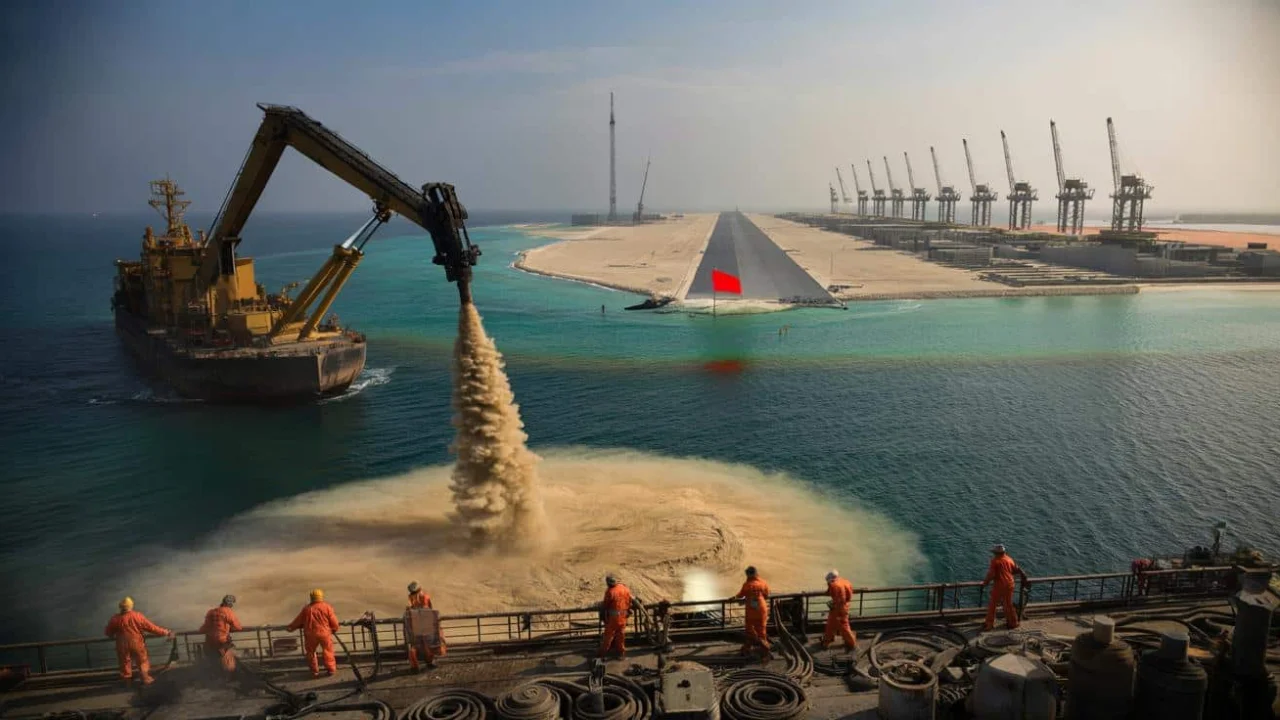
Where yesterday there had been nothing but blue water, a massive ship was shooting fountains of sand and mud into the air. “It looked like a dragon spitting,” he tells me over coffee in a Manila port. “But dragons don’t build airports.”
That ship was part of China’s most audacious engineering project of the 21st century. Over the past decade, Chinese vessels have dumped more than 200 million tonnes of sand and crushed coral into the ocean, creating entirely new landmasses from scratch. What Captain Li witnessed was artificial island construction on a scale never before attempted in human history.

The implications extend far beyond engineering marvel. These manufactured islands have fundamentally altered the strategic landscape of one of the world’s most contested waterways, where $5.4 trillion in annual trade passes through shipping lanes now overlooked by Chinese military installations that emerged from the seafloor in less than two years.
How China Turned Ocean Into Land
The process sounds almost too simple to reshape geography. Massive dredging ships, some longer than football fields, vacuum up sand and sediment from the seabed. They then spray this material onto partially submerged reefs in controlled patterns, gradually building them above the waterline.

But the scale makes it extraordinary. In the Spratly Islands alone, China has created over 3,200 acres of new land. That’s roughly the size of 2,400 football fields materializing where fish once swam.
The technical achievement required unprecedented coordination. Chinese engineers developed specialized pump boats capable of moving 4,500 cubic meters of sand per hour. Multiple vessels worked in rotation around the clock, with GPS precision to ensure sand placement within centimeters of planned coordinates. Weather windows had to be carefully calculated, as typhoon season could undo weeks of work in a single storm.

“We’re witnessing the first time in modern history that a nation has literally rewritten the map through pure industrial force,” says Dr. Sarah Chen, a maritime security expert at the Naval War College. “They’ve turned engineering into geopolitics.”
The transformation happens surprisingly fast. Satellite images show Fiery Cross Reef growing from a tiny outcrop to a full military installation with a 10,000-foot runway in just 18 months. Subi Reef expanded from 0.08 square miles to 1.5 square miles in similar timeframe.

Each island follows a similar construction pattern. First, temporary barriers contain the pumped sand to prevent dispersal. Then successive layers are built up using progressively coarser material, with the finest sand placed last to create stable surfaces. Finally, concrete seawalls and foundations are poured to ensure permanence against ocean forces.
The Numbers Behind the Sand
The sheer volume of material moved defies imagination. Here’s what China’s artificial island construction project looks like by the numbers:
| Location | Land Created (Acres) | Key Features | Completion Time |
|---|---|---|---|
| Fiery Cross Reef | 677 | 3,000m runway, port, buildings | 20 months |
| Subi Reef | 976 | 3,000m runway, harbor, hangars | 24 months |
| Mischief Reef | 1,379 | 2,600m runway, radar domes | 18 months |
| Johnson South Reef | 109 | Military facilities | 15 months |
| Cuarteron Reef | 56 | Harbor, buildings | 12 months |
Beyond the basic land creation, the infrastructure development reveals the true scope of ambition. Each major installation includes:
- Deep-water harbors capable of berthing destroyers and supply ships
- Concrete aircraft hangars hardened against missile strikes
- Multi-story administrative and residential complexes
- Advanced radar systems with 200-mile detection ranges
- Underground fuel storage and ammunition bunkers
- Desalination plants and power generation facilities
The environmental cost tells another story:
- Over 40,000 acres of coral reef damaged or destroyed
- Entire marine ecosystems buried under sand
- Fish populations disrupted across traditional breeding grounds
- Water quality degraded by constant dredging operations
- Sediment plumes affecting marine life up to 50 miles away
- Critical spawning habitats for endangered species eliminated
“Each cubic meter of sand represents thousands of years of coral growth,” explains marine biologist Dr. James Rodriguez. “We’re watching geological time get reversed in real time.”
The Strategic Revolution
These aren’t just impressive engineering projects. Each artificial island serves as a permanent military outpost, complete with radar systems, missile batteries, and aircraft hangars. China now has the ability to project power across shipping lanes that carry $3 trillion in global trade annually.
The strategic transformation is mathematical in its precision. Before 2014, Chinese military aircraft had to fly over 600 miles from Hainan Island to patrol the southern reaches of their claimed territory. Now, with airfields on Fiery Cross, Subi, and Mischief Reefs, that distance has been cut to under 200 miles, tripling effective patrol time and dramatically reducing fuel costs.
The implications ripple far beyond the South China Sea. By creating “facts on the water,” China has effectively challenged international maritime law without firing a shot. Other nations find themselves responding to new realities rather than disputing theoretical claims.
Vietnam, Philippines, and Malaysia suddenly face Chinese military installations in areas they previously patrolled freely. Commercial shipping routes now pass under the watch of Chinese radar systems that didn’t exist five years ago. Insurance rates for vessels transiting these waters have increased as geopolitical risks multiply.
“It’s like someone built a highway through your backyard while you were sleeping,” says former Philippine Navy Admiral Roberto Santos. “By the time you wake up, the concrete’s already dry.”
The psychological impact may be the most significant change. Regional navies that once operated with confidence now must calculate Chinese response capabilities before any routine patrol. Commercial vessels adjust routes to avoid potential confrontation zones. Even scientific research expeditions require diplomatic clearance where none was needed before.
The Continuing Evolution
The construction continues today, though at a slower pace. Recent satellite imagery shows ongoing work on Woody Island and new preparations at previously untouched reefs. Each month brings subtle changes that shift the regional balance of power.
Intelligence analysts track new patterns in Chinese construction activity. Secondary installations are being built on smaller reefs, creating a network of observation posts and supply depots. Underwater cables connect the islands, enabling real-time communication and coordination. Solar farms and wind generators are being installed to reduce dependence on fuel shipments.
The latest phase focuses on making these outposts more livable for permanent garrisons. Recreation facilities, expanded medical clinics, and improved living quarters suggest China intends these installations to operate indefinitely with minimal external support.
For fishermen like Captain Li, the transformation means adapting to a completely altered seascape. Traditional fishing grounds have vanished under sand and concrete. New territorial boundaries restrict access to waters their families have worked for generations. Many have been forced to find new livelihoods or travel much farther to reach productive fishing areas.
Local fishing communities report that catch sizes have declined by 60-70% in areas near the new islands. Species that once migrated through these waters now avoid the region entirely. Traditional fishing calendars, passed down through generations, no longer apply to dramatically changed marine environments.
“My grandfather taught me to read the water, but now the water speaks a different language,” Captain Li reflects. “The fish remember these places as coral gardens. They don’t understand concrete.”
But perhaps the most profound change is psychological. China has demonstrated that geography itself can be rewritten with enough determination and industrial capacity. Other nations are taking notes, and similar projects are already being planned in disputed waters worldwide.
The age of artificial island construction has begun, and the South China Sea was just the proving ground. As satellite imagery reveals new dredging activities in disputed areas near India, Japan, and even in the Arctic, the question is no longer whether this technology will spread, but how quickly other nations will master it.
“We’ve entered an era where the phrase ‘permanent geography’ no longer applies,” observes Dr. Michael Harrison, a geopolitical analyst at the Center for Strategic Studies. “If you have the technology and the will, you can literally build your way to a stronger strategic position. China has just shown the world the playbook.”
FAQs
How much did China’s artificial island construction cost?
Estimates range from $10-20 billion, though exact figures remain classified by the Chinese government.
Are these artificial islands permanent?
Yes, the islands are built with concrete foundations and are designed to withstand typhoons and storm surges for decades.
Can other countries build artificial islands too?
Technically yes, but it requires massive financial resources, specialized equipment, and favorable geographic conditions like shallow reefs.
What happens to the marine life in these areas?
Most coral ecosystems are completely destroyed during construction, and fish populations are displaced or eliminated from the immediate area.
How do these islands get fresh water and power?
Each major installation includes desalination plants for water and diesel generators for power, with newer solar and wind systems being added for sustainability.
How fast can an artificial island be built?
With modern dredging technology, a basic island can be created in 12-24 months, though full military installations take several additional years to complete.
About the Author