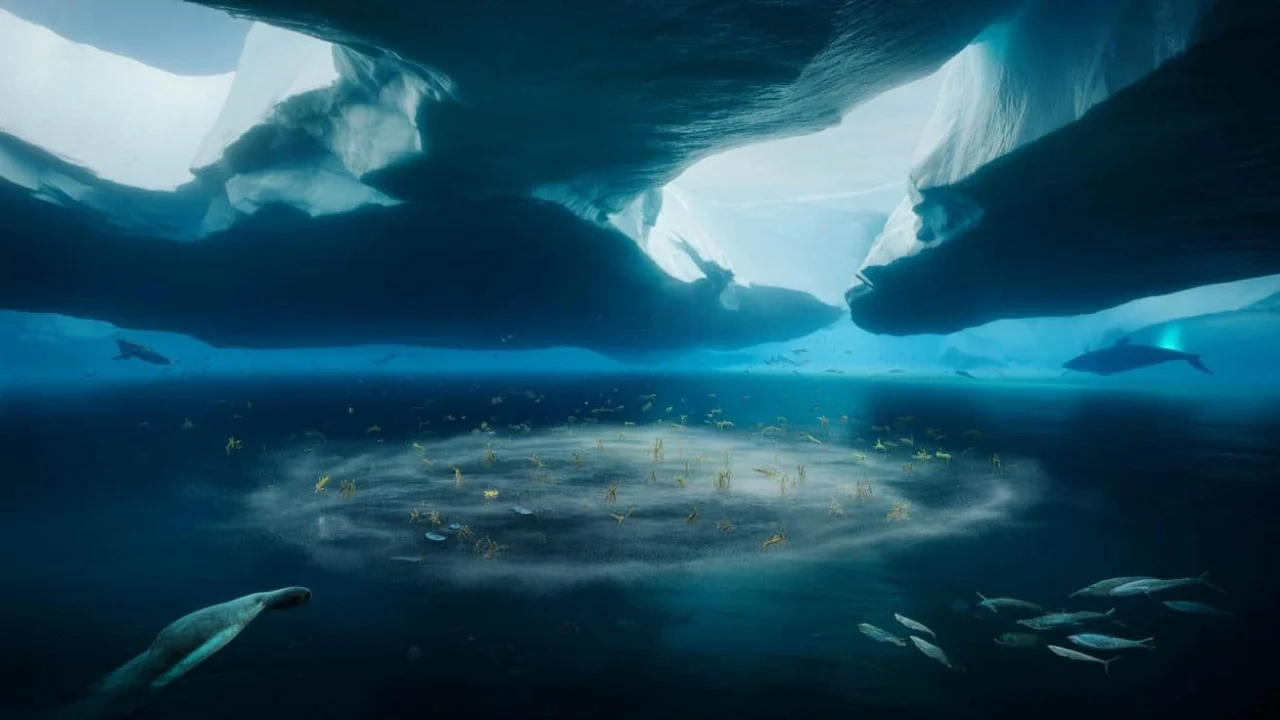
Marine biologist Sarah Chen still remembers the moment her research vessel broke through a patch of Arctic ice and she saw something impossible. The water below wasn’t the lifeless, crystal-clear void she expected. Instead, it shimmered with microscopic life—billions of tiny organisms working silently in the darkness.

“I thought our equipment was broken,” Chen recalls from that 2023 expedition. “How could anything be thriving down there?” What she discovered that day would change how we think about fighting climate change. Hidden beneath the Arctic ice lies nature’s own carbon-fighting army, and it’s been working overtime without us even knowing.
Now, as Arctic ice continues melting at record speeds, scientists are racing to understand these microscopic warriors before they—and their climate benefits—disappear forever.

The Arctic’s Secret Carbon-Fighting Army
For generations, researchers treated the Arctic Ocean like a frozen wasteland. The conventional wisdom was simple: cold, dark waters under thick ice couldn’t support much life, especially the kind that helps regulate our planet’s carbon levels.
That assumption just got shattered. Deep under multi-year Arctic ice, scientists have discovered thriving communities of diazotrophs—specialized microbes that can capture nitrogen from the atmosphere and transform it into food for marine life.

“These microbes are essentially underwater fertilizer factories,” explains Dr. Lisa von Friesen from the University of Copenhagen, who led groundbreaking expeditions aboard research vessels Polarstern and Oden. “They’re operating in conditions we thought were too harsh for complex biological processes.”
The discovery is reshaping our understanding of how Arctic ice carbon cycles work. These nitrogen-fixing microbes don’t just survive in near-freezing darkness—they actively support entire food webs that pull carbon dioxide from our atmosphere.

Von Friesen’s team measured nitrogen fixation rates in the Eurasian Arctic basin that shocked the scientific community. Even in the darkest, coldest waters under thick ice, these microbes were working as efficiently as their tropical cousins.
Breaking Down the Arctic Carbon Connection
Here’s how this hidden weapon against global warming actually works, and why it matters so much for our planet’s future:

- Nitrogen Liberation: Diazotrophs capture atmospheric nitrogen gas and convert it into ammonia, creating natural fertilizer in the ocean
- Algae Explosion: This fertilizer feeds microscopic algae, which multiply rapidly even in cold Arctic waters
- Carbon Capture: Growing algae absorb massive amounts of CO2 from seawater and atmosphere through photosynthesis
- Deep Storage: When these organisms die, much of that captured carbon sinks to the ocean floor, storing it for centuries
Recent measurements published in Communications Earth & Environment reveal just how powerful this process is. Some Arctic zones show nitrogen fixation rates of 5.3 nanomoles per liter per day—comparable to temperate ocean regions.
| Arctic Zone | Nitrogen Fixation Rate | Equivalent Carbon Capture |
|---|---|---|
| Eurasian Basin | 5.3 nmol/L/day | High potential |
| Central Arctic | 3.8 nmol/L/day | Moderate potential |
| Marginal Ice Zone | 7.2 nmol/L/day | Very high potential |
“Nobody expected to find tropical-level biological activity under Arctic ice,” notes Dr. Michael Torres, an oceanographer not involved in the original research. “This completely changes how we calculate the Arctic’s role in global carbon cycles.”
The implications go far beyond academic curiosity. As Arctic ice carbon systems become better understood, they could represent one of nature’s most important tools for slowing climate change—if we can protect them.
What This Means for Our Warming World
The discovery of these Arctic carbon fighters comes at a critical time. Arctic sea ice is disappearing at an alarming rate, shrinking by about 13% per decade. As the ice melts, we’re not just losing a frozen landscape—we’re potentially losing a massive natural carbon capture system.
The real-world impacts affect everyone, not just polar bears. Here’s what’s at stake:
Coastal Communities: Millions of people living near coastlines depend on stable ocean carbon cycles to prevent accelerated sea-level rise. Arctic ice carbon systems help regulate these processes.
Global Agriculture: Ocean carbon absorption affects atmospheric CO2 levels, which directly influence global weather patterns and growing seasons worldwide.
Economic Consequences: The economic value of natural carbon capture is estimated at $50-100 per ton of CO2. Arctic systems could be worth billions in avoided climate damage.
“We’re essentially watching a natural climate solution disappear in real-time,” warns Dr. Elena Rodriguez, a climate systems researcher. “Understanding these processes isn’t just academic—it’s about buying time for human civilization.”
The challenge now is speed. Scientists estimate we have perhaps a decade to fully understand and potentially protect these Arctic ice carbon systems before they’re irreversibly altered by warming temperatures.
Some researchers are already exploring whether these natural processes could be enhanced or protected through targeted conservation efforts. The idea isn’t to replace emissions reductions—nothing can substitute for that—but to preserve every natural advantage we have.
The Arctic’s hidden carbon fighters remind us that nature still has secrets that could help us in the climate fight. But they also underscore how much we stand to lose if we don’t act quickly enough to preserve these remarkable systems.
As Chen reflects on that life-changing moment when she first glimpsed the Arctic’s hidden world: “We thought we were studying a dying ocean. Instead, we found one of the most important climate systems on Earth. The question is whether we can understand it fast enough to save it.”
FAQs
How much carbon can Arctic microbes actually capture?
While exact amounts are still being calculated, early estimates suggest Arctic carbon capture could be comparable to temperate ocean regions, potentially removing millions of tons of CO2 annually.
Will these microbes survive as Arctic ice continues melting?
Scientists aren’t sure yet. Some species might adapt to open water conditions, while others specifically depend on under-ice environments and could disappear.
Could we artificially boost these natural carbon-fighting processes?
Researchers are exploring this possibility, but any intervention would need careful study to avoid unintended ecological consequences.
How long have these Arctic carbon systems been operating?
Based on ice core data, similar processes likely existed for thousands of years, but we’ve only recently developed technology sensitive enough to detect them.
What happens if we lose these Arctic carbon fighters?
Losing these systems would reduce the ocean’s natural carbon absorption capacity, potentially accelerating atmospheric CO2 buildup and climate change.
How quickly are scientists studying these systems?
Multiple research teams are now prioritizing Arctic carbon research, but studying these remote systems requires expensive expeditions and specialized equipment, limiting research speed.
About the Author
