Picture this: you’re watching news footage of a humanitarian crisis unfolding in a remote mountain region. Aid planes circle overhead, but there’s nowhere safe to land. The existing airstrip is cratered, debris-covered, or simply too rough for cargo aircraft carrying life-saving supplies.

Now imagine if those same planes could drop not just food and medicine, but actual bulldozers that hit the ground ready to work. Within hours, a proper landing zone emerges from the chaos, and suddenly everything changes. This isn’t science fiction anymore.
That exact capability is what Italy just bought into, ordering five revolutionary air-droppable bulldozers that could reshape how military and humanitarian operations work in the world’s most challenging locations.

Italy Makes a Strategic Bet on Airborne Engineering
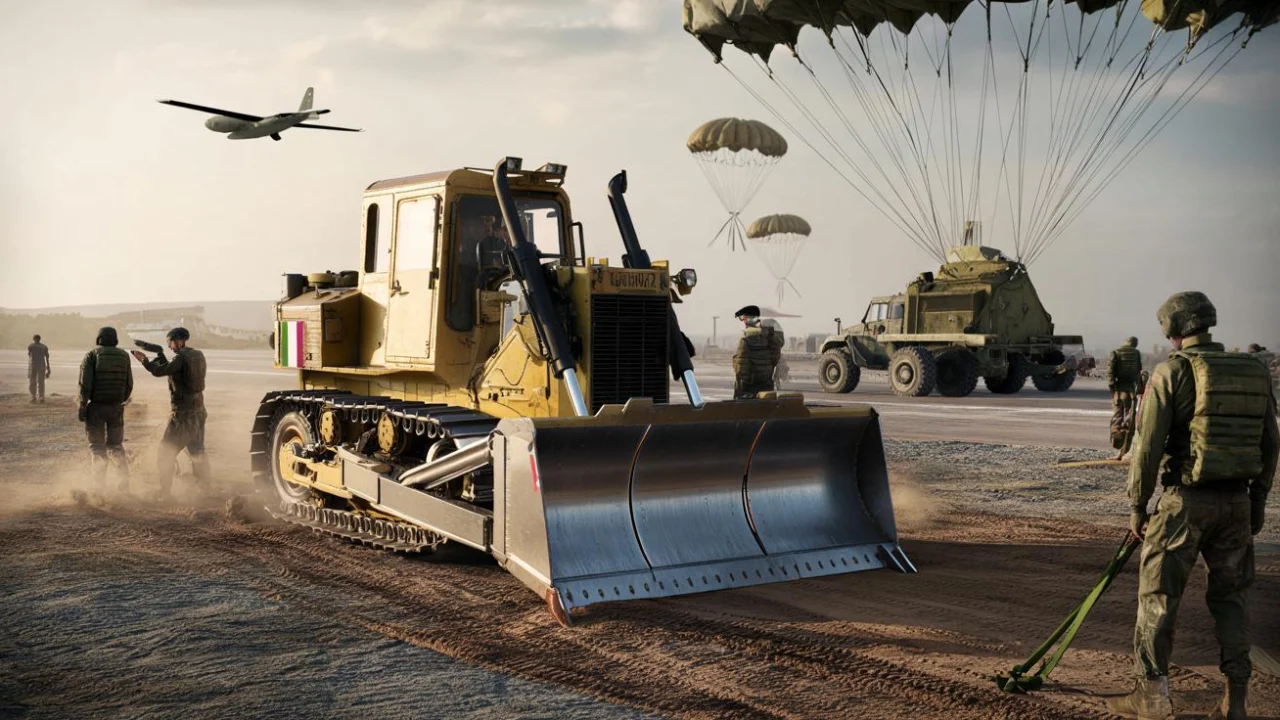
The Italian Army has signed a contract with French manufacturer UNAC to acquire five Tracto-Niveleurs Aérolargables (TNA) bulldozers. These aren’t your typical construction machines – they’re specially designed combat bulldozers built to be parachuted directly into hostile or remote areas.
The deal focuses on Italy’s elite 46th “Folgore” Parachute Brigade, giving these airborne specialists something they’ve never had before: the ability to reshape terrain immediately after landing. The contract includes the machines, training, deployment support, and ongoing maintenance.

“The TNA gives parachute units the power to build or repair basic infrastructure within hours of landing, without waiting for heavy logistics,” explains a defense industry analyst familiar with airborne operations.
This purchase represents a significant shift in how Italy thinks about rapid deployment. Instead of sending paratroopers with just weapons and light equipment, they’ll now drop with actual earth-moving capability.

What Makes These Bulldozers So Special
The airdroppable TNA bulldozers aren’t modified construction equipment – they were engineered from scratch for military airborne operations. Here’s what sets them apart:
- Parachute-Ready Design: Built to survive air drops and function immediately upon landing
- Compact Yet Powerful: Small enough for cargo aircraft but capable of serious earthwork
- Quick Assembly: Designed for rapid setup by small teams in hostile environments
- Military Durability: Reinforced to operate under combat conditions
- Versatile Attachments: Multiple blade and tool configurations for different missions

| Specification | Details |
|---|---|
| Weight | Approximately 8-10 tons |
| Drop Method | Multi-parachute cargo system |
| Setup Time | 30-45 minutes after landing |
| Primary Mission | Airfield preparation and obstacle clearing |
| Operator Training | Military engineers and combat specialists |
“These machines bridge a critical gap between what paratroopers can carry and what combat engineers need to accomplish on the ground,” notes a former military engineer who has worked with similar equipment.
The TNA can clear landing zones, build defensive positions, remove obstacles, and prepare temporary roads. Most importantly, it does this without waiting for sea or land-based heavy equipment that might take days or weeks to arrive.
Real-World Impact Beyond Military Operations
While designed for military use, these airdroppable TNA bulldozers could transform humanitarian response and disaster relief operations worldwide.
Consider recent natural disasters where rescue teams reached affected areas but couldn’t establish proper logistics hubs. Airports damaged by hurricanes, landing strips blocked by landslides, or remote areas where traditional heavy equipment simply can’t reach quickly enough.
“The civilian applications are enormous,” says an emergency response coordinator. “We’ve had situations where we could get people to disaster zones, but couldn’t get the equipment needed to really help until much later.”
The technology opens up possibilities for:
- Rapid disaster response in remote locations
- Emergency airfield construction for humanitarian aid
- Infrastructure development in challenging terrain
- Environmental restoration projects in inaccessible areas
- Scientific expedition support in extreme environments
Italy’s investment also strengthens European defense cooperation. The French-Italian partnership on this project demonstrates how NATO allies are working together to develop niche capabilities that benefit the entire alliance.
For Italy specifically, these bulldozers enhance the country’s ability to respond to crises in Africa, the Middle East, and other regions where Italian forces frequently deploy on peacekeeping or humanitarian missions.
“This gives Italian paratroopers a unique capability that very few military units worldwide possess,” explains a defense policy expert. “They can now establish forward operating bases in locations that would normally take weeks of preparation.”
The timing is significant too. As conflicts become more distributed and humanitarian crises more frequent, the ability to quickly establish infrastructure in remote locations becomes increasingly valuable.
These five machines might seem like a small order, but they represent Italy testing a concept that could revolutionize rapid response operations. If successful, we might see much larger orders and other countries following suit.
The real test will come when these airdroppable TNA bulldozers face their first real-world deployment. Will they perform as promised under pressure? Can military engineers master their operation quickly enough to make them tactically useful?
One thing is certain: Italy is betting that the future of rapid deployment operations includes the ability to reshape the ground itself, not just operate on it as found.
FAQs
How are these bulldozers actually dropped from aircraft?
They use specially designed multi-parachute systems that allow the machines to land safely and be operational within 30-45 minutes of touchdown.
Can civilian contractors operate these machines?
No, they’re designed specifically for military engineers and combat specialists who receive specialized training on their operation and maintenance.
What aircraft can carry these airdroppable TNA bulldozers?
They’re designed to fit in standard military cargo aircraft like the C-130 Hercules and larger transport planes used by NATO forces.
How much do these specialized bulldozers cost?
While exact pricing isn’t public, similar specialized military engineering equipment typically costs several times more than civilian bulldozers due to their unique capabilities.
Could these be used for disaster relief operations?
Yes, while designed for military use, they could be extremely valuable for humanitarian operations in remote areas hit by natural disasters where traditional heavy equipment can’t reach quickly.
How long does it take to train operators on these machines?
Military engineers typically need several weeks of specialized training to become proficient with the unique systems and deployment procedures of airdroppable TNA bulldozers.
About the Author