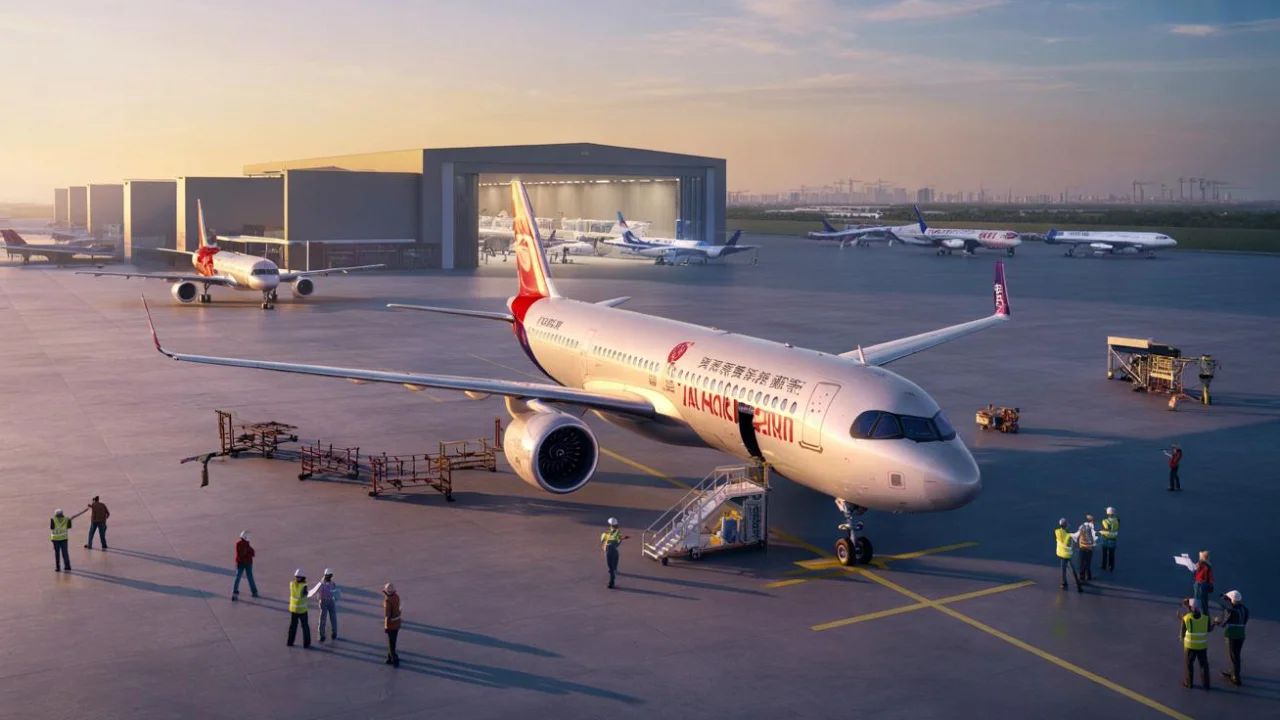
Wang Li still remembers her first flight from Beijing to Shanghai fifteen years ago. The cramped seats, the noisy engines, and that slightly anxious feeling as the older aircraft struggled through turbulence. Last month, she boarded the exact same route on a brand-new A320neo that had rolled off the production line just miles from where she grew up in Tianjin.
The difference was night and day. Quieter engines, more spacious cabin, smoother ride. What she didn’t realize was that she was experiencing history in the making—this particular aircraft was one of hundreds now being assembled right in her backyard, part of a manufacturing revolution that’s quietly reshaping global aviation.
That personal transformation mirrors something much bigger happening in the aviation world. The Airbus Tianjin factory has just hit a milestone that aviation experts are calling a game-changer: the delivery of its 800th aircraft.
How a Small Factory Became Aviation’s New Powerhouse
The Airbus Tianjin factory story reads like a business fairy tale, but the numbers tell a more dramatic story. When the first A320 rolled out of this coastal Chinese facility in 2009, few predicted what would happen next.
The factory spent eleven long years building its first 500 aircraft. Then something remarkable happened—the next 300 planes took less than half that time. We’re talking about a production acceleration that has industry veterans scratching their heads and competitors taking notes.
“The speed at which Tianjin has ramped up production is unprecedented in aviation manufacturing,” says aviation analyst Chen Ming. “This isn’t just about assembling planes faster—it’s about China becoming a genuine manufacturing partner rather than just a customer.”
The 800th aircraft wasn’t just any plane. It was an A321neo destined for Air China, the stretched version of Airbus’s bestselling single-aisle family. The choice feels symbolic—a larger, more advanced aircraft for China’s flag carrier, assembled by Chinese workers in a Chinese facility.
Since October 2025, the Airbus Tianjin factory has been operating two separate final assembly lines. The goal is straightforward but ambitious: double the current output to meet China’s exploding demand for new aircraft.
The Numbers That Tell the Real Story
Understanding the true impact of the Airbus Tianjin factory requires looking at the hard data. These figures paint a picture of an industry in transformation:
| Milestone | Year Reached | Time to Achieve |
|---|---|---|
| First 100 aircraft | 2013 | 4 years |
| First 500 aircraft | 2020 | 11 years total |
| 800 aircraft | 2025 | 5 years for last 300 |
But production speed is only part of the story. Here’s what makes this milestone particularly significant:
- China now accounts for roughly 25% of all global aircraft demand
- The country expects to need over 9,000 new aircraft by 2042
- Tianjin’s two assembly lines can theoretically produce one aircraft every few days
- Local Chinese suppliers now provide major components for aircraft assembled at the facility
- The factory employs thousands of Chinese engineers and technicians
“We’re witnessing the decentralization of aircraft manufacturing,” explains industry consultant Sarah Johnson. “Twenty years ago, if you wanted a commercial airliner, it was essentially built in Seattle or Toulouse. Today, final assembly happens across multiple continents.”
The Airbus Tianjin factory represents more than just geographic diversification. It’s about developing local expertise, creating supply chain resilience, and meeting customers where they are—literally.
What This Means for Travelers and Airlines
For passengers like Wang Li, the Airbus Tianjin factory milestone translates into tangible benefits that most people never think about when booking a flight.
Airlines get their new aircraft faster when final assembly happens closer to home. Shorter delivery flights mean lower costs and reduced environmental impact. More importantly, the increased production capacity helps airlines expand their fleets to meet growing travel demand.
Chinese carriers have been particularly aggressive in their expansion plans. Air China, China Southern, and China Eastern have ordered hundreds of A320-family aircraft, many of which will be assembled at the Tianjin facility.
“Having local assembly capability gives Chinese airlines more flexibility in their fleet planning,” notes aviation economist Dr. Liu Wei. “They can coordinate deliveries more effectively and sometimes even customize aircraft specifications for local market needs.”
The ripple effects extend beyond China’s borders. As the Airbus Tianjin factory increases production, it helps reduce delivery backlogs that have been plaguing the industry for years. Airlines worldwide benefit from shorter waiting times for new aircraft.
For travelers, this means more modern aircraft with better fuel efficiency, quieter cabins, and improved passenger amenities. The A320neo family, which represents the majority of Tianjin’s current production, offers passengers a noticeably better flying experience compared to older aircraft models.
The environmental implications are equally significant. Modern aircraft assembled at Tianjin consume roughly 15-20% less fuel than their predecessors, contributing to the aviation industry’s broader sustainability goals.
But perhaps the most interesting development is how this manufacturing shift is changing the competitive landscape. Boeing, Airbus’s primary rival, is watching these developments closely and considering its own manufacturing partnerships in Asia.
The success of the Airbus Tianjin factory proves that aircraft manufacturing can be successfully globalized without compromising quality or safety standards. Every aircraft that rolls off the Tianjin production line must meet the same rigorous certification requirements as those assembled in Hamburg or Toulouse.
Industry experts predict that this model will likely expand to other regions. Brazil, India, and other major aviation markets may soon host their own final assembly lines for both Airbus and Boeing aircraft.
As Wang Li settles into her seat for another smooth flight aboard a Tianjin-assembled aircraft, she’s experiencing firsthand how global manufacturing partnerships can create better products for everyone involved. The 800-aircraft milestone at the Airbus Tianjin factory isn’t just a number—it’s proof that the future of aviation manufacturing is truly global.
FAQs
What makes the Airbus Tianjin factory special compared to other aircraft assembly facilities?
The Tianjin facility represents Airbus’s largest final assembly operation outside Europe, and it’s the first major Western aircraft manufacturer to establish significant production capacity in China.
How does aircraft quality compare between Tianjin-assembled and European-assembled Airbus planes?
There’s no difference in quality or safety standards. All aircraft must meet identical certification requirements regardless of where they’re assembled.
Why did Airbus choose Tianjin for its Chinese manufacturing operations?
Tianjin offers excellent logistics infrastructure, proximity to major Chinese airlines, and strong government support for aviation manufacturing development.
Will other aircraft manufacturers follow Airbus’s example in China?
Boeing and other manufacturers are closely studying the Tianjin model and considering similar partnerships in various global markets.
How many jobs has the Airbus Tianjin factory created?
The facility employs several thousand people directly and supports thousands more jobs in the local supplier network.
What types of aircraft are currently assembled at the Tianjin facility?
The factory focuses exclusively on the A320 family, including the A319, A320, and A321 variants, both in standard and neo (new engine option) configurations.
About the Author