Lieutenant Colonel Rajesh Kumar still remembers the moment everything changed during his deployment near the Line of Control in 2019. His unit had spotted enemy positions dug deep into rocky terrain—targets that would have required multiple sorties and risked pilot lives just a few years earlier. But this time, a single precision-guided munition from high altitude eliminated the threat in minutes, keeping his soldiers safe and the mission on track.

Stories like Kumar’s explain why India’s defense establishment is buzzing about a game-changing partnership. When you can turn ordinary bombs into surgical strike weapons with pinpoint accuracy, you’re not just upgrading your arsenal—you’re rewriting the rules of engagement.
That’s exactly what’s happening now as France’s Safran prepares to bring its cutting-edge A2SM HAMMER bomb technology directly to Indian soil through local production.
French Precision Weapons Get an Indian Address
Safran Electronics & Defence has inked a groundbreaking joint venture with India’s Bharat Electronics Limited (BEL) to industrialize the A2SM HAMMER bomb on Indian territory. The deal, formalized in New Delhi following protocols announced at the Aero India airshow, represents far more than a typical arms transfer.
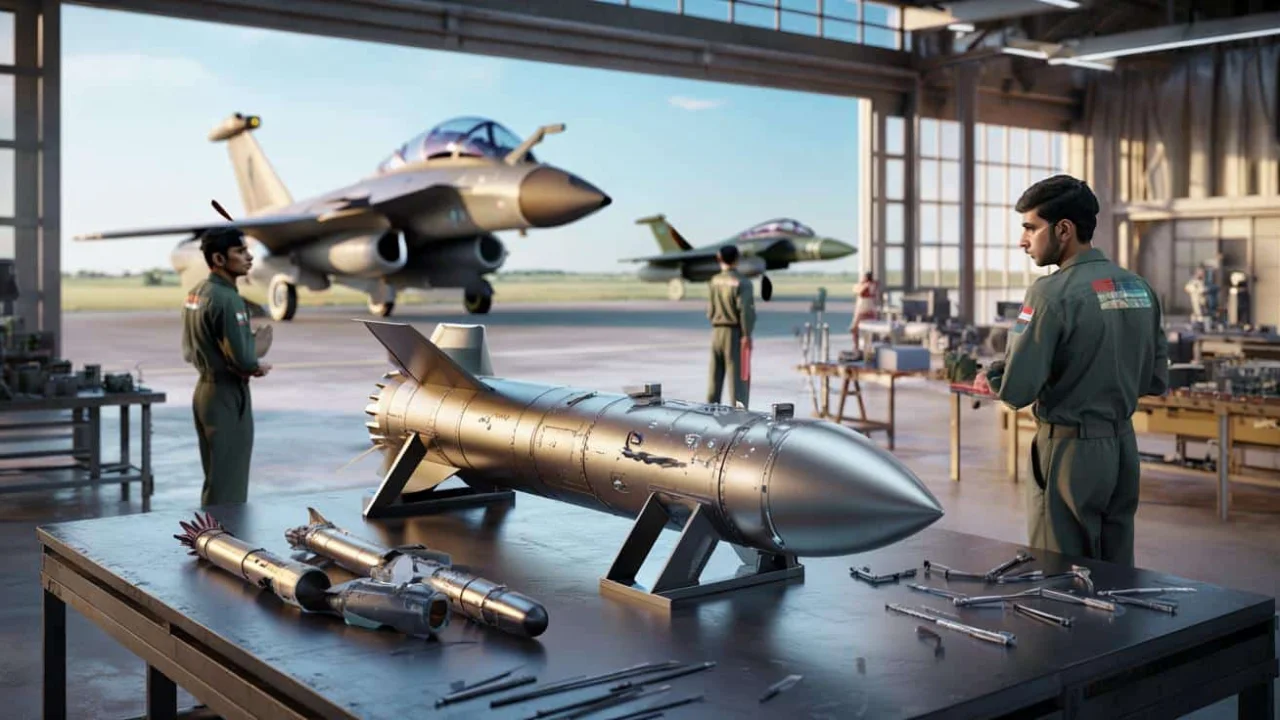
The A2SM HAMMER—short for Highly Agile Modular Munition Extended Range—transforms standard “dumb” bombs into precision-guided weapons capable of hitting targets from extended distances. Think of it as giving traditional munitions a high-tech brain and rocket-powered legs.
“This isn’t just about buying weapons anymore,” explains defense analyst Arjun Subramaniam. “We’re talking about France handing over some of its most sensitive strike capabilities to Indian industry. That’s a level of trust you don’t see every day.”
The technology works by retrofitting existing bombs with guidance electronics at the front and a rocket booster at the rear. Pilots can launch these weapons from much safer distances while maintaining devastating accuracy against ground targets.

Breaking Down the Partnership Details
The joint venture structure reveals just how serious both countries are about long-term cooperation. Here’s what makes this deal unique:
| Aspect | Details |
|---|---|
| Ownership Split | 50/50 between Safran and BEL |
| Company Structure | Private entity based in India |
| Initial Focus | Assembly of HAMMER systems |
| Target Local Content | Gradually increase to 60% |
| Primary Customers | Indian Air Force and Navy |
The production strategy starts with basic assembly but gradually builds toward substantial local manufacturing. Key components that will eventually be produced in India include:
- Navigation and guidance systems
- Rocket motor assemblies
- Control surfaces and fins
- Electronic warfare protection modules
- Software integration platforms
“The 60% local content target isn’t just a number—it’s a pathway to self-reliance,” notes former Indian Air Force chief B.S. Dhanoa. “Once you control the majority of production, you control your own destiny in conflicts.”
The A2SM HAMMER family offers multiple variants designed for different mission profiles, from bunker-busting to anti-ship operations. This flexibility means the Indian production line could potentially serve multiple branches of the armed forces with customized solutions.
Why This Changes Everything for Regional Defense
The real impact of domestically producing A2SM HAMMER bombs extends far beyond India’s borders. Regional rivals are already recalculating their defensive strategies as India gains access to proven precision-strike technology that has seen combat success in conflicts from Libya to the Sahel.
For Indian pilots, the operational advantages are immediate and substantial. Current air-to-ground operations often require aircraft to venture into dangerous airspace to ensure accuracy. The HAMMER system’s extended range—up to 70 kilometers depending on launch conditions—keeps pilots safely outside most surface-to-air missile threats.
“When you can hit what you’re aiming at from 60 kilometers away, you’re no longer trading pilot lives for target destruction,” explains retired Wing Commander Anupam Banerjee. “That’s a fundamental shift in how air power works.”
The economic implications are equally significant. Defense manufacturing typically creates high-skilled jobs and drives technological innovation across multiple sectors. The joint venture will likely require:
- Specialized electronics manufacturing capabilities
- Advanced materials processing facilities
- Precision engineering and testing equipment
- Software development teams
- Quality assurance and certification processes
Beyond immediate military applications, the technology transfer could accelerate India’s broader aerospace and defense manufacturing ambitions. Skills developed in precision-guided munitions often translate to civilian aerospace, satellite technology, and even space exploration programs.
Regional allies are watching closely too. Countries like Vietnam, Bangladesh, and several African nations that operate French or Indian military equipment could become future customers for Indian-manufactured HAMMER systems, creating an export market worth potentially billions of dollars.
“India is positioning itself as a defense manufacturing hub for friendly nations,” observes strategic affairs expert Harsh Pant. “This partnership with Safran could be the template for future technology transfers that actually build Indian industrial capacity instead of just filling immediate needs.”
The timing aligns perfectly with broader geopolitical shifts. As traditional arms suppliers face their own supply chain challenges and export restrictions, countries are increasingly looking for alternative sources of advanced military technology. An Indian production line offers that alternative while maintaining Western technology standards.
FAQs
What makes the A2SM HAMMER bomb different from regular bombs?
The HAMMER system adds precision guidance and extended range to standard bombs, allowing accurate strikes from much greater distances than traditional “dumb” munitions.
How long will it take for India to start producing these weapons locally?
The joint venture will begin with assembly operations and gradually increase local manufacturing content over several years to reach the 60% target.
Which Indian military branches will use the HAMMER bombs?
Both the Indian Air Force and Indian Navy are designated as primary customers for the locally-produced munitions.
Could India export these weapons to other countries?
While not explicitly stated, the industrial capacity being built could potentially serve export markets for friendly nations, subject to appropriate approvals.
What does this mean for India’s defense independence goals?
The 50/50 joint venture and 60% local content target directly support India’s Make in India and Atmanirbhar Bharat self-reliance policies.
How does this partnership benefit France?
France secures a long-term strategic partnership with India while accessing the growing Indian defense market and potentially reducing its own production costs.
About the Author