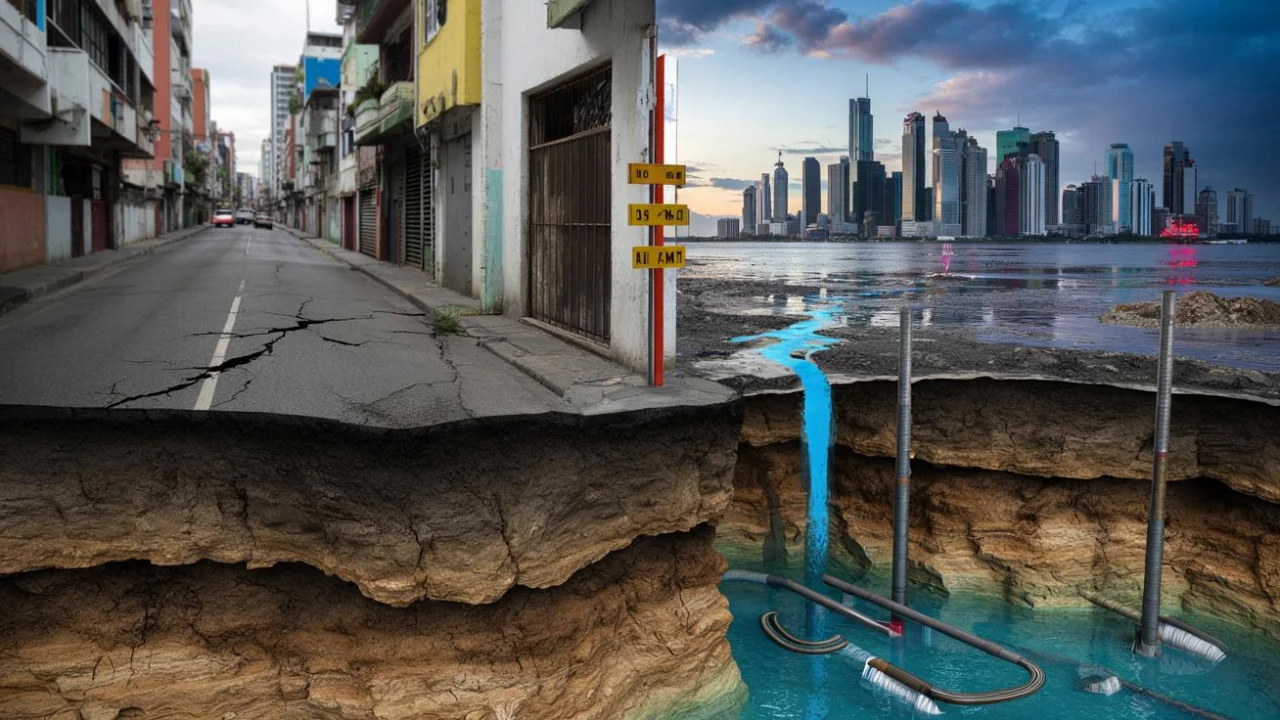
Maria Gonzalez watched her grandmother’s house slowly disappear. Not all at once—that would have been easier to understand. Instead, the front steps sank a few millimeters each month, the doorframe tilted just enough to stick, and cracks spread across the walls like spider webs. Her grandmother blamed the neighbors’ new construction. The city blamed old pipes. But Maria, an engineering student at the time, suspected something deeper was happening beneath the streets of Mexico City.

Decades later, as a geotechnical engineer, Maria returned to that same neighborhood. The house was gone, demolished years ago when the foundation became unsalvageable. But something remarkable had happened—the relentless sinking that had claimed her grandmother’s home was finally slowing down. The answer lay not in what engineers were taking from the ground, but in what they had started putting back.
This is the story of how cities learned to fight back against their own disappearing act.

The underground battle against sinking cities
Land subsidence affects over 200 cities worldwide, threatening the homes and livelihoods of more than 1.2 billion people. When oil companies extract petroleum and groundwater from deep underground reservoirs, they remove the natural pressure that has supported the overlying rock and soil for millions of years. Without that support, the ground simply collapses into the empty spaces below.
“Think of it like removing the air from a balloon,” explains Dr. James Rodriguez, a subsidence specialist at the University of California. “The balloon doesn’t just get smaller—it wrinkles and folds in unpredictable ways. That’s exactly what’s happening to our cities.”

The solution sounds almost too simple: pump water back into those depleted reservoirs. This process, called managed aquifer recharge or water flooding, has been quietly saving some of the world’s most vulnerable urban areas for decades. Engineers inject treated water, often recycled wastewater or desalinated seawater, into abandoned oil fields to restore underground pressure and slow the sinking.
But the results vary dramatically from city to city. While some areas have seen subsidence rates drop from several centimeters per year to just millimeters, others continue their downward slide despite massive water injection projects.

Where water injection works—and where it doesn’t
The effectiveness of water injection depends on several critical factors that engineers are still learning to navigate:
- Rock type and depth: Soft clay layers compress more easily and rarely recover, while harder sandstone formations respond better to pressure restoration
- Time since extraction: The longer the ground has been sinking, the harder it becomes to reverse the process
- Water quality and volume: Injected water must be clean enough to avoid clogging underground formations, and volumes must match or exceed original extraction rates
- Underground geology: Complex fault systems can redirect injected water away from target areas

| City | Peak Subsidence Rate (cm/year) | Current Rate with Water Injection (cm/year) | Reduction Achieved |
|---|---|---|---|
| Long Beach, California | 71 | 0.5 | 99% |
| Mexico City | 30 | 15 | 50% |
| Jakarta, Indonesia | 25 | 20 | 20% |
| Houston, Texas | 15 | 3 | 80% |
“Long Beach is our poster child for successful subsidence control,” notes Dr. Sarah Chen, a hydrogeologist who has studied water injection programs across three continents. “They started pumping water back in the 1950s and essentially stopped a crisis that was threatening to put entire neighborhoods underwater.”
The city’s Pier A, once a bustling shipping terminal, had sunk so far below sea level that it required constant pumping to keep from flooding. Today, thanks to decades of water injection into nearby oil fields, the subsidence has virtually stopped.
The hidden costs of saving sinking cities
Water injection programs come with their own challenges and unintended consequences. The process requires enormous amounts of water—often millions of gallons per day—in regions where water is already scarce. Treatment facilities must remove salt, chemicals, and bacteria before injection to prevent underground contamination.
Some communities worry about induced seismicity, though studies show that water injection typically causes fewer and smaller earthquakes than oil and gas extraction. More pressing concerns include the ongoing costs of operation and maintenance, which can run into hundreds of millions of dollars over decades.
“We’re essentially buying time,” admits Dr. Rodriguez. “Water injection can slow subsidence, sometimes dramatically, but it rarely reverses damage that’s already occurred. The key is starting early, before the worst sinking begins.”
Environmental justice issues also complicate these programs. The communities most affected by land subsidence are often low-income neighborhoods built on cheaper, more vulnerable land. Meanwhile, the costs of water injection projects are typically spread across entire metropolitan areas through utility bills and taxes.
In Mexico City, recent satellite measurements show that water injection has reduced subsidence rates in some districts by up to 60%. But progress remains uneven—wealthy neighborhoods with newer infrastructure show better results than older, more densely populated areas where decades of sinking have already caused irreversible damage.
The future of urban subsidence control likely lies in prevention rather than cure. Cities like Amsterdam and Venice are experimenting with floating architecture and elevated construction techniques. Others are strictly limiting groundwater extraction and requiring developers to contribute to water injection programs before breaking ground on new projects.
“Every city sitting on former oil fields or depleted aquifers needs to think about this problem now,” warns Dr. Chen. “Waiting until the cracks appear in your grandmother’s house is already too late.”
FAQs
What causes land subsidence in cities?
Land subsidence occurs when underground fluids like oil, gas, or groundwater are extracted faster than natural processes can replace them, causing the overlying ground to sink into empty spaces.
How much can cities sink each year?
Subsidence rates vary widely, from a few millimeters to over 70 centimeters annually in extreme cases like historical Long Beach, California.
Does water injection completely stop cities from sinking?
Water injection can dramatically slow subsidence but rarely stops it entirely or reverses existing damage. Success depends on geology, timing, and the scale of the injection program.
Which cities have the most successful water injection programs?
Long Beach, California, and Houston, Texas, have achieved the most dramatic reductions in subsidence rates through decades of managed water injection into depleted oil fields.
Is water injection safe for drinking water supplies?
When properly managed with treated water and appropriate geological barriers, injection programs pose minimal risk to drinking water aquifers, though monitoring is essential.
How much does it cost to run a water injection program?
Costs vary by location and scale, but major programs typically require tens to hundreds of millions of dollars in initial infrastructure plus ongoing operational expenses.
About the Author