Picture this: you’re standing in line at your local coffee shop, scrolling through news headlines about another tech billionaire buying a social media platform or launching a vanity space mission. The barista hands you your latte, and you shake your head thinking, “Must be nice to have money to burn on toys.”

Then your phone buzzes with breaking news that stops you mid-sip. €850 million has just been committed to something that sounds like science fiction but isn’t a movie or a rocket ship. It’s going underground, deep under the Swiss and French countryside, to build the world’s most ambitious particle accelerator.
Suddenly, billionaire spending doesn’t seem so frivolous anymore. Welcome to the story of how private wealth is reshaping the future of fundamental physics, one massive check at a time.

The FCC Physics Project Gets Its Financial Rocket Fuel
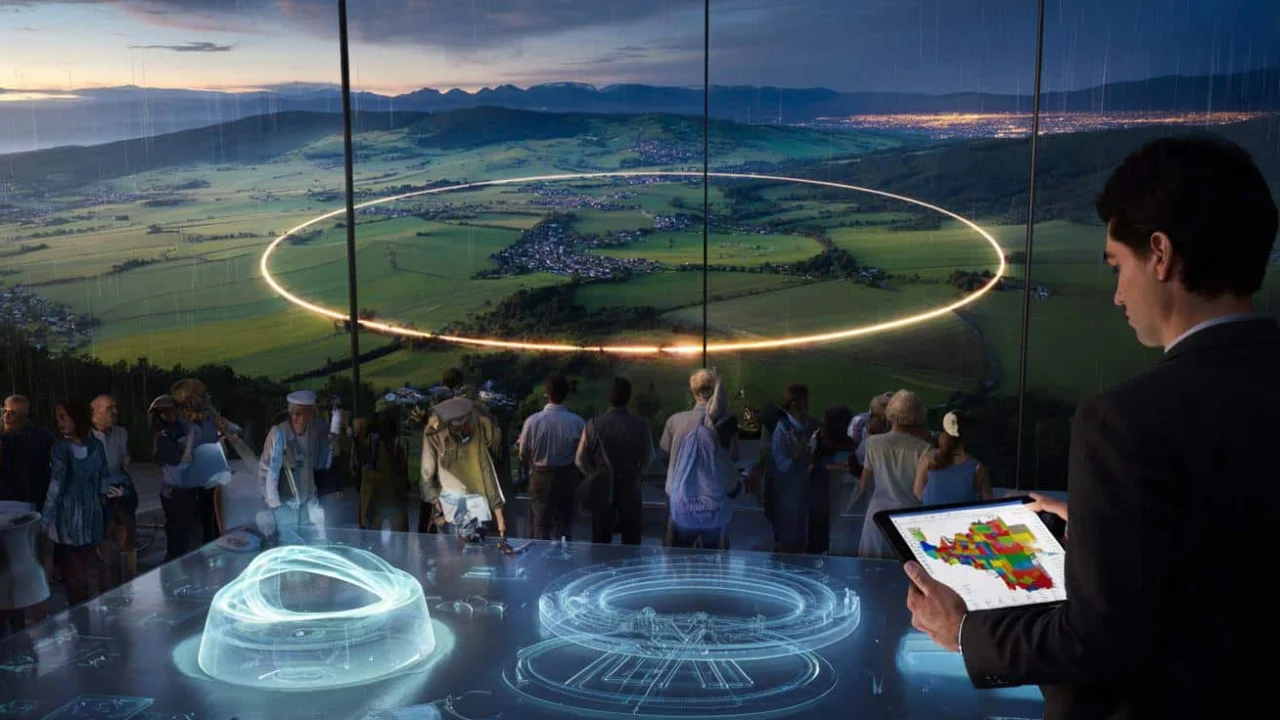
The Future Circular Collider, known in scientific circles as the FCC physics project, represents everything audacious about human curiosity. While most of us struggle to imagine the 27-kilometer ring of CERN’s Large Hadron Collider, the FCC would dwarf it completely.
We’re talking about a 90-kilometer underground tunnel that would loop beneath French villages and Swiss forests like a buried highway to the universe’s secrets. To put that in perspective, you could drive the entire ring in about an hour, if roads existed down there.

“This isn’t just an upgrade to what we have,” explains Dr. Sarah Chen, a theoretical physicist at CERN. “The FCC would open energy ranges we’ve never accessed before, potentially revealing new particles and forces that could rewrite our understanding of reality.”
The recent €850 million commitment comes from a consortium that reads like a who’s who of global wealth. Tech entrepreneurs, sovereign wealth funds, and dedicated science philanthropists have pooled resources in what experts are calling the largest private investment in fundamental physics research in history.

Breaking Down the Numbers Behind the Dream
The FCC physics project timeline and funding structure reveals just how serious this commitment really is:
| Project Phase | Timeline | Estimated Cost | Purpose |
|---|---|---|---|
| Design & Planning | 2024-2028 | €1.2 billion | Technical feasibility studies |
| Construction Phase 1 | 2029-2035 | €15 billion | Tunnel excavation |
| Construction Phase 2 | 2036-2040 | €8 billion | Installing accelerator technology |
| Initial Operations | 2041+ | €2 billion annually | Research and maintenance |
The recent €850 million injection specifically targets the crucial design phase, ensuring that when construction begins, every technical challenge has been solved on paper first. Here’s where that money goes:

- Advanced superconducting magnet development (€300 million)
- Geological surveys and environmental impact studies (€200 million)
- Computing infrastructure for simulations (€150 million)
- International coordination and project management (€100 million)
- Prototype testing facilities (€100 million)
“We’ve learned from the LHC that the devil is in the details,” notes Professor Marcus Rodriguez, former CERN director. “This upfront investment means we won’t hit nasty surprises once we start digging.”
The funding coalition includes names that rarely appear together in the same sentence. Technology moguls who made fortunes in software and semiconductors are partnering with oil-rich sovereign funds and established science foundations. What unites them isn’t politics or profit, but genuine curiosity about the fundamental nature of reality.
What This Means for Science and Society
The FCC physics project represents more than just bigger, faster particle collisions. The ripple effects could transform technology, medicine, and our basic understanding of existence itself.
Previous particle accelerators gave us the World Wide Web, advanced cancer treatments, and revolutionary materials science. The LHC alone has generated over 3,000 patents and spawned countless technological innovations that now power everything from medical imaging to quantum computing research.
The FCC would operate at energy levels seven times higher than the current LHC, potentially discovering:
- Dark matter particles that could explain 85% of the universe’s missing mass
- Evidence of extra dimensions beyond the three we experience
- New fundamental forces that could revolutionize energy production
- Supersymmetric particles that could unify all known physics
“Every time we’ve built a more powerful microscope to look at nature, we’ve discovered things that seemed impossible,” explains Dr. Chen. “The FCC isn’t just about confirming theories – it’s about finding the unexpected.”
The project also promises economic benefits that extend far beyond pure research. Construction would create an estimated 50,000 jobs across Europe, while the advanced technologies required would drive innovation in superconducting materials, precision engineering, and quantum sensors.
Local communities around the proposed tunnel route are already seeing property values rise as international attention focuses on the region. Universities across Europe are expanding their physics programs in anticipation of new research opportunities.
Perhaps most significantly, the FCC physics project demonstrates that private wealth can tackle challenges too large and long-term for traditional government funding cycles. While space exploration captures headlines, fundamental physics research offers potentially greater returns for human knowledge and technological advancement.
“This changes the game completely,” says Dr. Elena Hoffman, a science policy expert at the European Science Foundation. “When private donors commit this kind of money to basic research, it signals confidence that fundamental discoveries still drive human progress.”
The €850 million commitment also includes provisions for international collaboration, ensuring that results benefit the global scientific community rather than remaining proprietary to funders. This open-science approach could set new standards for how private money supports public knowledge.
As tourists continue pressing their faces against the glass at CERN’s visitor center, they’re now looking at more than just the LHC. They’re glimpsing the future of human curiosity, funded not by governments alone, but by individuals who believe that understanding the universe is the ultimate investment in our collective future.
FAQs
What exactly is the FCC physics project?
The Future Circular Collider is a proposed 90-kilometer particle accelerator that would be built underground near Geneva, making it nearly four times larger than the current Large Hadron Collider.
Why does it cost so much money?
The FCC requires cutting-edge superconducting magnets, precision engineering, massive tunneling operations, and sophisticated computing systems that push the boundaries of current technology.
When would the FCC actually be built?
Construction could begin in the early 2030s if current funding and approval timelines hold, with the first experiments potentially starting in the early 2040s.
Who are the billionaires funding this project?
While specific names haven’t been fully disclosed, the funding consortium includes tech entrepreneurs, sovereign wealth funds, and established science philanthropists from multiple countries.
What could the FCC discover that the LHC can’t?
Operating at much higher energies, the FCC could potentially discover dark matter particles, evidence of extra dimensions, or entirely new fundamental forces that current accelerators can’t detect.
Will this research have practical applications?
Historical patterns suggest yes – previous particle accelerators led to the World Wide Web, advanced medical treatments, and numerous technological innovations we use today.
About the Author