Picture this: you’re driving through your neighborhood at night, but all the streetlights are out. You can’t see the roads, houses, or anything around you directly. But every now and then, a car’s headlights sweep across the darkness, briefly illuminating the invisible landscape that was always there. That’s essentially what scientists have been doing with the universe’s most mysterious component – dark matter.

For decades, we’ve known that something invisible is out there, shaping everything we see in space. Now, thanks to a groundbreaking new dark matter map, we’re getting the clearest picture yet of this cosmic skeleton that holds our universe together.
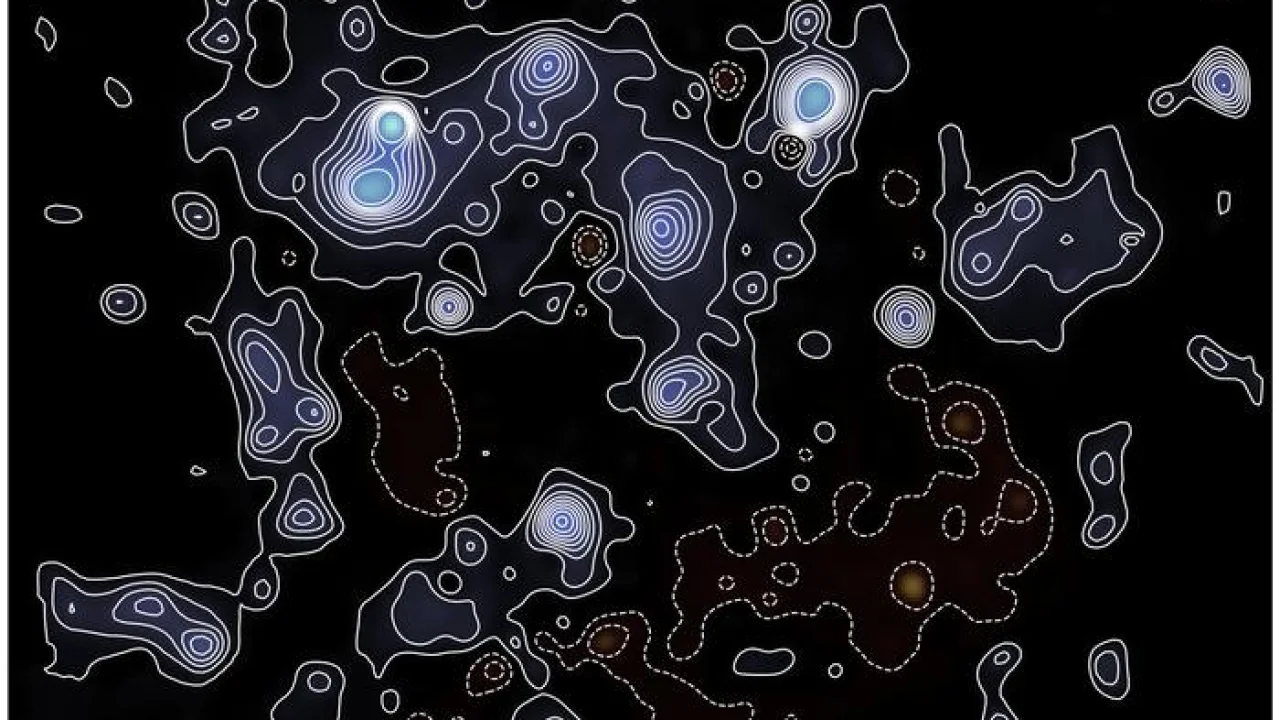
The James Webb Space Telescope has just delivered something remarkable: the most detailed dark matter map ever created, covering a region of space larger than any previous attempt. This isn’t just another scientific achievement – it’s like suddenly getting high-definition vision in a world we’ve only seen through foggy glasses.

The Universe’s Invisible Backbone Revealed
Scientists using data from the James Webb Space Telescope’s COSMOS-Web survey have created a revolutionary dark matter map spanning 0.54 square degrees of sky. To put that in perspective, that’s more than twice the area of the full moon, making it the largest contiguous high-resolution map of dark matter ever produced.
“The map shows the dark matter backbone of the universe in much finer detail than ever before,” explains Diana Scognamiglio, a cosmologist at NASA’s Jet Propulsion Laboratory who co-led the study. “We can see the small-scale structure of the cosmic web and even detect mass concentrations that were invisible in earlier maps.”

The new dark matter map reveals something extraordinary: the universe looks like a vast web, with dense clusters of dark matter connected by long strands, separated by enormous empty voids. It’s as if someone took a giant spider web and scattered galaxies along its threads.
What makes this map so special is its incredible resolution – it has twice the detail of previous attempts. This means scientists can now see features they’ve never spotted before, including faint galaxy groups that were completely hidden and the intricate connections between massive galaxy clusters.

Key Discoveries from the New Dark Matter Map
The research team’s findings, published in Nature Astronomy, reveal several fascinating details about our universe’s structure:
- Galaxy clusters and their connections: The map shows how dark matter concentrates around galaxy clusters and reveals the filaments connecting these massive structures
- Hidden galaxy groups: Previously invisible faint galaxy groups are now detectable, expanding our understanding of cosmic structure
- Cosmic voids: Large empty regions where very little dark matter exists are clearly visible
- Small-scale structures: Fine details of the cosmic web that were impossible to see before

Here’s what the numbers tell us about this cosmic architecture:
| Component | Percentage of Universe | Role in Cosmic Structure |
|---|---|---|
| Dark Matter | 85% of all matter | Provides gravitational scaffolding |
| Regular Matter | 15% of all matter | Forms stars, planets, and everything we see |
| Map Coverage | 0.54 square degrees | Largest contiguous high-resolution survey |
| Resolution Improvement | 2x better than previous maps | Reveals previously hidden structures |
The technique behind this breakthrough involves something called weak gravitational lensing. Think of it like this: dark matter acts like a cosmic magnifying glass, bending the light from distant galaxies as it travels toward us. By carefully measuring these tiny distortions in thousands of galaxy images, scientists can work backward to figure out exactly where the invisible dark matter must be located.
“The whole swirling cloud of dark matter around the Milky Way has enough gravity to hold our entire galaxy together,” notes Richard Massey, a cosmologist at Durham University who contributed to the research. “Without dark matter, the Milky Way would spin itself apart.”
What This Means for Our Understanding of Everything
This new dark matter map isn’t just a pretty picture – it’s reshaping how we understand the universe and our place in it. The implications ripple through multiple areas of science and could influence future space exploration and research.
For cosmologists, this detailed map provides the first clear view of how dark matter behaves on both large and small scales. It’s like finally getting a detailed road map of a city you’ve only seen from airplane windows before.
The map also helps scientists test their theories about how the universe evolved. If our current models are correct, the distribution of dark matter should match certain predictions. Early analysis suggests the map aligns well with existing theories, but researchers are still digging into the data.
Perhaps most exciting is what this means for finding dark matter itself. By knowing exactly where it’s concentrated, future experiments can focus their search efforts on the most promising locations.
“This gives us unprecedented insight into the cosmic web structure,” Scognamiglio adds. “We’re seeing connections and patterns that we suspected existed but could never confirm before.”
The research also reveals something profound about the nature of our cosmic neighborhood. The dark matter structures we see today took billions of years to form, growing from tiny fluctuations in the early universe into the massive web-like patterns we observe now.
Future observations will extend this dark matter map to cover even larger areas of the sky, potentially revealing how these structures connect across vast cosmic distances. Scientists are particularly interested in mapping the regions around our own Local Group of galaxies to better understand our cosmic environment.
This breakthrough demonstrates the incredible power of the James Webb Space Telescope and sets the stage for even more detailed maps in the coming years. As our view of the universe’s invisible architecture becomes clearer, we’re getting closer to solving one of the biggest mysteries in modern science – what dark matter actually is and how it shaped everything we see around us.
FAQs
What exactly is dark matter?
Dark matter is an invisible form of matter that makes up about 85% of all matter in the universe but doesn’t emit or absorb light, making it impossible to see directly with telescopes.
How do scientists create a dark matter map if they can’t see it?
They use a technique called gravitational lensing, measuring how dark matter’s gravity bends light from distant galaxies to determine where the invisible matter is located.
Why is this new dark matter map special?
It covers the largest area ever mapped at high resolution and has twice the detail of previous maps, revealing structures and connections that were previously invisible.
What does dark matter actually do in the universe?
Dark matter provides the gravitational scaffolding that holds galaxies and galaxy clusters together – without it, these structures would fly apart.
Could this help us finally discover what dark matter is made of?
Yes, by showing exactly where dark matter is concentrated, this map helps guide future experiments designed to detect dark matter particles directly.
How big is the area this map covers?
The map covers 0.54 square degrees of sky, which is more than twice the apparent size of the full moon as seen from Earth.
About the Author