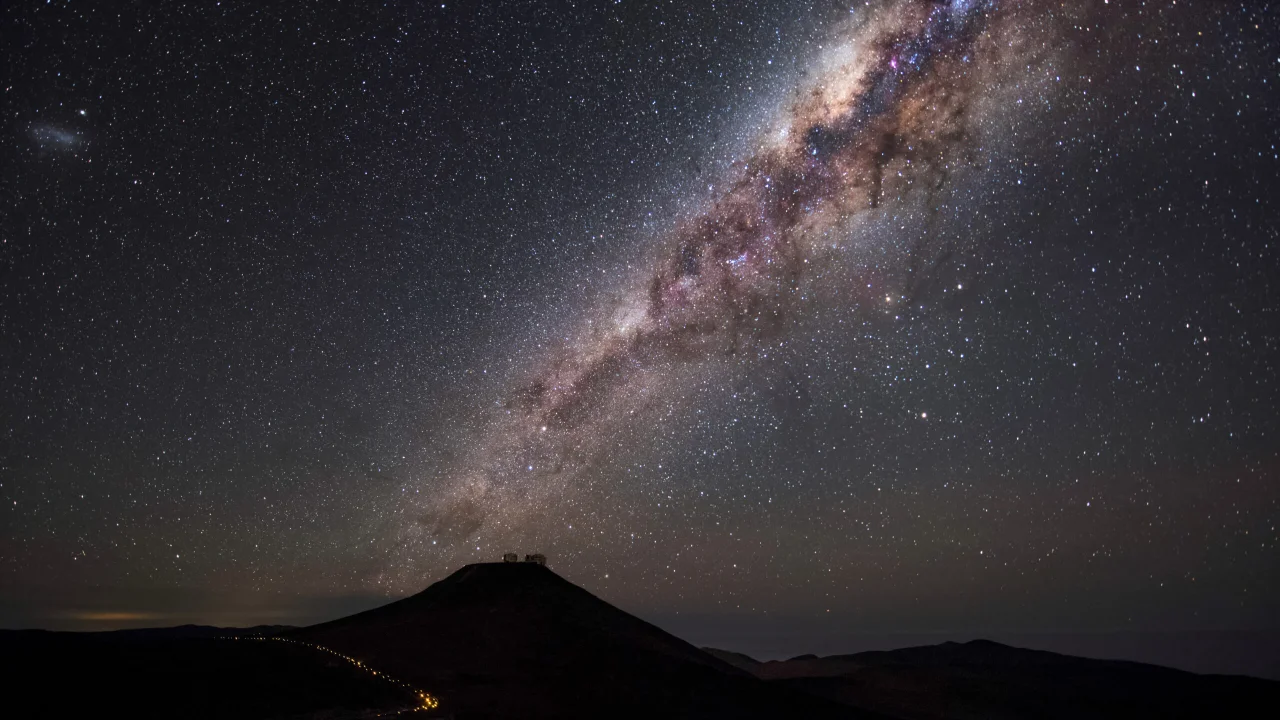
Last summer, amateur astronomer Maria Santos drove three hours into Chile’s Atacama Desert with her teenage daughter, hoping to show her the Milky Way stretching across an unpolluted night sky. When they arrived at their camping spot and looked up, both were speechless. The cosmos blazed overhead in a way that city lights had never allowed them to see.

“I finally understood why my mom always talked about the stars,” her daughter whispered that night. It’s moments like these that make Chile’s Atacama Desert so precious—home to some of the world’s darkest skies where the universe reveals its full glory.
Now, those same pristine dark skies have scored a rare victory against industrial development. Chilean energy company AES Andes just announced they’re canceling their massive INNA project, a green energy facility that would have devastated astronomical observations at one of Earth’s most important telescope sites.

A Close Call for Astronomical Heritage
The Paranal Observatory sits in Chile’s Atacama Desert, hosting some of the world’s most advanced telescopes under skies so dark they’re practically cosmic windows. This isn’t just another telescope location—it’s where humanity peers deepest into space, studying everything from distant galaxies to potentially habitable planets.
AES Andes had been planning since 2024 to build their INNA facility nearby—a sprawling industrial complex for producing green hydrogen and ammonia. While renewable energy sounds positive, the location would have been catastrophic for astronomy.

“Due to its planned location, the project would pose a major threat to the darkest and clearest skies on Earth,” explained Xavier Barcons, director general of the European Southern Observatory (ESO).
Think about this: the night sky already brightens by roughly 10 percent each year due to light pollution. Finding truly dark skies has become like discovering hidden treasure, which makes the Atacama Desert’s pristine conditions irreplaceable.
What Would Have Been Lost
The numbers tell a sobering story about what almost happened to these darkest skies. Technical analysis revealed the INNA project would have created devastating impacts across multiple areas:
- Light pollution increase: 35% more over the Very Large Telescope, 55% over the gamma-ray observatory site
- Atmospheric turbulence: Up to 40% increase from wind turbines, making stars appear more “twinkly” and blurring observations
- Physical disruption: Vibrations from machinery and construction dust threatening sensitive instruments
- Scale: Over 1,000 planned light sources across a facility roughly the size of a small city

| Observatory Instrument | Primary Function | Threat Level from INNA |
|---|---|---|
| Very Large Telescope (VLT) | Deep space imaging and spectroscopy | 35% light pollution increase |
| VLT Interferometer | High-resolution stellar observations | Severe atmospheric turbulence |
| Extremely Large Telescope (planned) | World’s largest optical telescope | Construction interference |
| Cherenkov Telescope Array South | Gamma-ray astronomy | 55% light pollution increase |
The Paranal Observatory doesn’t just house random telescopes—it’s home to instruments that have revolutionized our understanding of the universe. The Very Large Telescope has captured the first direct images of planets around other stars. The upcoming Extremely Large Telescope, dubbed “the world’s biggest eye on the sky,” promises to study potentially habitable worlds in unprecedented detail.
“These facilities represent decades of international investment and collaboration,” noted Dr. Elena Rodriguez, an astronomer who has worked at Paranal for over fifteen years. “Losing even a fraction of our observing capability would set back multiple research programs by years.”
Why Dark Skies Matter More Than Ever
You might wonder why astronomers can’t just adjust their equipment or work around light pollution. The reality is that truly dark skies are becoming extinct, and once they’re gone, they’re nearly impossible to restore.
Modern telescopes are incredibly sophisticated, but they can’t create darkness where none exists. Light pollution doesn’t just make stars harder to see—it fundamentally changes how telescopes can detect faint signals from distant objects. When studying galaxies billions of light-years away, even tiny amounts of stray light can overwhelm the delicate signals astronomers are trying to capture.
The Atacama Desert’s unique geography creates some of Earth’s darkest skies naturally. High altitude, minimal atmospheric moisture, and isolation from major cities combine to create observing conditions that exist nowhere else on the planet.
“We’re not just protecting telescopes,” emphasized Maria Gonzalez, a local environmental advocate. “We’re preserving humanity’s ability to explore the cosmos for future generations.”
The cancellation of the INNA project represents something rarely seen in our industrialized world—economic interests stepping aside for scientific heritage. AES Andes faced intense pressure from the international astronomy community, local environmental groups, and UNESCO, which had threatened to revoke the region’s World Heritage status.
This victory offers hope that other dark sky locations might be preserved. Similar battles are being fought around observatories worldwide, from Hawaii’s Mauna Kea to the Canary Islands, where light pollution from development constantly threatens astronomical research.
The message is clear: some places on Earth are too valuable to science and human knowledge to sacrifice for short-term economic gains. The darkest skies that remain deserve protection not just for astronomers, but for anyone who has ever looked up and wondered about our place in the universe.
“Every time we protect a site like Paranal, we’re keeping alive humanity’s sense of wonder,” reflected Dr. James Peterson, who studies light pollution’s impact on astronomy. “These dark skies connect us to the same cosmos that inspired our ancestors to ask the biggest questions of all.”
FAQs
Why are dark skies so important for astronomy?
Dark skies allow telescopes to detect extremely faint light from distant cosmic objects without interference from artificial lighting, enabling discoveries that would be impossible in light-polluted areas.
What made the INNA project particularly threatening?
The facility would have created over 1,000 light sources plus atmospheric turbulence from wind turbines, increasing light pollution by 35-55% over different telescope sites.
How rare are truly dark skies today?
Extremely rare—studies show the night sky brightens by about 10% each year due to increasing light pollution, making sites like Paranal irreplaceable.
What telescopes would have been affected?
The Very Large Telescope, VLT Interferometer, the planned Extremely Large Telescope, and the Cherenkov Telescope Array South would all have suffered significant observational degradation.
Could the energy project have been built elsewhere?
Yes, renewable energy facilities can be constructed in many locations, but the world’s darkest skies suitable for cutting-edge astronomy exist in very few places globally.
What does this mean for future development near observatories?
This sets an important precedent that scientific heritage and dark sky preservation can successfully compete with industrial development when the stakes are clearly understood.
About the Author