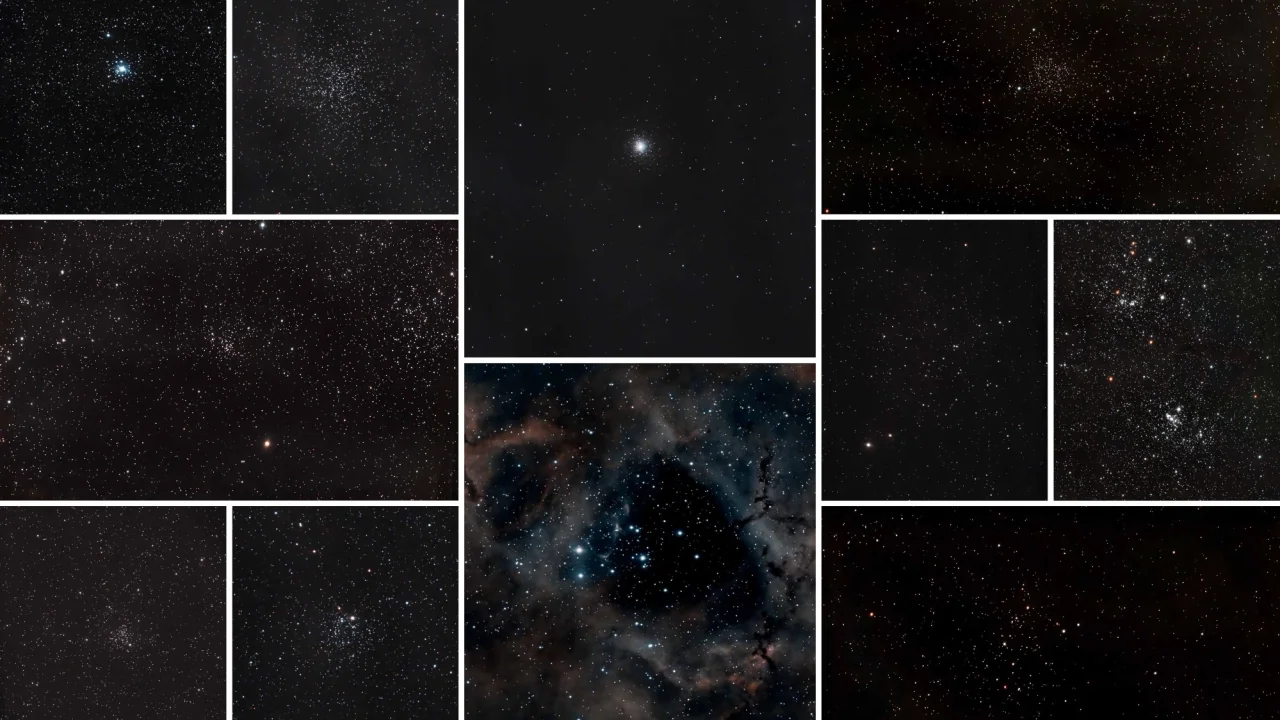
I remember the first time I stepped outside on a crisp January night with my telescope. The cold air bit at my cheeks, and my breath formed small clouds that quickly dissipated into the star-filled darkness. As I adjusted the eyepiece and peered through the lens, something magical happened. What looked like faint smudges to my naked eye suddenly burst into brilliant collections of stars, each one a distant sun burning millions of miles away.

That night changed everything for me. I discovered that beyond the famous Orion Nebula and the Pleiades star cluster, there existed a hidden universe of celestial treasures waiting to be explored. These weren’t the well-known Messier objects that every astronomy book talks about. These were the NGC clusters – mysterious, numbered collections of stars that seemed to whisper secrets from the depths of space.
Winter nights might be cold, but they offer some of the most spectacular views of these stellar gems. The crisp air clears away summer’s haze, revealing NGC clusters in all their glory across constellations like Perseus, Auriga, and Orion.

Why Winter NGC Clusters Deserve Your Attention
Most amateur astronomers start their journey with the Messier catalog, and for good reason. Charles Messier compiled his list of 110 objects specifically because they were bright and easy to find. But the New General Catalogue contains over 7,800 objects, including hundreds of star clusters that rival or even surpass their famous Messier cousins.
Winter offers unique advantages for observing NGC clusters. The cold air is typically drier and more stable than summer’s humid conditions, providing clearer views through your telescope. Plus, the winter Milky Way stretches across some of the most star-rich regions of our galaxy, including the spectacular sweep through Perseus, Auriga, Gemini, and Orion.

“The winter sky is like nature’s own jewelry box,” explains Dr. Sarah Martinez, an observational astronomer at the University of Arizona. “NGC clusters in these constellations often contain hundreds or thousands of stars packed into relatively small areas. When you see them through a telescope, they look like handfuls of diamonds scattered across black velvet.”
These clusters tell fascinating stories about stellar evolution and galactic structure. Some are young, hot, and blue, containing stars that formed together from the same cosmic cloud. Others are ancient, with stars that have been gravitationally bound for billions of years.
Top Winter NGC Clusters You Can Actually See
Here are the most spectacular NGC clusters visible during winter months, along with key information for observers:
| NGC Number | Common Name | Constellation | Magnitude | Best Viewing Time |
|---|---|---|---|---|
| NGC 869/884 | Double Cluster | Perseus | 4.3/4.4 | November-February |
| NGC 1912 | M38 | Auriga | 7.4 | December-March |
| NGC 2168 | M35 | Gemini | 5.3 | January-April |
| NGC 2099 | M37 | Auriga | 6.2 | December-March |
| NGC 2287 | M41 | Canis Major | 4.6 | January-March |
The crown jewel of winter NGC clusters has to be the famous Double Cluster in Perseus (NGC 869 and 884). Even amateur astronomers with small telescopes can see these twin stellar collections clearly. They’re young clusters, only about 13 million years old, containing hot blue giants that burn brilliantly against the cosmic darkness.

NGC clusters in Auriga present another treasure trove for observers. The constellation hosts three magnificent Messier clusters, but dozens of lesser-known NGC objects populate the same region. Many require only binoculars or small telescopes to appreciate their beauty.
Key features to look for when observing NGC clusters include:
- Star color variations – young clusters show blue-white stars, while older ones display yellows and reds
- Density patterns – some clusters are tightly packed, others more loosely scattered
- Background star fields – notice how clusters stand out from surrounding Milky Way stars
- Size differences – clusters range from compact groups to sprawling stellar neighborhoods
“What I love most about NGC cluster hunting is the surprise factor,” says amateur astronomer Tom Reynolds, who has logged observations of over 200 NGC objects. “You’ll be scanning along the Milky Way and suddenly stumble across this incredible stellar city that most people never even know exists.”
Getting Started with Your Own NGC Adventures
You don’t need expensive equipment to begin exploring NGC clusters. A decent pair of binoculars can reveal many of the brighter examples, while a small telescope opens up hundreds more possibilities. The key is knowing where to look and what to expect.
Modern star charts and astronomy apps make finding NGC clusters much easier than it was for previous generations of observers. Many apps allow you to simply point your phone at the sky and identify clusters in real-time. However, learning to star-hop using traditional methods provides a deeper connection to the night sky.
Weather plays a crucial role in successful NGC cluster observations. Clear, moonless nights provide the best contrast for seeing faint stellar collections. Winter’s longer nights give observers more time to explore multiple targets during a single session.
Dr. Jennifer Walsh, director of the Pine Mountain Observatory, emphasizes patience when starting NGC cluster observations. “Many beginners expect every cluster to look like the spectacular photos they see online. The reality is that visual observation shows subtle details and patterns that photographs often miss. Take time to really study each cluster and let your eyes adapt to the darkness.”
Consider joining local astronomy clubs or attending star parties where experienced observers can guide you to their favorite NGC clusters. These events provide opportunities to try different telescopes and learn advanced observation techniques from seasoned stargazers.
The winter months offer perfect conditions for beginning your journey into the hidden universe of NGC clusters. Bundle up against the cold, grab your telescope or binoculars, and prepare to discover stellar treasures that have been waiting millions of years for someone like you to find them.
FAQs
What does NGC stand for in astronomy?
NGC stands for New General Catalogue, a catalog of deep-sky objects compiled by Danish astronomer John Louis Emil Dreyer in 1888.
Can I see NGC clusters without a telescope?
Yes! Several NGC clusters are visible with binoculars, and a few of the brightest ones can be spotted with the naked eye under dark skies.
What’s the difference between NGC clusters and Messier objects?
Many Messier objects are actually NGC objects too – Messier just selected the brightest and most obvious ones. The NGC catalog contains thousands more objects, including many spectacular clusters that aren’t in Messier’s list.
When is the best time to observe winter NGC clusters?
The best viewing occurs on clear, moonless nights between November and March, when winter constellations are highest in the evening sky.
Do I need dark skies to see NGC clusters?
While darker skies always help, many brighter NGC clusters can be observed from suburban locations. Light pollution mainly affects the faintest background stars rather than the cluster cores.
How do I know if I’m looking at a real cluster or just random stars?
True star clusters show distinct patterns and concentrations of stars that stand out from the random background star field. They often have characteristic shapes or densities that become obvious once you know what to look for.
About the Author