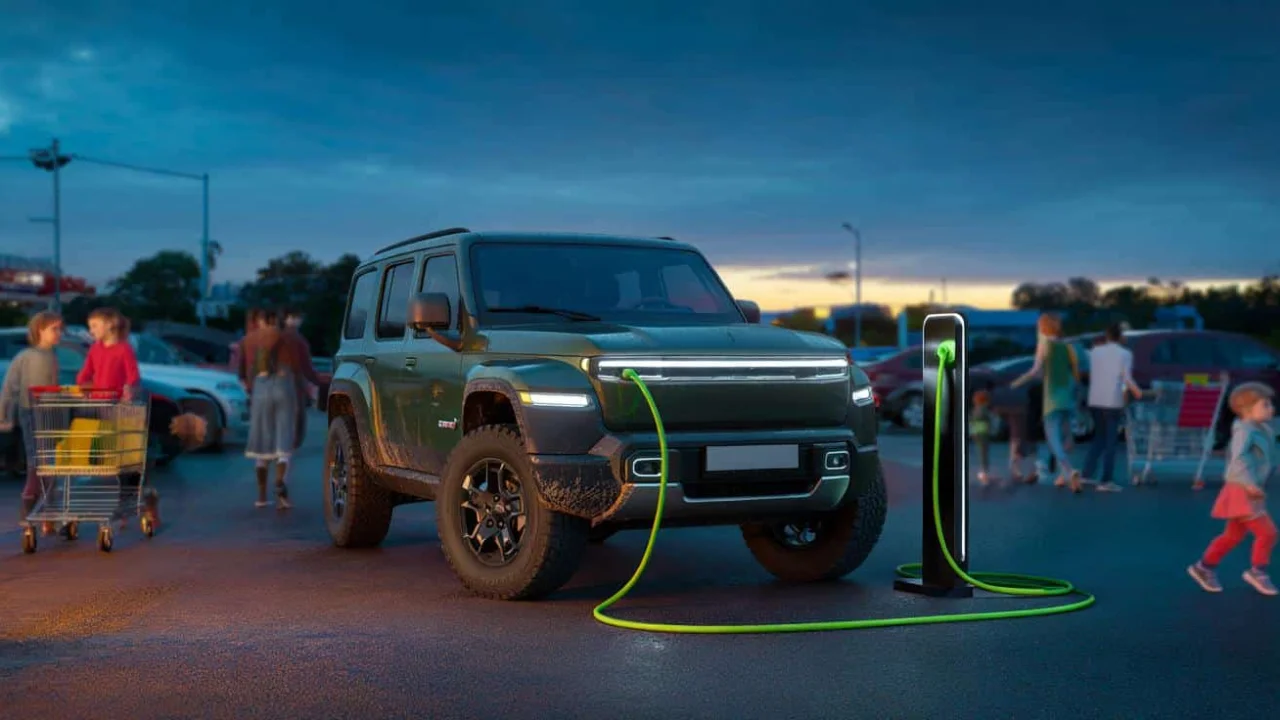
The parking lot was buzzing the way supermarket aisles do on a Saturday morning: kids running, trolleys squeaking, someone swearing at a shopping app. In the middle of this suburban chaos, a matte green 4×4 slid in almost silently. No V6 rumble. No diesel clatter. Just the soft crunch of gravel and a neon charging cable snaking from the front grille.

The logo on the nose was familiar: Jeep. The sound – or rather the lack of it – felt almost wrong. Inside, a guy in a worn leather jacket paused before unplugging the cable, like he was betraying someone. Or something. Jeep used to mean muddy boots, petrol fumes and a soundtrack of growl and turbo whistle.
Now we’re talking about a 2026 Jeep electric 4×4 with 600 horsepower and 500 km of whisper-quiet range. The scene looked strangely normal. And that’s precisely what’s unsettling.

When silence becomes the new soundtrack of adventure
Jeep has spent decades selling noise as much as freedom. The cough of a cold engine at dawn, the roar when you floor it onto a motorway, that slightly guilty pleasure of burning fuel on a deserted trail. This 2026 Jeep electric powerhouse blows up that soundtrack in one move.
You press the start button and… nothing. No vibration in the steering wheel, no idle murmur. Just pixels lighting up and a digital animation of mountains on the central screen. The wild has moved behind glass.

“We knew we were crossing a line when our test drivers kept asking where the engine sound was,” says Mark Rodriguez, Jeep’s head of electric vehicle development. “But then they drove it up a 30-degree slope in Colorado snow, and suddenly nobody was missing the noise.”
The 2026 Jeep electric isn’t just about swapping engines. It’s about redefining what off-road capability means when you have instant torque at every wheel and computer-controlled traction that adjusts grip a hundred times per second.

Power specs that make petrolheads question everything
The numbers tell a story that traditional Jeep fans might struggle to accept. Here’s what happens when 80 years of combustion engine heritage meets cutting-edge electric technology:
| Power Output | 600 horsepower |
| Torque | Instant delivery from 0 RPM |
| Range (WLTP) | 500 kilometers |
| 0-100 km/h | Under 4.5 seconds |
| Charging Speed | 350kW fast charging capability |
| Drivetrain | Quad-motor all-wheel drive |
But raw power is just the beginning. The real revolution lies in how this 2026 Jeep electric handles the stuff that made Jeep famous in the first place:

- Rock crawling with millimeter-precise wheel control
- Water fording up to 76cm deep (no air intake to worry about)
- Silent wildlife observation during hunting or photography trips
- Overnight camping with vehicle-to-load power for your entire campsite
- Regenerative braking that actually adds range on long downhill descents
“The first time I took it through a river crossing, I realized something,” explains Sarah Chen, an off-road instructor who tested early prototypes. “Without engine noise, you actually hear the water, the rocks, your tires finding grip. It’s like someone turned up the volume on everything that actually matters.”
What this electric transformation means for real drivers
Strip away the marketing speak and industry jargon, and you’re left with some practical questions. Like: what happens to weekend warriors who live for that Saturday morning ritual of warming up the engine before hitting the trails?
The 2026 Jeep electric changes the entire pre-adventure routine. No more checking oil levels, warming up transmissions, or that slightly anxious moment when you wonder if your old Wrangler will start after sitting in the driveway all week. Instead, you check your charge level on an app, plan your route around charging stations, and go.
For families, the shift gets interesting. Kids who grew up associating adventure with engine noise will experience their first off-road adventures in near-silence. Parents won’t have to shout over V8 rumble to point out wildlife or explain trail etiquette.
But the change goes deeper than comfort. Electric motors deliver peak torque instantly, which means no more careful throttle modulation to avoid wheel spin on loose surfaces. The computer handles that. No more manual transmission skills needed for hill descents. The regenerative braking system does the work.
“We’re essentially democratizing off-road capability,” notes automotive journalist Tom Bradley, who spent six months testing various electric 4×4 prototypes. “Skills that took years to master with combustion engines become accessible to anyone who can work a smartphone.”
The flip side? Traditional mechanics who’ve built careers around carburetors, transmissions, and exhaust systems will need to learn battery management, electric motor diagnostics, and high-voltage safety protocols. Small-town garages that have serviced hunting trucks and farm vehicles for decades face a steep learning curve.
Range anxiety becomes trail anxiety. Running out of fuel on a remote trail means a phone call and a jerry can. Running out of battery means a much more complicated rescue operation, at least until charging infrastructure reaches truly remote areas.
Yet early adopters report something unexpected: the 500-kilometer range actually increases their adventure radius. Without the noise and vibration of combustion engines, long highway drives to trailheads become less tiring. The instant torque makes highway passing safer and more confident.
Off-road, the 2026 Jeep electric opens possibilities that combustion engines never could. Rock crawling in national parks where noise restrictions apply. Dawn wildlife photography without engine idle disturbing the scene. Overlanding with enough stored power to run laptops, fridges, and lighting for days without a generator.
“The silence isn’t the absence of something,” reflects mountain guide Lisa Torres, who tested the vehicle on backcountry rescue operations. “It’s the presence of everything else you were missing.”
Whether Jeep loyalists will embrace this electric future remains the biggest unknown. The 2026 Jeep electric delivers more power, more capability, and more range than any Wrangler in history. But it does so without the sensory experience that defined the brand for generations. That’s either evolution or betrayal, depending on where you’re sitting.
FAQs
How long does the 2026 Jeep electric take to charge?
With 350kW fast charging, you can get from 10% to 80% battery in about 25-30 minutes at compatible charging stations.
Can it really handle serious off-road conditions without engine noise?
Yes, the quad-motor system actually provides more precise traction control than traditional engines, and the silence lets you better hear terrain conditions and obstacles.
What happens if I run out of battery on a remote trail?
You’ll need professional recovery with specialized equipment, unlike gas vehicles where you can carry spare fuel. This makes trip planning more critical.
Will this electric Jeep cost more than traditional models?
While Jeep hasn’t announced pricing, expect a significant premium initially, though operating costs per mile will be much lower than gas engines.
Can I still modify it like traditional Jeeps?
Modifications will be limited compared to combustion engines, focusing more on body armor, lighting, and accessories rather than engine performance upgrades.
How does cold weather affect the 500km range?
Like all electric vehicles, cold temperatures reduce range by 15-30%, but the robust battery system is designed to maintain performance in extreme conditions.
About the Author