Sarah watched her daughter’s model rocket fizz and pop in the backyard, barely reaching the height of their neighbor’s oak tree. “Mom, why can’t we just shoot rockets like cannonballs?” her eight-year-old asked, frustrated that her carefully painted spacecraft had landed in the flower bed instead of orbiting the moon.

What Sarah didn’t know was that hundreds of miles away in New Mexico, a group of engineers was asking the exact same question. Except they weren’t playing with toys—they were building a machine that could revolutionize how we get to space.
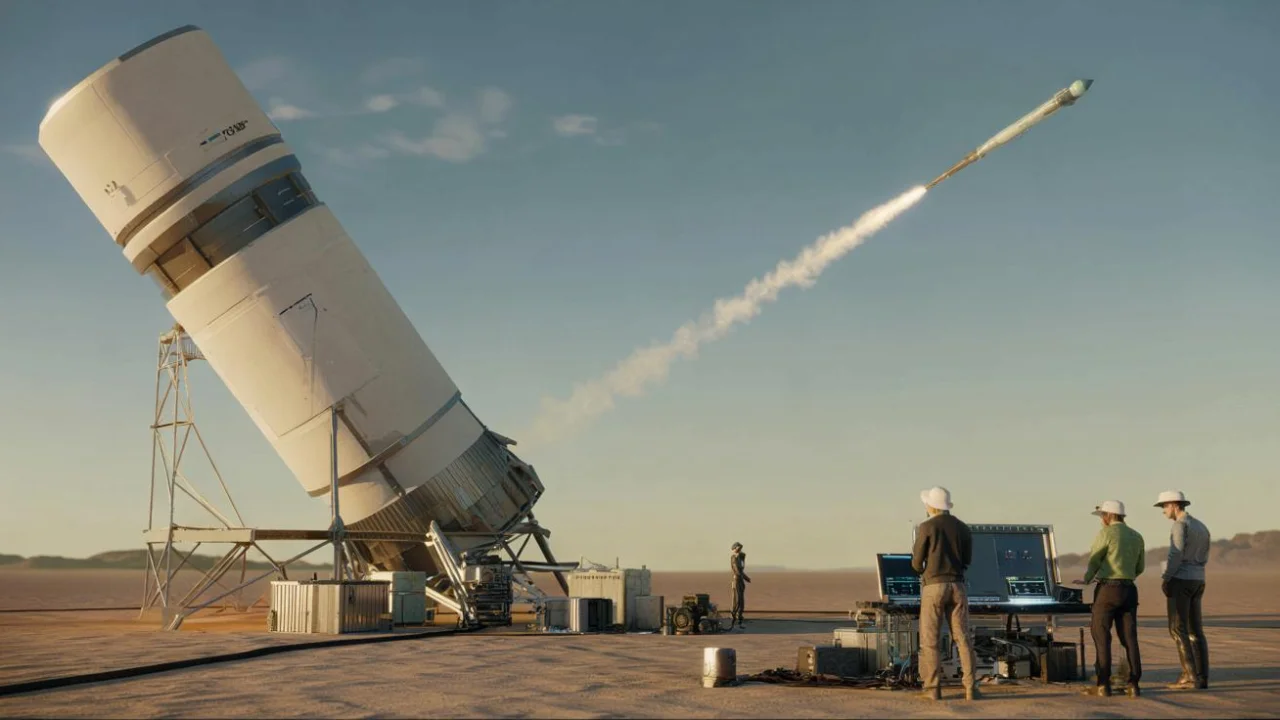
On a windswept plateau, something that looks like a giant white pipe half-buried in desert sand is quietly challenging everything we thought we knew about space travel. No flames, no countdown, no thunderous roar of engines. Just a space-age cannon that launches satellites without burning a single drop of fuel.
When Physics Meets Ambition
The company shaking up the space industry is SpinLaunch, and their approach sounds almost too simple to work. Instead of strapping satellites to massive rockets filled with explosive fuel, they spin projectiles at incredible speeds in a vacuum chamber, then release them through a launch tube that catapults them toward orbit.
Think of it as a medieval trebuchet that went to engineering school and got a PhD in physics.
“We’re essentially turning the rocket equation on its head,” explains Dr. Jonathan Yaney, SpinLaunch’s founder. “Why carry all that fuel weight when you can generate the energy on the ground and transfer it to your payload?”
The prototype currently operating in New Mexico is only one-third the size of what they’re planning to build. Even this smaller version hurls projectiles at several thousand miles per hour without burning any rocket fuel during launch. The scene looks almost wrong—like space technology stripped of all its usual drama and spectacle.

When the cannon fires, there’s no visible flame or smoke. Just a compressed “whoompf” that ripples through the air and sets off car alarms miles away. On computer monitors, engineers watch a tiny object streak upward faster than the eye can follow.
The Numbers That Have Everyone Talking
Behind this deceptively quiet launch system are numbers that make both investors and competitors pay attention. The economics of getting things to space could be about to change dramatically.

| Launch Method | Cost Per Kilogram | Fuel Required | Launch Frequency |
|---|---|---|---|
| Traditional Rocket | $5,000-$10,000 | Hundreds of tons | Days between launches |
| SpaceX Falcon 9 | $2,700 | 400+ tons | Weekly |
| SpinLaunch Cannon | $500 (projected) | Zero for launch | Multiple per day |
The potential cost savings are staggering. Current satellite launches can cost millions of dollars, with most of that expense going toward rocket fuel and the complex engines needed to burn it efficiently. SpinLaunch’s kinetic approach could slash those costs by 90% or more.
Key advantages of the space-age cannon system include:
- No rocket fuel needed for initial launch
- Rapid turnaround between launches
- Reduced environmental impact
- Lower operational complexity
- Potential for multiple daily launches
But the technology isn’t without significant challenges. The extreme forces involved—tens of thousands of times Earth’s gravity—mean that only specially designed, ruggedized payloads can survive the launch process.
“The acceleration forces are brutal,” admits aerospace engineer Dr. Maria Santos, who has been following the project closely. “We’re talking about subjecting satellites to forces that would instantly crush most conventional electronics.”
The Great Space Industry Divide
Not everyone in the space community is convinced that kinetic launch systems represent the future. The debate has split the industry between traditionalists who believe in proven rocket technology and innovators betting on radical alternatives.
Traditional rocket manufacturers argue that their systems are already highly refined and capable of handling delicate payloads that would never survive a cannon launch. They point out that human spaceflight—a growing market—would be impossible with kinetic systems.
Meanwhile, supporters of the cannon approach argue that the vast majority of space launches involve robust satellites and cargo that could easily be redesigned to handle higher G-forces. They see the fuel-free launch as the key to making space truly accessible.
“The rocket industry has been optimizing the same basic concept for 70 years,” argues space industry analyst Rebecca Chen. “Sometimes you need to completely rethink the problem rather than just making incremental improvements.”
The timing couldn’t be better for alternative launch methods. The satellite industry is booming, with thousands of new satellites planned for deployment over the next decade. Internet constellation projects, Earth monitoring systems, and space manufacturing all require frequent, cost-effective launches.
Environmental concerns are also driving interest in fuel-free alternatives. Traditional rocket launches produce significant emissions and require the production of toxic propellants. A kinetic launch system powered by renewable energy could offer a much cleaner path to orbit.
However, critics worry about the limitations. The cannon can only launch relatively small payloads—larger satellites and crewed missions would still require traditional rockets. There are also questions about launch trajectory flexibility and the ability to reach different orbital inclinations.
Commercial space companies are watching the development closely. Several have already signed letters of intent to use SpinLaunch services once the full-scale system becomes operational. Others remain skeptical, preferring to stick with proven rocket technology.
The next few years will be crucial for determining whether this space-age cannon represents a genuine breakthrough or an expensive dead end. As the company works toward building their full-scale launcher, the entire industry is holding its breath to see if they can deliver on their bold promises.
For now, that giant white tube in New Mexico continues its quiet revolution, one fuel-free launch at a time. Whether it becomes the future of space access or remains a fascinating footnote in aerospace history may depend on whether the rest of the world is ready to reimagine how we reach for the stars.
FAQs
How fast does the space-age cannon launch projectiles?
The current prototype launches projectiles at several thousand miles per hour, with the full-scale version expected to reach even higher velocities approaching orbital speeds.
Can this cannon launch humans to space?
No, the extreme acceleration forces involved would be fatal to humans. The system is designed only for cargo and specially hardened satellites.
How much cheaper could space launches become?
SpinLaunch projects costs as low as $500 per kilogram, compared to current rocket launch costs of $2,700-$10,000 per kilogram.
What types of satellites can survive the launch forces?
Only specially designed, ruggedized satellites built to withstand tens of thousands of times Earth’s gravity can survive kinetic launch systems.
When will the full-scale cannon be ready?
SpinLaunch is working toward deploying their full-scale system within the next few years, though exact timelines depend on testing results and funding.
Does the cannon use any fuel at all?
The launch itself uses no rocket fuel, though some small satellites may carry tiny thrusters for final orbital adjustments after reaching space.
About the Author