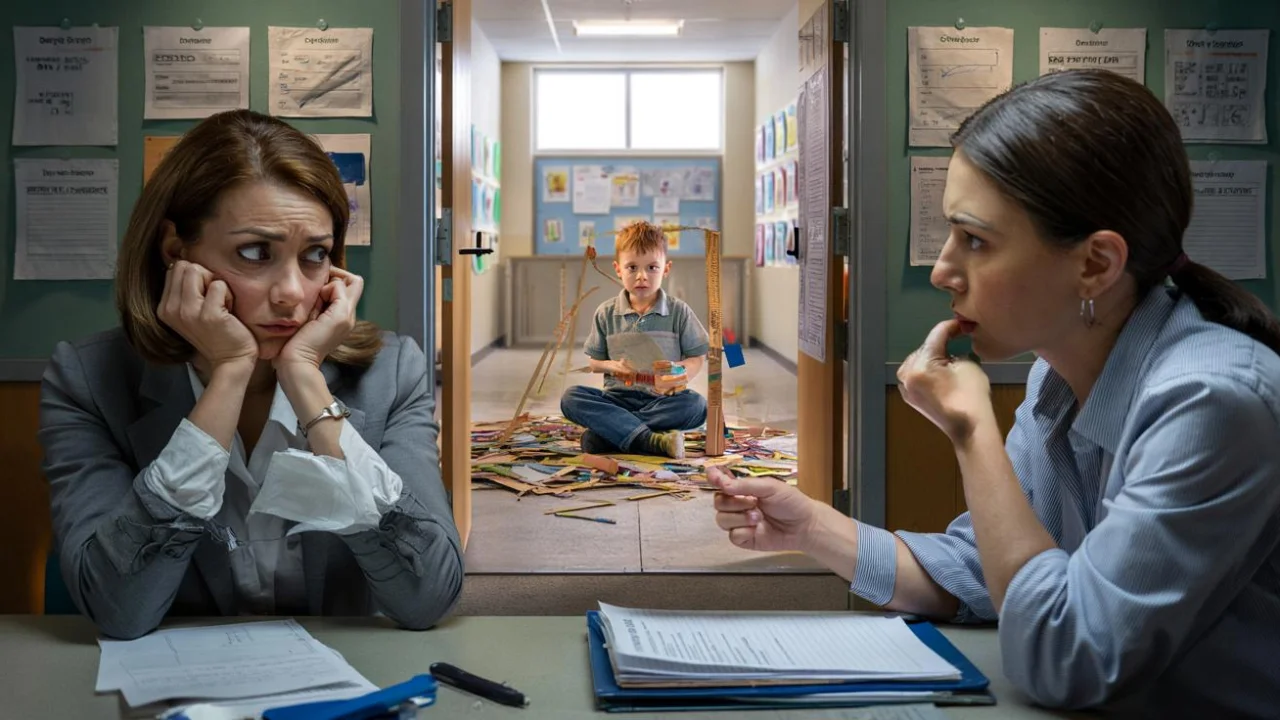
The teacher’s voice is calm, almost rehearsed. Across the small table, a mother twists a crumpled notice from school between her fingers. “He’s clearly bright,” the teacher says, “but he refuses to work. He’s disruptive. We can’t keep going like this.” The boy they’re talking about is down the hall, bored out of his mind, building an elaborate spaceship out of scrap cardboard in the corridor.

At home, he recites obscure science facts and asks questions that stump adults. At school, he “forgets” homework, rolls his eyes, picks fights with group projects. Two worlds. One child.
The label changes from “gifted” to “lazy” in the time it takes to sign a disciplinary form. And something starts to crack—not just in the child, but in families and school systems that don’t know how to bridge this impossible gap.

When brilliance looks like sabotage
Parents of gifted but struggling children face a heartbreaking paradox. These kids demonstrate exceptional intelligence in some areas while appearing completely unmotivated in others. The disconnect creates friction that ripples through every aspect of their lives.
“We see children who can solve complex puzzles or discuss philosophy, then melt down over a simple math worksheet,” says Dr. Sarah Chen, a pediatric psychologist specializing in giftedness. “The gap between their intellectual capacity and their academic performance often gets misinterpreted as defiance.”

The pattern is painfully familiar to thousands of families. A child who memorizes entire books struggles to write a paragraph. Someone who understands advanced concepts can’t organize their backpack. Teachers see laziness. Parents see wasted potential. The child sees failure everywhere they look.
What looks like stubbornness is often something much more complex. These children may be dealing with learning differences, perfectionism, or simply boredom from work that feels too easy or too repetitive. When the regular curriculum doesn’t match their thinking style, school becomes a daily battle.

The hidden struggles behind the “laziness”
Gifted but struggling children often share specific challenges that masquerade as behavioral problems. Understanding these patterns helps explain why bright kids sometimes fail in traditional settings.
- Perfectionism paralysis: Fear of making mistakes prevents them from starting tasks
- Executive function gaps: Brilliant thinking paired with poor organizational skills
- Sensory overwhelm: Heightened sensitivity to classroom noise, lighting, or textures
- Social isolation: Feeling different from peers leads to withdrawal or acting out
- Asynchronous development: Advanced reasoning with age-appropriate emotional regulation
- Dual exceptionalities: Giftedness combined with ADHD, autism, or learning disabilities

The following table shows common behaviors and their possible underlying causes:
| Observable Behavior | Possible Root Cause | What It Really Means |
| Refuses to do homework | Work feels too easy or too hard | Needs appropriate challenge level |
| Argues with teachers | Questions authority naturally | Seeks logical explanations |
| Won’t show work on math | Solves problems mentally | Different processing style |
| Daydreams constantly | Bored by repetitive content | Mind seeks stimulation |
| Emotional outbursts | Perfectionism or sensory overload | Overwhelmed by expectations |
“Parents tell me they feel like they’re raising two different children,” explains Dr. Michael Rodriguez, an educational consultant. “The brilliant kid at home who discusses quantum physics becomes the ‘problem student’ who can’t sit still during story time.”
The family fracture that nobody talks about
The impact on families goes far deeper than report cards and parent-teacher conferences. When a gifted but struggling child can’t succeed in traditional settings, everyone suffers.
Marriages strain under the pressure of constant school meetings, expensive testing, and disagreements about how to help. Siblings feel neglected as parents focus intensively on the struggling child’s needs. Extended family members offer well-meaning but harmful advice: “Just make him do his homework” or “He’s manipulating you.”
Parents often blame themselves. They wonder if they pushed too hard or not hard enough. They question every decision from preschool choices to discipline strategies. The constant advocacy required to get appropriate educational support is exhausting.
“I felt like I was fighting everyone—the school, my husband, even my own mother,” shares Lisa, whose 10-year-old son was eventually diagnosed with twice-exceptional learning differences. “Everyone had an opinion about what we were doing wrong.”
The financial burden adds another layer of stress. Private testing, specialized tutoring, alternative schools, and therapy sessions quickly drain family resources. Many parents take second jobs or go into debt trying to find solutions.
School districts often lack resources for properly supporting these complex learners. Teachers, already overwhelmed, may not have training in gifted education or learning differences. The result is a system that works against the very children who could benefit most from educational innovation.
Social isolation compounds the problem. These children often struggle to connect with age peers who don’t share their interests or intensity. They may gravitate toward older kids or adults, further highlighting their difference from typical students.
“The child starts to internalize the message that they’re broken,” notes Dr. Jennifer Walsh, a specialist in twice-exceptional learners. “They hear ‘so smart but so lazy’ so often that they begin to believe something is fundamentally wrong with them.”
Hope exists in understanding and appropriate support. When gifted but struggling children receive recognition for their unique learning profile, many begin to thrive. Schools that offer flexible pacing, creative projects, and individualized approaches can transform these students’ experiences.
The key lies in shifting perspective. Instead of seeing defiance, adults can recognize a child trying to advocate for their learning needs. Instead of laziness, they might see a mismatch between teaching methods and learning style.
Families need comprehensive support that addresses both the child’s educational needs and the family’s emotional wellbeing. This might include educational therapy, family counseling, and connection with other families facing similar challenges.
FAQs
What makes a child “twice-exceptional” or gifted but struggling?
Twice-exceptional children have both giftedness and learning challenges like ADHD, dyslexia, or autism that can mask each other and create complex educational needs.
Why do smart kids sometimes refuse to do schoolwork?
Work may be too easy and boring, too difficult due to learning differences, or presented in a way that doesn’t match their learning style, leading to avoidance behaviors.
How can parents advocate for their gifted but struggling child?
Document specific behaviors, request comprehensive testing, communicate regularly with teachers, and consider seeking outside specialists who understand complex learners.
Do these children eventually outgrow their struggles?
With proper support and understanding, many learn to manage their challenges, but they typically need ongoing accommodations and different approaches throughout their education.
What should parents do when schools don’t understand their child?
Provide educational resources to teachers, consider getting independent evaluations, explore alternative educational options, and connect with parent support groups for guidance.
Is it normal for gifted children to have emotional outbursts?
Yes, many gifted children experience intense emotions and perfectionism that can lead to meltdowns when they feel overwhelmed or misunderstood.
About the Author