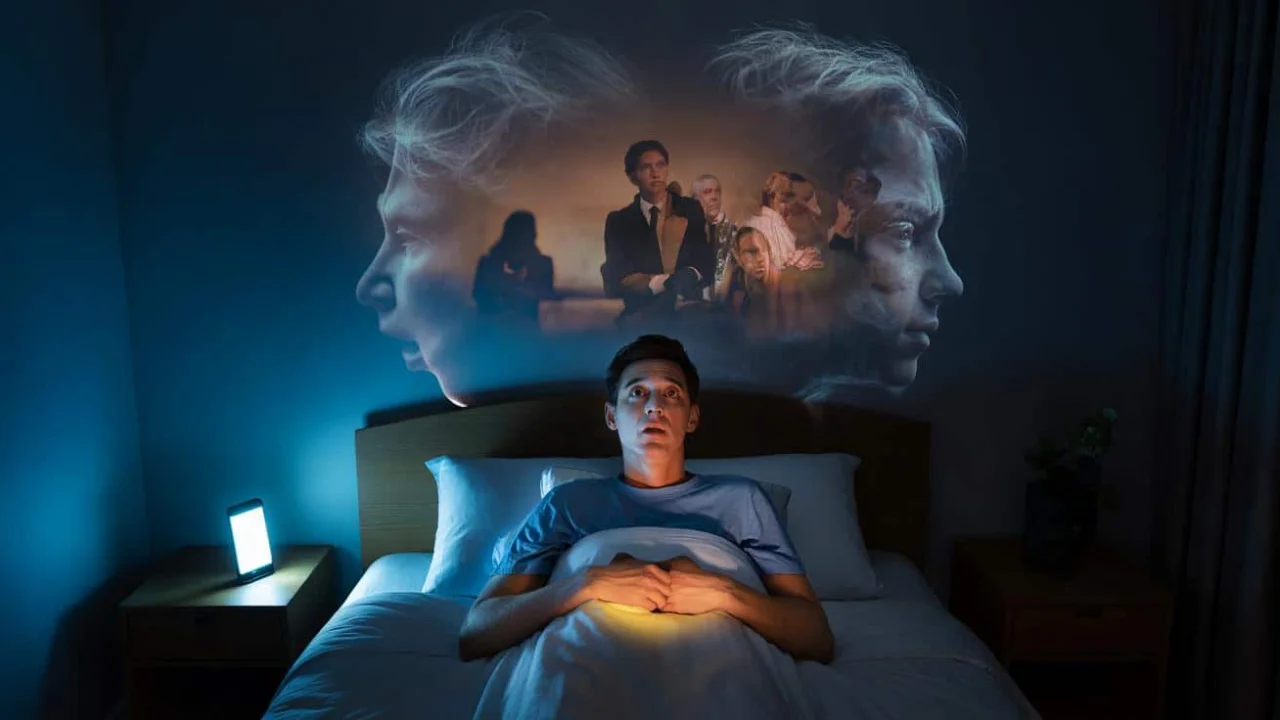
Sarah stares at her ceiling at 2:47 a.m., replaying the staff meeting from earlier. Her boss had paused for three seconds after her presentation. Three seconds that her nighttime brain has now stretched into evidence that she’s incompetent, that everyone noticed, that her job is hanging by a thread.

During the actual meeting, she felt confident. Her colleagues nodded. Her boss even said “good work” afterward. But now, in the dark silence of her bedroom, those positive moments have vanished like they never happened.
This is overthinking at night in its purest form – and it’s lying to her about everything she actually felt just hours earlier.

Your brain becomes a master manipulator after midnight
When the sun goes down and distractions fade away, something strange happens to our mental processing. The same brain that handled stress reasonably well during daylight hours suddenly transforms into an anxiety-producing machine that rewrites recent history.
“Nighttime overthinking isn’t just thinking too much – it’s your brain actively distorting reality,” explains Dr. Michael Chen, a sleep psychologist. “The emotional centers become hyperactive while the rational thinking areas slow down. It’s like having a drama queen narrate your life story.”

This isn’t just about being tired. Your brain chemistry actually shifts in the evening hours. Cortisol levels fluctuate, melatonin production begins, and the prefrontal cortex – responsible for logical thinking – starts to dial down its activity.
The result? Every minor interaction gets magnified. Every uncertain moment becomes proof of impending disaster. Every relationship gets questioned through the lens of worst-case scenarios.

But here’s the kicker: most people will swear this nighttime analysis feels more “honest” than their daytime perspective. That’s exactly how the lie works.
The telltale signs your nighttime thoughts are fabricated drama
Recognizing when overthinking at night is feeding you false information requires knowing the warning signs. These mental patterns consistently show up when your brain is manufacturing problems that don’t exist during normal waking hours.

Dr. Lisa Rodriguez, a cognitive behavioral therapist, notes: “The biggest red flag is when your nighttime fears completely contradict your daytime confidence about the same situations.”
| Daytime Reality | Nighttime Fiction |
|---|---|
| Friend responds normally to texts | They’re definitely avoiding you |
| Boss gives constructive feedback | You’re about to be fired |
| Partner seems tired after work | They’re falling out of love |
| Minor social awkwardness | Everyone thinks you’re weird |
Key indicators that your brain is lying include:
- Thoughts that feel urgent and catastrophic despite nothing actually changing
- Emotional intensity that doesn’t match the actual importance of the situation
- Conclusions based on mind-reading what others think
- Problems that seem massive at night but manageable during the day
- Physical anxiety symptoms with no clear external trigger
“Your nighttime brain loves to take tiny data points and build elaborate conspiracy theories,” says Dr. Rodriguez. “It’s like a detective who only looks for evidence that confirms the worst possible outcome.”
Why most people refuse to admit this is happening
Here’s where things get psychologically messy. Even when presented with clear evidence that their nighttime overthinking produces false conclusions, most people resist acknowledging it.
The resistance isn’t just stubbornness – it’s self-protection. Admitting that your deepest, most emotional thoughts might be unreliable feels dangerous. If you can’t trust your own mind when it feels most “real,” what can you trust?
Dr. James Park, who studies rumination patterns, explains: “People often mistake emotional intensity for truth. The more painful a thought feels, the more real it seems. Questioning that threatens their sense of knowing themselves.”
This creates a perfect storm of denial. During the day, when perspective returns, people minimize their nighttime anxiety. “I was just tired,” they tell themselves. “It wasn’t that bad.”
But deep down, they often believe their 2 a.m. thoughts revealed hidden truths about their relationships, career, or self-worth. They carry this secret conviction while publicly dismissing their nighttime fears.
The real issue? Those nighttime “insights” were never insights at all. They were cognitive distortions amplified by fatigue, darkness, and reduced rational thinking capacity.
Breaking free from this cycle requires recognizing a simple but uncomfortable truth: your most emotionally intense thoughts are often your least accurate ones. The brain that feels like it’s finally being “honest” at 2 a.m. is actually lying more creatively than it does all day.
Dr. Chen puts it bluntly: “Your nighttime overthinking isn’t revealing your true feelings – it’s manufacturing fake ones that feel more real than reality.”
Understanding this doesn’t make the nighttime thoughts less intense. But it does give you permission to stop treating them as gospel truth and start seeing them for what they are: tired brain fiction masquerading as emotional revelation.
FAQs
Why does overthinking at night feel so much more intense than daytime worries?
Your brain’s emotional centers become hyperactive while rational thinking areas slow down in the evening, creating a perfect storm for magnified fears and distorted thinking.
Is it normal to have completely different thoughts about the same situation during day versus night?
Absolutely normal. Sleep deprivation and evening brain chemistry changes can make the same situation feel drastically different depending on when you’re thinking about it.
How can I tell if my nighttime thoughts are real concerns or just overthinking?
If the thoughts feel urgent and catastrophic despite nothing actually changing in your external circumstances, and if they contradict your daytime perspective, they’re likely overthinking distortions.
Why do I resist believing that my nighttime overthinking isn’t accurate?
Because emotional intensity often feels like truth. The more painful or “raw” a thought feels, the more real it seems, making it psychologically threatening to question those thoughts.
Can nighttime overthinking actually damage my relationships or decisions?
Yes, when you make important decisions or have serious conversations based on distorted nighttime thinking, it can create real problems in otherwise healthy situations.
What’s the difference between genuine late-night reflection and harmful overthinking?
Genuine reflection leads to actionable insights or peaceful resolution. Harmful overthinking creates anxiety spirals, contradicts your daytime knowledge, and offers no constructive solutions.
About the Author