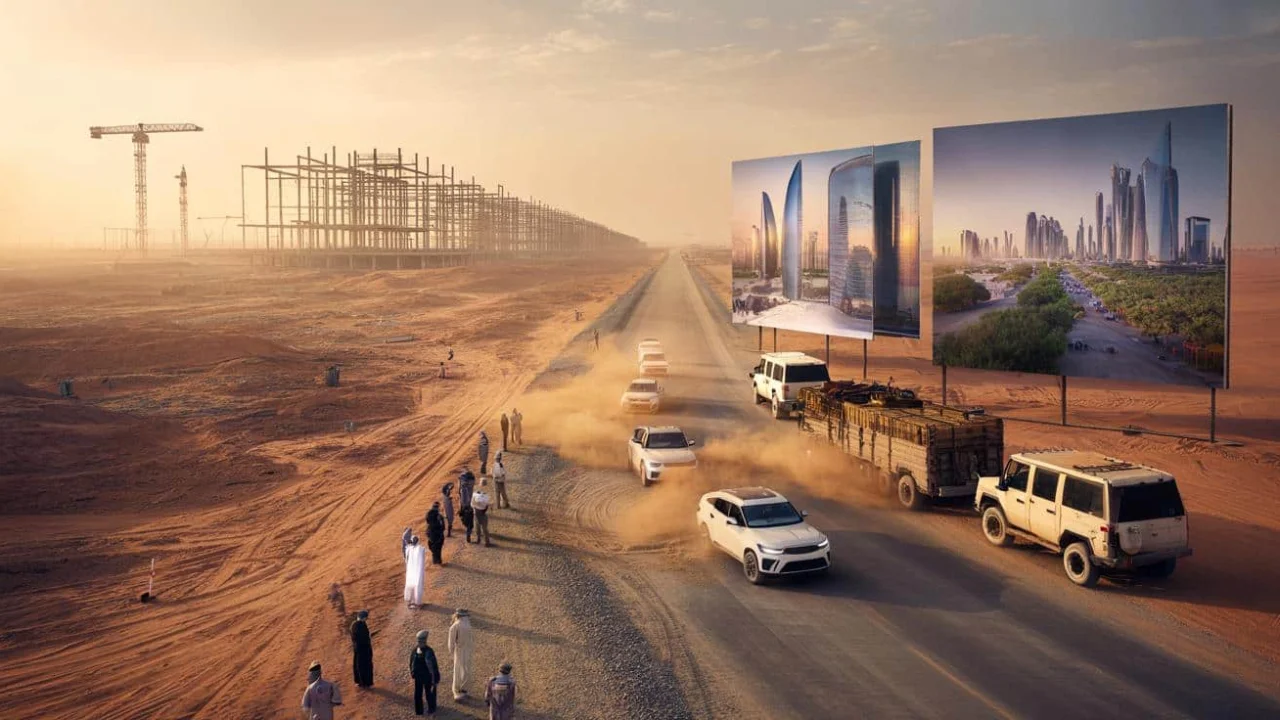
Ahmed used to drive tourists from Tabuk to the ancient ruins at Mada’in Salih. Simple work, good tips, stories to tell his kids about the wealthy Europeans amazed by Saudi Arabia’s hidden history. Then came the billboards promising something bigger than history—a city unlike anything the world had ever seen, stretching 100 miles across the desert like a gleaming mirror.
Three years later, Ahmed still drives the same dusty roads. But now his passengers are different. They’re engineers heading home early, investors with tight lips and tighter schedules, workers whose contracts got cut short. The billboards are still there, sun-bleached and sand-scarred, but the dream they promised feels more distant than ever.
The NEOM desert megacity was supposed to change everything. Instead, it’s become Saudi Arabia’s most expensive question mark.

The line that was meant to redefine civilization
Crown Prince Mohammed bin Salman announced NEOM in 2017 with the kind of swagger that makes headlines worldwide. This wouldn’t be just another city—it would be THE city. A 100-mile linear metropolis called “The Line,” stretching from the mountains to the sea, housed within two parallel mirrored walls 500 meters high.
The vision was intoxicating. No cars, no pollution, no traditional urban sprawl. Instead, residents would live in a climate-controlled paradise where artificial intelligence managed everything from traffic flow to temperature. Flying taxis would zip between districts. The entire city would run on renewable energy.

“We’re not just building a city,” one early NEOM executive told international media. “We’re reimagining how humans live, work, and connect with each other.”
Saudi Arabia committed $500 billion to make this desert megacity dream reality. International architects submitted designs that looked like something from a sci-fi movie. Construction crews arrived from around the globe. The world watched and wondered if the Saudis could actually pull off something this ambitious.
What the money bought and what it didn’t
Today, the NEOM desert megacity exists mostly in promotional videos and half-finished infrastructure. Here’s what billions of dollars have actually produced so far:
| Investment Category | Amount Spent | Current Status |
|---|---|---|
| Land preparation and excavation | $15+ billion | Partially complete |
| Worker housing and facilities | $8 billion | Built but underutilized |
| Infrastructure (power, water) | $12 billion | Basic systems only |
| Marketing and design | $3 billion | Complete but outdated |
| Legal and consulting fees | $5 billion | Ongoing |
The numbers tell a story of ambition colliding with reality. Construction has slowed dramatically over the past year. Many international contractors have quietly withdrawn from projects. Local suppliers report unpaid invoices stretching back months.

What’s most striking isn’t what’s been built—it’s what hasn’t. The signature mirrored walls that were supposed to define The Line? They exist only in computer renderings. The revolutionary transportation system? Still on drawing boards. The nine million residents? They have nowhere to live.
Key challenges plaguing the NEOM desert megacity include:
- Engineering obstacles that prove more complex than anticipated
- Environmental impact studies revealing serious ecological concerns
- Cost overruns exceeding even the most pessimistic projections
- Difficulty attracting the international talent needed for completion
- Local resistance from Bedouin tribes displaced by construction
“The scale of what they’re attempting is genuinely unprecedented,” explains Dr. Sarah Mitchell, an urban planning expert who has consulted on megaprojects worldwide. “But unprecedented doesn’t always mean possible, especially when you’re fighting physics, economics, and human nature all at once.”
Real people paying the real price
Behind the grand vision and financial figures are thousands of workers, families, and communities whose lives have been upended by the NEOM experiment. Ahmed’s story is just one among many.
Construction workers from Bangladesh, Pakistan, and Egypt arrived expecting multi-year contracts building the future. Instead, many found themselves in temporary housing with irregular pay, working on projects that kept getting scaled back or cancelled entirely. Some have been waiting months for flights home.
Local Bedouin communities faced forced relocations to make room for The Line. Promises of compensation and new opportunities have largely gone unfulfilled. Traditional grazing lands are now behind security fences, cutting off access to resources families have used for generations.
Even wealthy investors are feeling the impact. International firms that invested heavily in NEOM-related projects are quietly writing off losses. Real estate speculators who bought land near the proposed megacity are finding their investments worthless.
“The human cost of these vanity projects is always much higher than the financial cost,” notes economist Dr. James Harrison, who studies Gulf state development projects. “When you promise people a better future and then can’t deliver, the damage goes far beyond balance sheets.”
The ripple effects extend throughout Saudi Arabia’s economy. Resources diverted to NEOM meant less investment in proven infrastructure projects. The kingdom’s reputation as a reliable partner for international development has taken a hit just as it seeks to diversify away from oil dependence.
Perhaps most frustrating for ordinary Saudis is watching billions disappear into the desert while hospitals, schools, and transportation systems in existing cities cry out for investment. The contrast between NEOM’s ambitious marketing and Saudi Arabia’s everyday infrastructure needs has become impossible to ignore.
So who will answer for this massive miscalculation? Crown Prince Mohammed bin Salman, the driving force behind NEOM, has grown noticeably quiet about the project in recent public appearances. Government officials now speak in vague terms about “adjusting timelines” and “refining the vision.”
Meanwhile, the desert wind continues to blow sand over half-finished foundations, and the NEOM desert megacity remains what it’s always been—an expensive dream floating somewhere between ambition and reality.
FAQs
What exactly is the NEOM desert megacity?
NEOM is a planned 100-mile linear city in the Saudi desert, designed to house 9 million people between two parallel mirrored walls, powered entirely by renewable energy.
How much money has Saudi Arabia spent on NEOM so far?
Conservative estimates suggest over $40 billion has been spent, though the Saudi government hasn’t released official figures and the total commitment was originally $500 billion.
Why is the project struggling?
NEOM faces massive engineering challenges, cost overruns, environmental concerns, difficulty attracting residents and workers, and local opposition from displaced communities.
Will NEOM ever be completed?
Current construction has slowed dramatically, and many experts doubt the original vision will ever be realized, though smaller portions might eventually be built.
What happens to the workers and displaced communities?
Many foreign workers are stuck with unpaid wages, while local Bedouin communities who were relocated have seen few of the promised benefits or compensation.
Is this typical for Saudi megaprojects?
Saudi Arabia has successfully completed other large projects, but NEOM’s unprecedented scale and complexity make it uniquely challenging compared to more conventional developments.
About the Author
